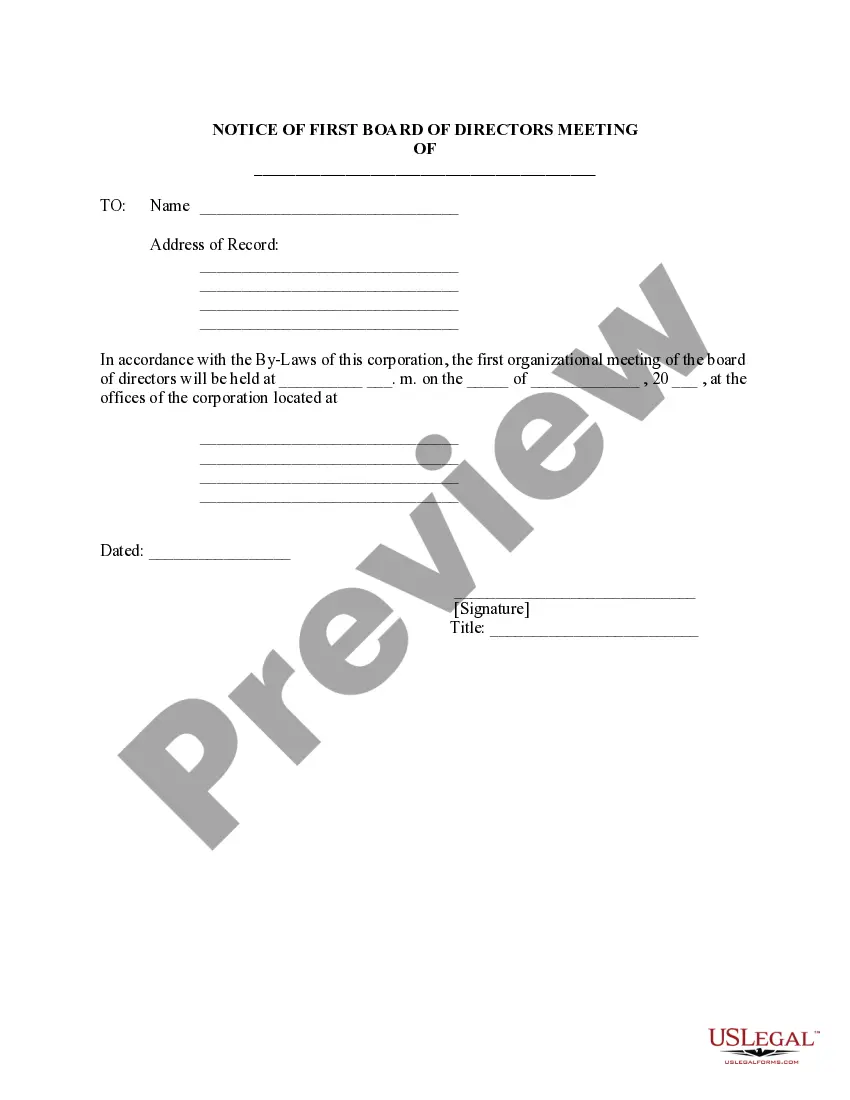
Stockholders Meeting Corporate Form Of Organization In Bexar
Description


Get your form ready online
Our built-in tools help you complete, sign, share, and store your documents in one place.
Make edits, fill in missing information, and update formatting in US Legal Forms—just like you would in MS Word.
Download a copy, print it, send it by email, or mail it via USPS—whatever works best for your next step.
Sign and collect signatures with our SignNow integration. Send to multiple recipients, set reminders, and more. Go Premium to unlock E-Sign.
If this form requires notarization, complete it online through a secure video call—no need to meet a notary in person or wait for an appointment.
We protect your documents and personal data by following strict security and privacy standards.

Make edits, fill in missing information, and update formatting in US Legal Forms—just like you would in MS Word.

Download a copy, print it, send it by email, or mail it via USPS—whatever works best for your next step.

Sign and collect signatures with our SignNow integration. Send to multiple recipients, set reminders, and more. Go Premium to unlock E-Sign.

If this form requires notarization, complete it online through a secure video call—no need to meet a notary in person or wait for an appointment.

We protect your documents and personal data by following strict security and privacy standards.
Looking for another form?





Form popularity
FAQ
All California S corporations and LLCs companies treated as S corporations for federal, should file Form 100S (California S Corporation Franchise or Income Tax Return).
While both forms serve entities that pass income to owners or shareholders, several distinctions warrant attention: Eligibility and election: Any entity that meets the IRS criteria can file Form 1065, while S corporations must file Form 2553 to elect S status.
There are seven steps you'll complete to start an S corp in Texas. Step 1: Check Name Availability. Step 2: Choose a Business Name. Step 3: Registered Agent. Step 4: Complete Form 201. Step 5: Bylaws and Regulations. Step 6: Obtain EIN. Step 7: File Form 2553.
Texas S Corporation IRS Process Before you apply, be sure your business meets the requirements to be an S Corp. Once you confirm you meet the requirements, you may apply for S Corporation status with the IRS by filing Form 2553. The State of Texas recognizes the federal S Corp election.
What Is the Difference Between IRS Forms 1120 and 1120-S? IRS Forms 1120 and 1120-S are both used by corporations to file tax returns. The difference is that Form 1120 is used by C corporations (C corps), which are liable for corporate federal taxes, and Form 1120-S is used exclusively by S corps.
How to Form a Corporation in Texas Choose a Corporate Name. Appoint a Registered Agent. File Certificate of Formation. Prepare Corporate Bylaws. Appoint Directors and Hold the First Meeting. Issue Stock. File a Texas Franchise Public Information Report. Obtain an EIN and Comply With Tax Requirements.
Step 7: File Form 2553 This form will allow your Texas corporation to elect to be an S corporation. To complete Form 2553, you'll need: The address and name business address. The date of incorporation.
A certificate of formation is a legal document that must be filed to legally create a limited liability company (LLC); it serves the purpose of proving the company's establishment, and contains all information about the formation of the company.
Step 1: Visit the Texas Secretary of State's Website. Step 2: Search by Business Name, File Number, or Registered Agent. Step 3: Review the Search Results & Verify Legal Status.
A Certificate of Formation is a legal document that is filed in Texas with the secretary of state to create a corporation, limited liability company, and similar entities. Certificates of formation will contain the entity's basic information (name, registered agent, office address, share structure, etc.).

