Notice Stockholders Meeting For Windows In Tarrant
Description
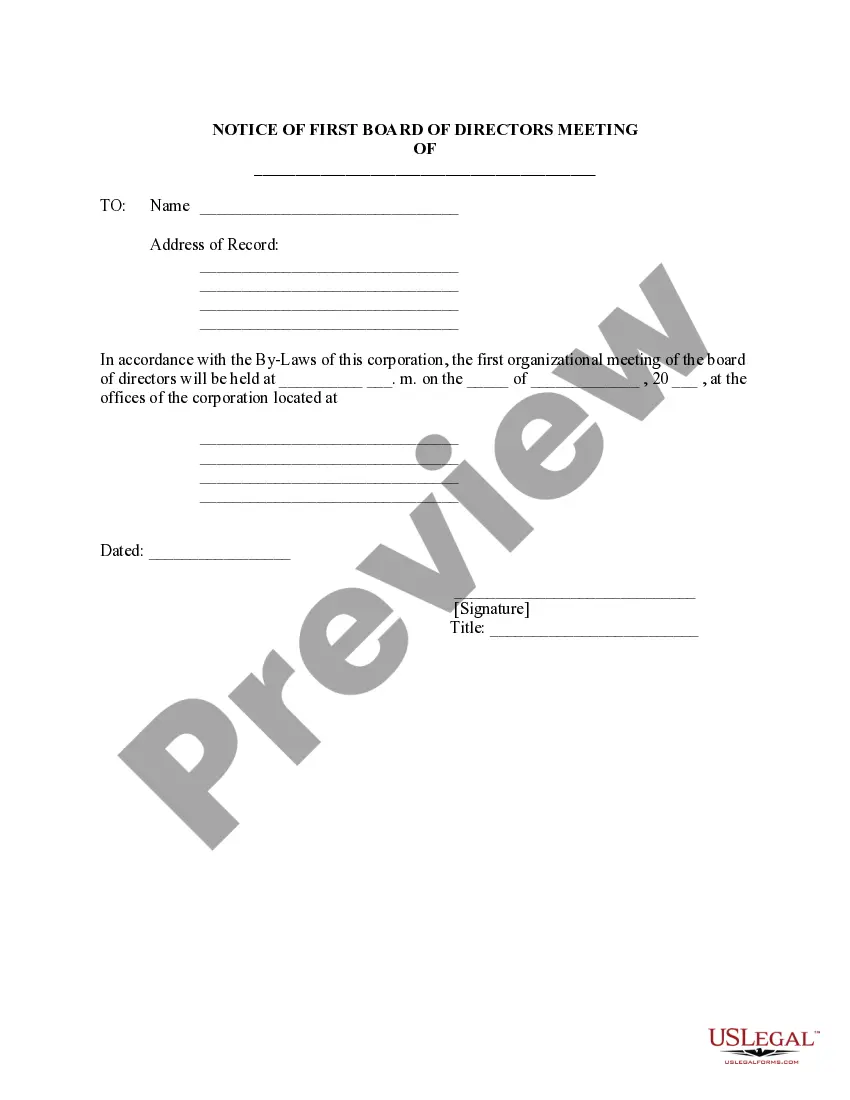


Get your form ready online
Our built-in tools help you complete, sign, share, and store your documents in one place.
Make edits, fill in missing information, and update formatting in US Legal Forms—just like you would in MS Word.
Download a copy, print it, send it by email, or mail it via USPS—whatever works best for your next step.
Sign and collect signatures with our SignNow integration. Send to multiple recipients, set reminders, and more. Go Premium to unlock E-Sign.
If this form requires notarization, complete it online through a secure video call—no need to meet a notary in person or wait for an appointment.
We protect your documents and personal data by following strict security and privacy standards.

Make edits, fill in missing information, and update formatting in US Legal Forms—just like you would in MS Word.

Download a copy, print it, send it by email, or mail it via USPS—whatever works best for your next step.

Sign and collect signatures with our SignNow integration. Send to multiple recipients, set reminders, and more. Go Premium to unlock E-Sign.

If this form requires notarization, complete it online through a secure video call—no need to meet a notary in person or wait for an appointment.

We protect your documents and personal data by following strict security and privacy standards.
Looking for another form?
Form popularity
FAQ
Tarrant County is an urban county located in the north central part of Texas. Fort Worth serves as the county seat to a county population of approximately 2.1 million citizens. Tarrant County is a member of the North Central Texas Council of Governments.
The Census Bureau legitimized it in 1973 by declaring Dallas-Fort Worth a single Standard Metropolitan Statistical Area. Before, there had been two separate areas. A few days ago the bureau went a step further by declaring that Dallas and Fort Worth had been merged into a single ''urbanized area.
Tarrant County is comprised of 41 incorporated areas: Arlington. Azle. Bedford. Benbrook. Blue Mound. Burleson. Colleyville. Crowley.
State Open Meeting Act laws, also known as sunshine laws or open meetings laws, are regulations and laws that require government agencies, boards, commissions, and other public bodies to conduct their meetings and decision-making processes transparently and openly.
General Guidelines for Public Comment Anyone wishing to make a comment must register prior to the meeting. A citizen may (1) register to speak on a posted agenda item, (2) register to make a general spoken comment, or (3) register a written comment or a position on a particular matter.
The law is now codified as part of the Texas Open Meetings Act and protects the right of a “member of the public” to air their concerns at public governmental board meetings as long as those concerns are “regarding an item on the agenda for an open meeting.” The law allows the school board to adopt “reasonable rules,” ...
Penalties for Indecent Exposure in Texas Under Texas law, indecent exposure is a Class B misdemeanor offense. ingly, it carries the following possible penalties: a maximum of up to 180 days (6 months) in jail. a fine of up to a maximum of $2,000.
HB 18 — the Securing Children Online through Parental Empowerment or SCOPE Act — took effect Sept. 1. It requires social media platforms to make their users register their age, and to restrict what users under 18 see on the sites.
Public Comment Period In a typical case, an agency will allow 60 days for public comment. However, in some cases, they provide either shorter or longer comment periods. An agency may receive no comments or as many as thousands of comments or more.

