Bill Personal Property Form For Insurance In Salt Lake
Description
Get your form ready online
Our built-in tools help you complete, sign, share, and store your documents in one place.
Make edits, fill in missing information, and update formatting in US Legal Forms—just like you would in MS Word.
Download a copy, print it, send it by email, or mail it via USPS—whatever works best for your next step.
Sign and collect signatures with our SignNow integration. Send to multiple recipients, set reminders, and more. Go Premium to unlock E-Sign.
If this form requires notarization, complete it online through a secure video call—no need to meet a notary in person or wait for an appointment.
We protect your documents and personal data by following strict security and privacy standards.
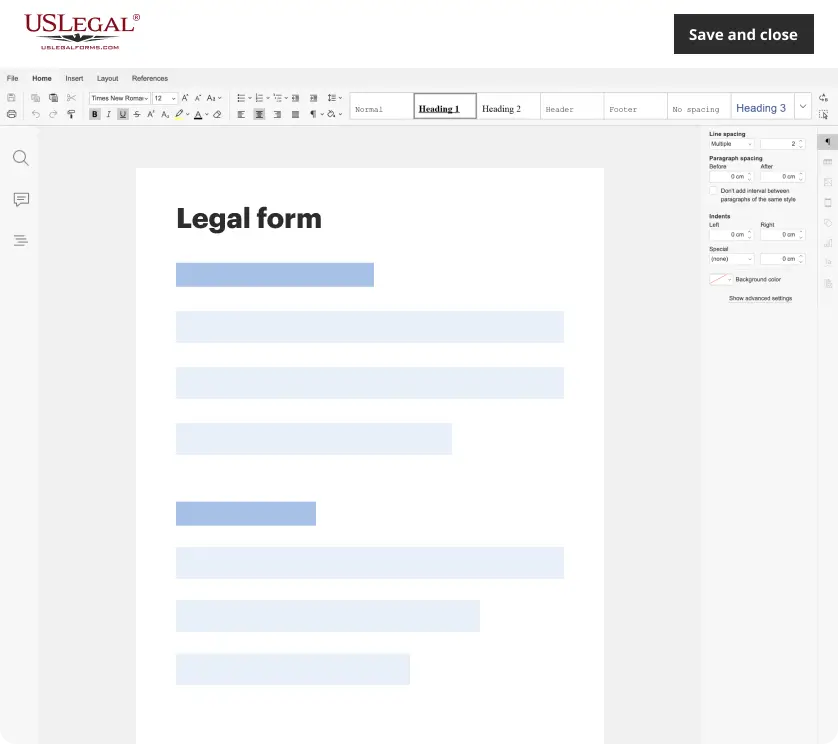
Make edits, fill in missing information, and update formatting in US Legal Forms—just like you would in MS Word.
Download a copy, print it, send it by email, or mail it via USPS—whatever works best for your next step.
Sign and collect signatures with our SignNow integration. Send to multiple recipients, set reminders, and more. Go Premium to unlock E-Sign.

If this form requires notarization, complete it online through a secure video call—no need to meet a notary in person or wait for an appointment.
We protect your documents and personal data by following strict security and privacy standards.
Looking for another form?
Form popularity
FAQ
The Utah State Tax Commission defines tangible personal property as material items such as watercraft, aircraft, motor vehicles, furniture and fixtures, machinery and equipment, tools, dies, patterns, outdoor advertising structures, and manufactured homes.
As a homeowner, you'll face property taxes at a state and local level. You can deduct up to $10,000 of property taxes as a married couple filing jointly – or $5,000 if you are single or married filing separately. Depending on your location, the property tax deduction can be very valuable.
Where to Report Personal Property on Your Taxes. Claim the itemized deduction on Schedule A – State and local personal property taxes (Line 5c). Taxes you deduct elsewhere on your return — like for a home office or rental — don't qualify for this deduction.
A personal property tax is imposed by state or local governments on certain assets that can be touched and moved such as cars, livestock, or equipment. Personal property includes assets other than land or permanent structures such as buildings. These are considered to be real property.
Your property tax bill is calculated by multiplying your taxable property value by each taxing entity's tax rate and then summing those amounts. Who determines property values in Utah county? The value and property type of your home or business property is determined by the Utah County Assessor.
These may include personally-owned cars, homes, appliances, apparel, food items, and so on. Personal use property can be insured against theft in most homeowners policies, but may require additional riders or carry limitations.
Personal property depends on a surprisingly simple test: Can you physically move it? The outcome of that test determines the distinction between real property and personal property, which in turn has real implications for taxation.
While there is no state in the U.S. that doesn't have property taxes on real estate, some have much lower property tax rates than others. Here's how property taxes are calculated. The effective property tax rate is used to determine the places with the lowest and highest property taxes in the nation.

