Retirement Plans Without Employer In Bexar
Description
















Get your form ready online
Our built-in tools help you complete, sign, share, and store your documents in one place.
Make edits, fill in missing information, and update formatting in US Legal Forms—just like you would in MS Word.
Download a copy, print it, send it by email, or mail it via USPS—whatever works best for your next step.
Sign and collect signatures with our SignNow integration. Send to multiple recipients, set reminders, and more. Go Premium to unlock E-Sign.
If this form requires notarization, complete it online through a secure video call—no need to meet a notary in person or wait for an appointment.
We protect your documents and personal data by following strict security and privacy standards.
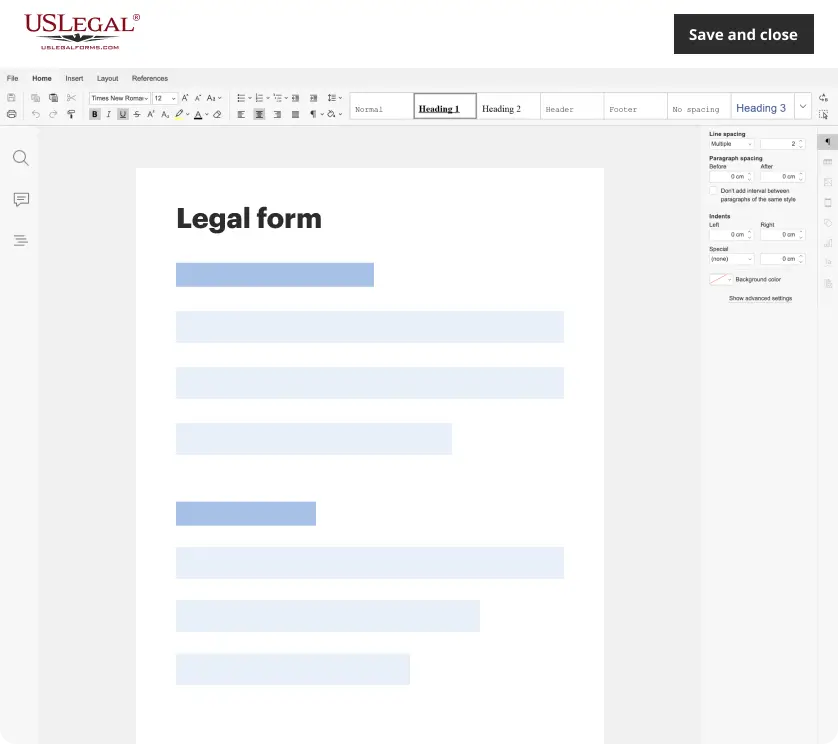
Make edits, fill in missing information, and update formatting in US Legal Forms—just like you would in MS Word.
Download a copy, print it, send it by email, or mail it via USPS—whatever works best for your next step.
Sign and collect signatures with our SignNow integration. Send to multiple recipients, set reminders, and more. Go Premium to unlock E-Sign.
If this form requires notarization, complete it online through a secure video call—no need to meet a notary in person or wait for an appointment.
We protect your documents and personal data by following strict security and privacy standards.
Looking for another form?
Form popularity
FAQ
Individuals cannot open a 401(k) unless their employer offers one; however, if you are self-employed or own a business, you can open other plans, such as a solo 401(k) retirement plan, a SIMPLE IRA, or a simplified employee pension (SEP) IRA. Bureau of Labor Statistics. "Employee Benefits." Bureau of Labor Statistics.
There are a number of ways to use existing retirement-savings vehicles to save without an employer, including a solo 401(k), a spousal individual retirement account (IRA), and a health savings account (HSA).
To qualify for a Solo 401(k), you must be self-employed or own a small business with no employees other than a spouse. But you don't need to be a full-time freelancer or business owner to qualify. You can own a Solo 401(k) even with part-time self-employment income, provided that other eligibility requirements are met.
You are required to have an EIN to open a Solo 401(k) plan. Choose a provider: Research and select a financial institution or provider that offers Solo 401(k) plans. This can be a bank, brokerage firm, or a specialized retirement plan provider.
Generally, no. 401k are employer sponsored plans. The exception is the so-called solo 401k, which you can open if you are self employed (and report the income to the IRS, etc.) IRAs are individually driven, and you can open an IRA without an employer. However, they require earned income.
You can open a self-managed IRA account as either a Roth, traditional or SEP IRA, with the latter applying to self-employed individuals or small business owners. Determining which IRA is best for your unique situation depends on your age, income and financial goals.
For self-employed workers, setting up a retirement plan is a do-it-yourself job. There are four plans you can choose from: a one-participant 401(k), a SEP IRA, a SIMPLE IRA, and a Keogh plan. Health savings plans (HSAs) and traditional and Roth IRAs are supplemental options.
Once you leave a job where you have a 401(k), you can no longer make contributions to the plan and no longer receive the match. There may be better investment vehicles out there — 401(k) plans may have higher fees, limited investment options and strict withdrawal rules.
You are required to have an EIN to open a Solo 401(k) plan. Choose a provider: Research and select a financial institution or provider that offers Solo 401(k) plans. This can be a bank, brokerage firm, or a specialized retirement plan provider.
Technically a 401(k) is a salary deferral plan, which can only be funded by payroll deduction. If your employer doesn't offer it, you cannot start your own. Unless you are legitimately self-employed.