Judgment Against Property For Sale In Hillsborough
Description




Get your form ready online
Our built-in tools help you complete, sign, share, and store your documents in one place.
Make edits, fill in missing information, and update formatting in US Legal Forms—just like you would in MS Word.
Download a copy, print it, send it by email, or mail it via USPS—whatever works best for your next step.
Sign and collect signatures with our SignNow integration. Send to multiple recipients, set reminders, and more. Go Premium to unlock E-Sign.
If this form requires notarization, complete it online through a secure video call—no need to meet a notary in person or wait for an appointment.
We protect your documents and personal data by following strict security and privacy standards.
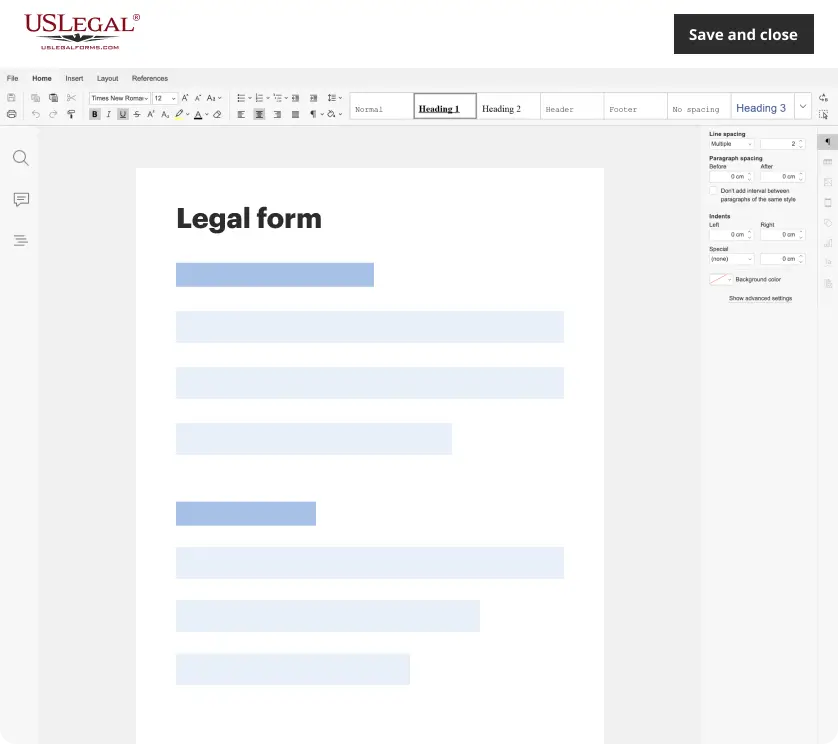
Make edits, fill in missing information, and update formatting in US Legal Forms—just like you would in MS Word.
Download a copy, print it, send it by email, or mail it via USPS—whatever works best for your next step.
Sign and collect signatures with our SignNow integration. Send to multiple recipients, set reminders, and more. Go Premium to unlock E-Sign.
If this form requires notarization, complete it online through a secure video call—no need to meet a notary in person or wait for an appointment.
We protect your documents and personal data by following strict security and privacy standards.
Looking for another form?
Form popularity
FAQ
File a Small Claims Case You, the plaintiff, must file a “Statement of Claim” form, available at your Clerk's office. This must be fully completed and signed to receive a pre-trial conference date. If your claim is based upon written documentation, attach a copy of the contract to the Statement of Claim form.
A person can file a quitclaim deed by (1) entering the relevant information on a quitclaim deed form, (2) signing the deed with two witnesses and a notary, and (3) recording the deed at the county comptroller's office. In Florida, quitclaim deeds must have the name and address of both the grantor and the grantee.
Tampa, Florida 33619-0917 Submit paper title or a completed HSMV 82101 if unable to locate paper title. Your customer should sign a completed form HSMV 82139 Notice of Lien. Submit the completed form HSMV 82139 and a check (see fees) to the Tax Collector's office. The lien will be added to show you as lienholder.
A motion to dismiss for failure to state a cause of action will be granted only if the movant establishes that the pleader has failed to properly plead all of the necessary elements of the particular claim. This hinges on the substantive law for the different elements of different causes of action.
Similar variation across courts was seen in motions to dismiss and motions for summary judgment. Across all cases, the mean time to rule on Rule 12 motions was almost 130 days, but when broken down by district the mean time varied from 63 days in the fastest court to 176 days in the slowest court.
A person can file a quitclaim deed by (1) entering the relevant information on a quitclaim deed form, (2) signing the deed with two witnesses and a notary, and (3) recording the deed at the county comptroller's office. In Florida, quitclaim deeds must have the name and address of both the grantor and the grantee.
Defendants may move to dismiss on the following grounds: Lack of subject matter jurisdiction (FRCP 12(b)(1)Opens in a new window). Lack of personal jurisdiction (FRCP 12(b)(2)Opens in a new window). Improper venue (FRCP 12(b)(3)Opens in a new window).
A motion to dismiss is a formal request by a party to the court to dismiss a case. This pretrial motion is often filed before a criminal or civil case begins. Often, the defendant files this type of motion shortly after receiving the complaint and before engaging in further legal proceedings.
Under Rule 3.190, a Motion to Dismiss can be filed for a multitude of reasons, including, but not limited to, statute of limitations violations, pardons, failures to establish a prima facie case of guilt (factual insufficiencies), double jeopardy, prosecutorial immunity, discovery violations, prosecutorial misconduct, ...
What types of property can and cannot be levied by the sheriff? The sheriff's department can seize: Personal property: movable things (e.g., cars, horses, boats, furniture, jewelry) owned by the debtor. The sheriff's department cannot seize: An individual's home or homestead.

