Example With Judgment In Wayne
Description




Get your form ready online
Our built-in tools help you complete, sign, share, and store your documents in one place.
Make edits, fill in missing information, and update formatting in US Legal Forms—just like you would in MS Word.
Download a copy, print it, send it by email, or mail it via USPS—whatever works best for your next step.
Sign and collect signatures with our SignNow integration. Send to multiple recipients, set reminders, and more. Go Premium to unlock E-Sign.
If this form requires notarization, complete it online through a secure video call—no need to meet a notary in person or wait for an appointment.
We protect your documents and personal data by following strict security and privacy standards.
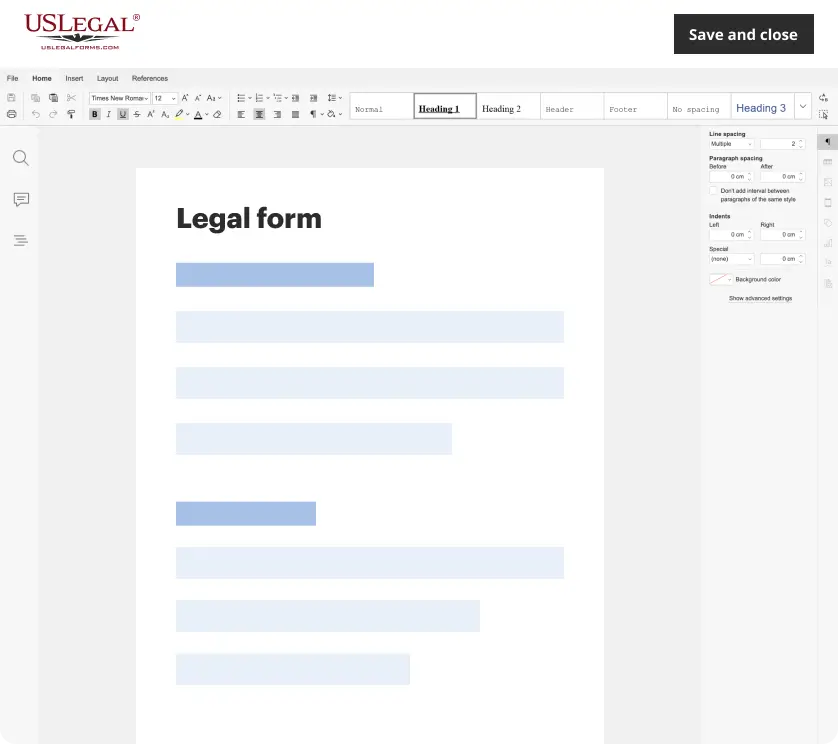
Make edits, fill in missing information, and update formatting in US Legal Forms—just like you would in MS Word.
Download a copy, print it, send it by email, or mail it via USPS—whatever works best for your next step.
Sign and collect signatures with our SignNow integration. Send to multiple recipients, set reminders, and more. Go Premium to unlock E-Sign.
If this form requires notarization, complete it online through a secure video call—no need to meet a notary in person or wait for an appointment.
We protect your documents and personal data by following strict security and privacy standards.
Looking for another form?








Form popularity
FAQ
Example of a Judgment As another example, a landlord who evicted a tenant for not paying the rent might file a lawsuit to collect the unpaid rent, and if the landlord won the lawsuit, it would result in a judgment against the tenant.
All judgments and court records are filed in the County Clerk Office in the County where the lawsuit was filed. You can go in person to the County Clerk Office in the County where you live to ask if a judgment has been entered against you. Most counties also allow you to search online.
Judgment means the final decision made by a court or tribunal . After the judges consider all the relevant evidence of the legal trial and consider all rights and obligations , the plaintiff and defendant will receive the final ruling .
Judgments may be classified as in personam, in rem, or quasi in rem. An in personam, or personal, judgment, the type most commonly rendered by courts, imposes a personal liability or obligation upon a person or group to some other person or group.
Example of a Judgment As another example, a landlord who evicted a tenant for not paying the rent might file a lawsuit to collect the unpaid rent, and if the landlord won the lawsuit, it would result in a judgment against the tenant.
Judgment is a court decision that settles a dispute between two parties by determining the rights and obligations of each party. Judgments are classified as in personam, in rem, or quasi in rem. Judgments are usually monetary, but can also be non-monetary, and are legally enforceable.
Some courts have online access for judgments and other court records. If you know which court you were probably sued in, you might be able to track down the judgment that way. If you're looking for a judgment against you, it's usually going to be in the court of the county where you live.
If the defendant responds to the lawsuit, then it can take months or even years, to finally get to a judgment – depending on how hard the defendant fights. If the defendant does not answer the lawsuit and we secure a default judgment, we must wait an additional 30 days before taking further actions.
The 'Judgment Search' segment could be reached at , which encapsulates the features such as search by Bench, Case Type, Case Number, Year, Petitioner/ Respondent Name, Judge Name, Act, Section, Decision: From Date, To Date and Full Text Search.

