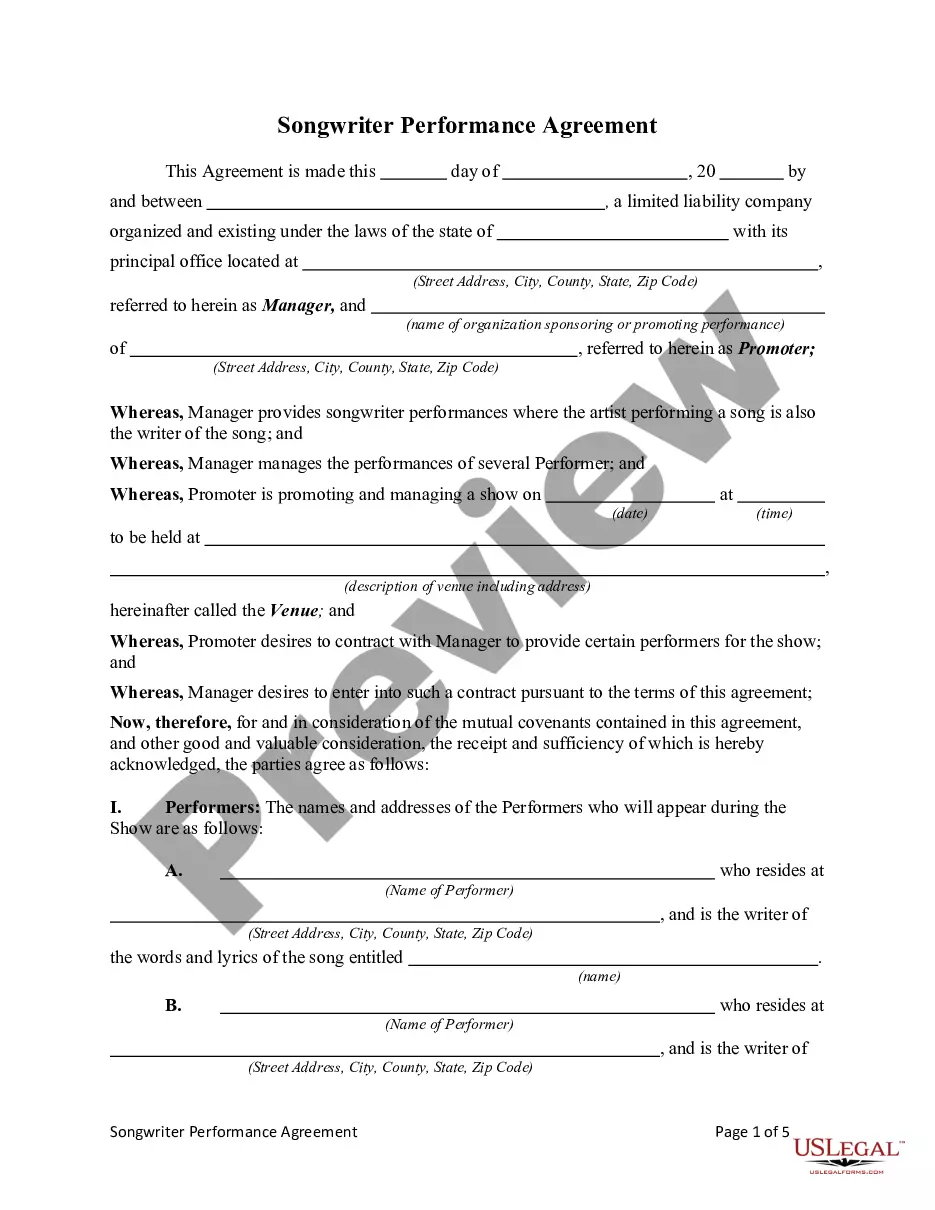
Songwriter Agreement Template For Employees In Ohio
Description



Form popularity
FAQ
How To Get A Songwriting Staff Writing Deal Get to know music publishers organically. Co-write with signed writers. Do your homework. Use everything you do well to your advantage. The fastest way to get a songwriting staff writing deal is by writing great songs.
A songwriter split sheet is a written agreement that identifies all contributors to a song as well as their ownership percentages of that song. These ownership percentages determine how publishing royalties will be "split" between creators. When all parties sign, split sheets become legally binding.
How To Get A Songwriting Staff Writing Deal Get to know music publishers organically. Co-write with signed writers. Do your homework. Use everything you do well to your advantage. The fastest way to get a songwriting staff writing deal is by writing great songs.
Your Music Recording Contract should cover details like: Compensation and royalties. Where and when the album will be recorded. The album's release date. Who has creative control over specific elements of the album. The termination clause. The exclusive agreement clause. Dispute resolution. Promotional appearances.
If you have internet access, search the data-bases of ascap, bmi, sesac, in the U.S.A. or the performing rights organization in your country. Search for song titles and writers in your style and find out who publishes them. Call for permission to submit your songs.
Under the exclusive agreement, the songwriter agrees to assign all compositions written during a specified term (for example, 2 years from January 1 or 1 year with four options), with the guarantee of a share of the income generated and usually a proviso for weekly or monthly payments.
Write the contract in six steps Start with a contract template. Open with the basic information. Describe in detail what you have agreed to. Include a description of how the contract will be ended. Write into the contract which laws apply and how disputes will be resolved. Include space for signatures.
A work for hire, or work made for hire , refers to works whose ownership belongs to a third party rather than the creator. Under general copyright principals, a copyright becomes the property of the author who created the work.
In the absence of a written agreement you automatically share equally, even if your contributions clearly were not equal. Thus, with two songwriters, you own the song 50-50; three songwriters, one-third each; and so on.
