Federal Habeas Corpus For State Prisoners In Ohio
Description



Form popularity
FAQ
The "Great Writ" of habeas corpus is a fundamental right in the Constitution that protects against unlawful and indefinite imprisonment. Translated from Latin it means "show me the body." Habeas corpus has historically been an important instrument to safeguard individual freedom against arbitrary executive power.
Today, habeas corpus is mainly used as a post-conviction remedy for state or federal prisoners who challenge the legality of the application of federal laws that were used in the judicial proceedings that resulted in their detention.
A federal petition for writ of habeas corpus under 28 U.S.C. § 2254 is used by a (1) state prisoner (2) being held in state custody (3) to challenge the validity of a state criminal conviction or sentence (4) for the purpose of obtaining release from custody.
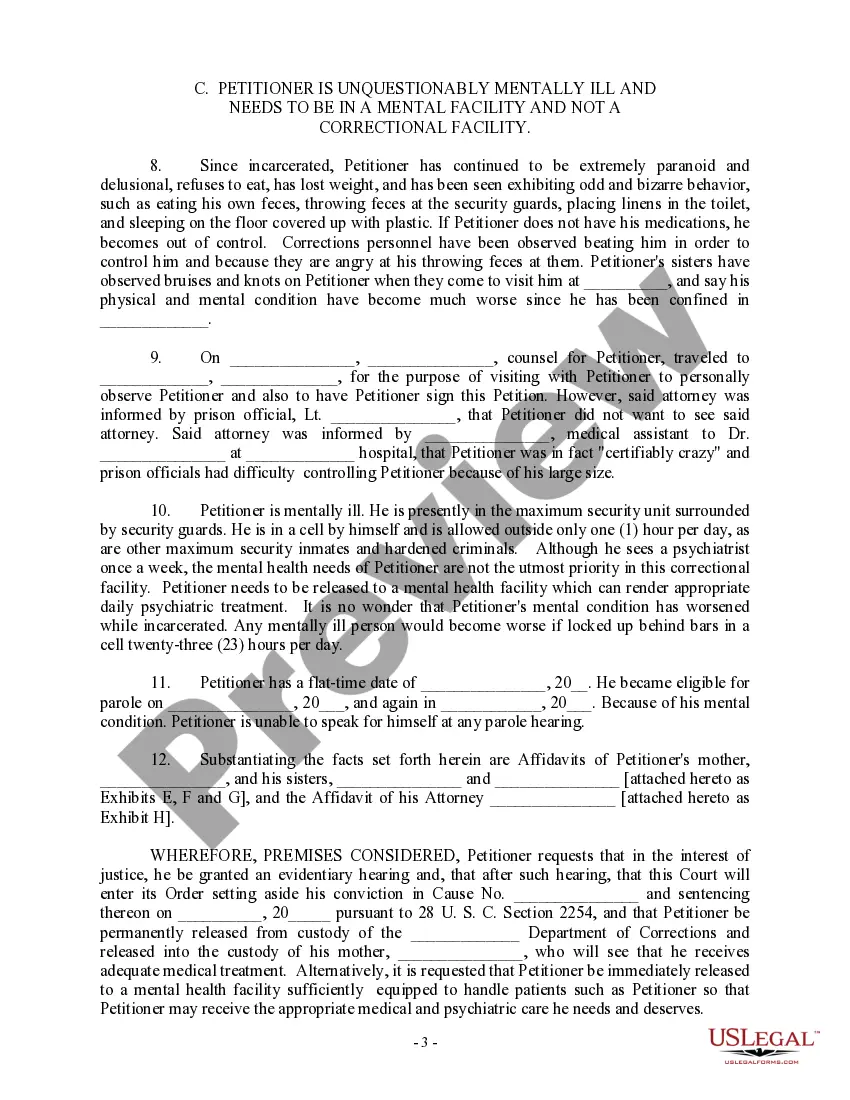
Typical examples where a court has granted a habeas corpus petition include claims of new evidence discovered in the case, ineffective assistance of counsel, prosecutorial misconduct, incompetence to stand trial, and challenging conditions of confinement.
A Writ of Habeas Corpus is usually filed by submitting a Petition, a Memorandum of Points and Authorities, a Declaration from the defendant, and other evidence which supports the Writ of Habeas Corpus. The Memorandum of Points of Authorities is a legal memorandum, which contains the legal arguments of the defendant.
Where can I file a state writ of habeas corpus? You can file in a common pleas court, a court of appeals, or the Ohio Supreme Court. Because a writ challenges the power of the person detaining you, you must file your petition in a court that has power over that person.
A Writ of Habeas Corpus is one of the primary ways of obtaining a client's freedom based on his or her actual innocence. Actual innocence Writs of Habeas Corpus can include witness statements, affidavits, and other external evidence that shows how the client has been wrongfully convicted.
Writs of habeas corpus can be filed in state or federal court. A state-court writ of habeas corpus is brought pursuant to California law, whereas a federal writ is brought under prevailing federal law.
In sum, in order for you, as a state prisoner, to obtain federal habeas relief, you must show that your rights were violated, that the violation was not harmless, and that the state court's ruling that your rights weren't violated and/or any violation was harmless was unreasonable.
James Liebman, Professor of Law at Columbia Law School, stated in 1996 that his study found that when habeas corpus petitions in death penalty cases were traced from conviction to completion of the case that there was "a 40 percent success rate in all capital cases from 1978 to 1995." Similarly, a study by Ronald Tabek ...