Illinois Right To Work Law For Unions In Clark
Description
















Get your form ready online
Our built-in tools help you complete, sign, share, and store your documents in one place.
Make edits, fill in missing information, and update formatting in US Legal Forms—just like you would in MS Word.
Download a copy, print it, send it by email, or mail it via USPS—whatever works best for your next step.
Sign and collect signatures with our SignNow integration. Send to multiple recipients, set reminders, and more. Go Premium to unlock E-Sign.
If this form requires notarization, complete it online through a secure video call—no need to meet a notary in person or wait for an appointment.
We protect your documents and personal data by following strict security and privacy standards.
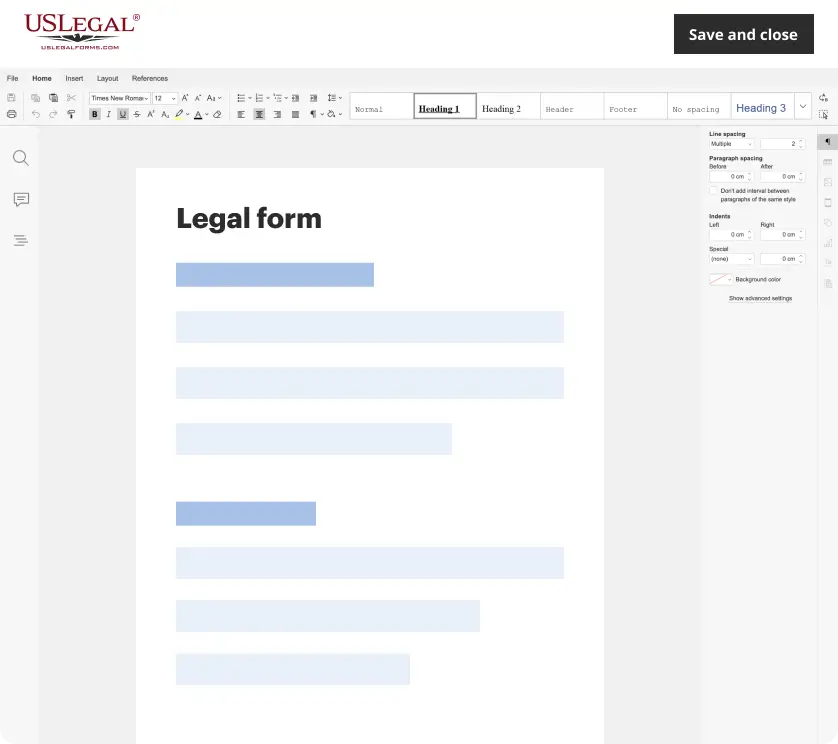
Make edits, fill in missing information, and update formatting in US Legal Forms—just like you would in MS Word.
Download a copy, print it, send it by email, or mail it via USPS—whatever works best for your next step.
Sign and collect signatures with our SignNow integration. Send to multiple recipients, set reminders, and more. Go Premium to unlock E-Sign.

If this form requires notarization, complete it online through a secure video call—no need to meet a notary in person or wait for an appointment.
We protect your documents and personal data by following strict security and privacy standards.
Looking for another form?



Form popularity
FAQ
Illinois is an "employment at-will" state, meaning that an employer or employee may terminate the relationship at any time, without any reason or cause.
Get together with your co-workers who may share a common interest in organizing a union. Talk to a union organizer in order to strategize and to learn the next steps. Talk to your co-workers to build support for the union. Show that support through an election or a card-check once you have a strong majority.
Currently, 26 states and Guam have enacted right-to-work laws. Labor unions still operate in those states, but workers cannot be compelled to become members as a requirement of their job. On March 24, 2023, Michigan became the first state in decades to repeal right-to-work after Gov.
As of April 2019, Illinois is not a right-to-work state. The legislation was signed into effect by Governor J.B. Pritzker, which rolled back the protections that Lincolnshire had established in 2015. The decision was later overruled by the federal court, which ruled that only states have the authority to adopt laws.
Since 1989, when comparable state data became available, union membership rates in Illinois have been above the U.S. average. Illinois had 708,000 union members in 2023.
On November 8, 2022, Illinois voters approved the Illinois Constitution Amendment 1 (the “Workers' Rights Amendment” or the “Amendment”), which amends the state constitution to guarantee workers a broad right to collective bargaining.
To summarize, Illinois is not a right-to-work state. The state's legislative landscape reflects a commitment to collective bargaining, union rights, and labor relations characterized by negotiated agreements between employers and unions.
There is no impediment to an employee's right to resign union membership at any time.
Effective July 1, 2024, the Freelance Worker Protection Act (FWPA) provides new protections for “independent contractors” who contract with any (non-governmental) person or entity to provide products or services in Illinois, or with an entity located in Illinois, worth at least $500 (either in a single contract or in ...
