Sc Labor Laws For Lunch Breaks In Georgia
Description
















Get your form ready online
Our built-in tools help you complete, sign, share, and store your documents in one place.
Make edits, fill in missing information, and update formatting in US Legal Forms—just like you would in MS Word.
Download a copy, print it, send it by email, or mail it via USPS—whatever works best for your next step.
Sign and collect signatures with our SignNow integration. Send to multiple recipients, set reminders, and more. Go Premium to unlock E-Sign.
If this form requires notarization, complete it online through a secure video call—no need to meet a notary in person or wait for an appointment.
We protect your documents and personal data by following strict security and privacy standards.
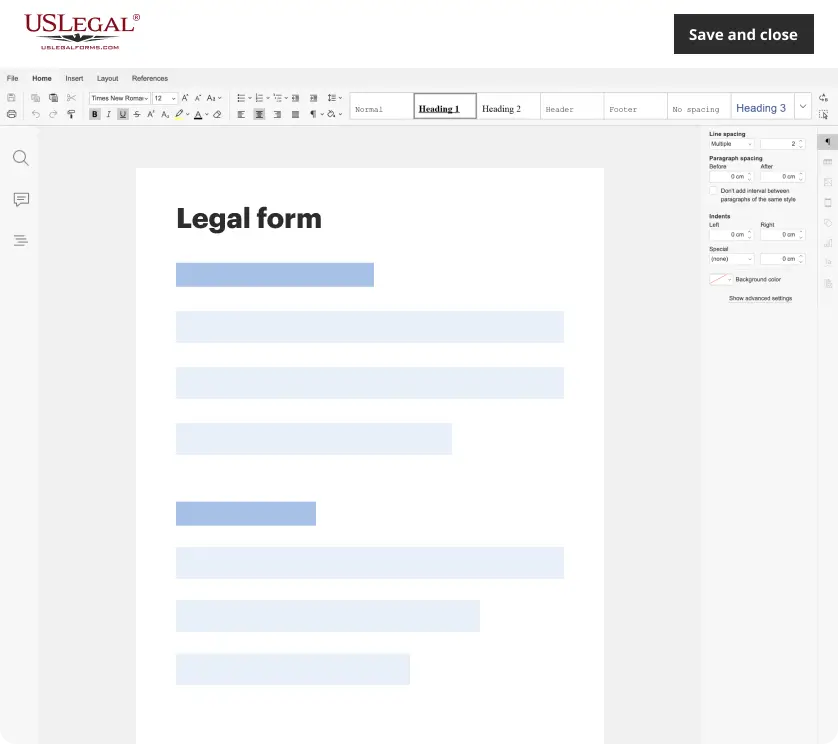
Make edits, fill in missing information, and update formatting in US Legal Forms—just like you would in MS Word.
Download a copy, print it, send it by email, or mail it via USPS—whatever works best for your next step.
Sign and collect signatures with our SignNow integration. Send to multiple recipients, set reminders, and more. Go Premium to unlock E-Sign.

If this form requires notarization, complete it online through a secure video call—no need to meet a notary in person or wait for an appointment.
We protect your documents and personal data by following strict security and privacy standards.
Looking for another form?


Form popularity
FAQ
There is no requirement under South Carolina law for an employer to provide employees with breaks or a lunch period.
Ing to the Labor Code of Georgia, working hours for an adult should not exceed 40 hours per week (Article 24, Paragraph 2 of the Labor Code of Georgia). Georgian legislation sets a different rule for enterprises with specific exemptions, where standard working hours should not exceed 48 hours per week.
Georgia On-Call Laws ing to these federal guidelines, employees must be compensated for on-call time if they are required to remain on the employer's premises or are otherwise restricted in a way that prevents them from using the time effectively for personal purposes.
(2) "Full-time" means an employee who regularly works 30 hours or more each week.
Neither the Fair Labor Standards Act (FLSA) nor Georgia law requires breaks or meal periods be given to workers. However, many employers do provide breaks and meal periods, even though discretionary with the employer. Breaks of short duration, from 5 to 20 minutes, are common.
Neither the Fair Labor Standards Act (FLSA) nor Georgia law requires breaks or meal periods be given to workers. However, many employers do provide breaks and meal periods, even though discretionary with the employer. Breaks of short duration, from 5 to 20 minutes, are common.
There is no requirement under South Carolina law for an employer to provide employees with breaks or a lunch period. Q.
Ing to the Labor Code of Georgia, working hours for an adult should not exceed 40 hours per week (Article 24, Paragraph 2 of the Labor Code of Georgia). Georgian legislation sets a different rule for enterprises with specific exemptions, where standard working hours should not exceed 48 hours per week.
No. Federal law does not require a lunch break. So if a company gave you 3 10 minute breaks a day that would be compensable. A 30 minute lunch would be non compensable. I would quit any company that didn't allow at least a 30 minute lunch break.
Ing to the Labor Code of Georgia, working hours for an adult should not exceed 40 hours per week (Article 24, Paragraph 2 of the Labor Code of Georgia). Georgian legislation sets a different rule for enterprises with specific exemptions, where standard working hours should not exceed 48 hours per week.