Illinois Right To Work Laws With Right-to-work In Montgomery
Description
















Get your form ready online
Our built-in tools help you complete, sign, share, and store your documents in one place.
Make edits, fill in missing information, and update formatting in US Legal Forms—just like you would in MS Word.
Download a copy, print it, send it by email, or mail it via USPS—whatever works best for your next step.
Sign and collect signatures with our SignNow integration. Send to multiple recipients, set reminders, and more. Go Premium to unlock E-Sign.
If this form requires notarization, complete it online through a secure video call—no need to meet a notary in person or wait for an appointment.
We protect your documents and personal data by following strict security and privacy standards.
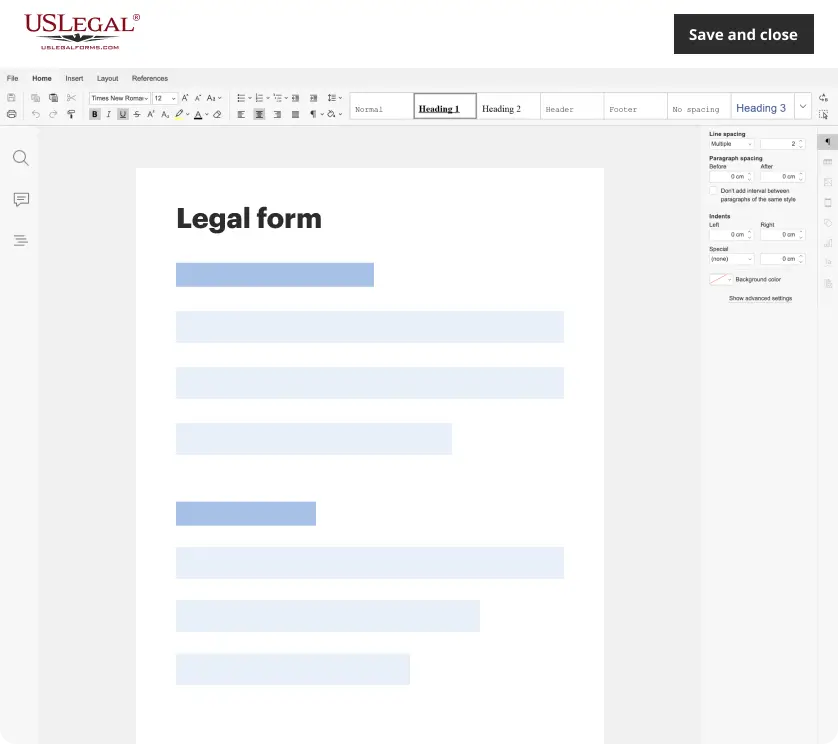
Make edits, fill in missing information, and update formatting in US Legal Forms—just like you would in MS Word.
Download a copy, print it, send it by email, or mail it via USPS—whatever works best for your next step.
Sign and collect signatures with our SignNow integration. Send to multiple recipients, set reminders, and more. Go Premium to unlock E-Sign.

If this form requires notarization, complete it online through a secure video call—no need to meet a notary in person or wait for an appointment.
We protect your documents and personal data by following strict security and privacy standards.
Looking for another form?
Form popularity
FAQ
Additionally, the agreement not to compete must not impose undue hardship on the employee. A clause prohibiting the employee from working for a competitor in a 10 mile radius may be acceptable, but one that prohibits him from working for any competitor in North America may not.
For employees who are not low-wage employees, under Illinois common law, non-competes are enforceable if the employer terminated employment in good faith and with good cause (Rao v. Rao, 718 F. 2d 219, 222-23 (7th Cir. 1983)).
To summarize, Illinois is not a right-to-work state. The state's legislative landscape reflects a commitment to collective bargaining, union rights, and labor relations characterized by negotiated agreements between employers and unions.
Now that the Amendment has passed, the NLRA preemption argument is expected to be the subject of future litigation. The Amendment also appears to block Illinois from to becoming a right-to-work state. Right-to-work legislation prohibits compulsory union membership.
The Illinois Freedom to Work Act prohibits non-compete agreements between an employer and low-wage employees, including non- competes that restrict a low-wage employee from performing work for another employer that is similar to the employee's work for the employer that is party to the agreement (see Question 1).
While citizens automatically have work authorization in the U.S., non-citizens must have the correct immigration status to work there legally. Like citizens, lawful permanent residents/green card holders are eligible to work in the United States.
Effective July 1, 2024, the Freelance Worker Protection Act (FWPA) provides new protections for “independent contractors” who contract with any (non-governmental) person or entity to provide products or services in Illinois, or with an entity located in Illinois, worth at least $500 (either in a single contract or in ...
Can an employer terminate me without advance notice or without giving a reason or an unfair reason for the termination? Yes. Illinois is an "employment at-will" state, meaning that an employer or employee may terminate the relationship at any time, without any reason or cause.
New meal and rest break requirements: Requires employees be given a 20-minute break if working a 12-hour shift or longer, and at least 24 consecutive hours of rest in every consecutive 7-day period, clarifying the day of rest requirements for workers whose schedules don't align with a Sunday to Saturday calendar week.
To summarize, Illinois is not a right-to-work state. The state's legislative landscape reflects a commitment to collective bargaining, union rights, and labor relations characterized by negotiated agreements between employers and unions.