Employee Handbook For Coffee Shop In Riverside
Description
















Get your form ready online
Our built-in tools help you complete, sign, share, and store your documents in one place.
Make edits, fill in missing information, and update formatting in US Legal Forms—just like you would in MS Word.
Download a copy, print it, send it by email, or mail it via USPS—whatever works best for your next step.
Sign and collect signatures with our SignNow integration. Send to multiple recipients, set reminders, and more. Go Premium to unlock E-Sign.
If this form requires notarization, complete it online through a secure video call—no need to meet a notary in person or wait for an appointment.
We protect your documents and personal data by following strict security and privacy standards.
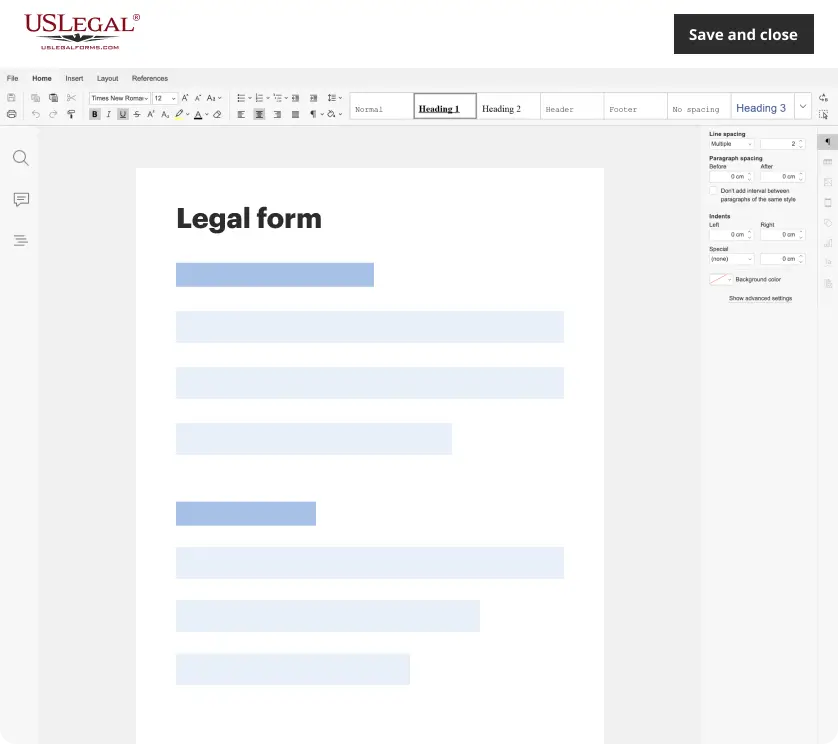
Make edits, fill in missing information, and update formatting in US Legal Forms—just like you would in MS Word.
Download a copy, print it, send it by email, or mail it via USPS—whatever works best for your next step.
Sign and collect signatures with our SignNow integration. Send to multiple recipients, set reminders, and more. Go Premium to unlock E-Sign.
If this form requires notarization, complete it online through a secure video call—no need to meet a notary in person or wait for an appointment.
We protect your documents and personal data by following strict security and privacy standards.
Looking for another form?
Form popularity
FAQ
Standard Documents Equal Employment Opportunity and Anti-Discrimination Policy (CA) Disability Accommodations Policy (CA) Anti-Harassment Policy (CA) Anti-Retaliation Policy (CA) Harassment, Discrimination, and Retaliation Prevention Policy (CA) Religious Accommodations Policy (CA)
Certain policies are mandatory and must be included in your employee handbook. For example, California employers must have a written harassment, discrimination and retaliation prevention policy. Including these policies clarifies for employees their rights and obligations, and protects you from potential liability.
While the law in California does not require businesses to create or distribute employee handbooks, the law does require every business to memorialize certain workplace policies in writing.
How to write an employee handbook Include your company's mission statement. Write a brief section on company history. State any legal declarations. Explain your dress code. Include details about work hours. Define duties. Include department-specific policies. Describe company benefits.
Forget to include any policies you are legally obligated to provide, such as FMLA. Overlook differences in federal, state and local law. Neglect to include information on leaving the company and how resignations, terminations and retirements will be handled.
The topics included in the employee handbook should cover the employer's mission statement, equal employment opportunity statement, contractual disclaimer and at-will employment statement (where allowed), purpose of the employee handbook, and background information on the company.
Building or updating an employee handbook and ensuring it complies with all federal and state policies can take as long as 8 weeks without the right tools.
Once the employer has updated the policies and formalized the common practices, legal counsel should review them, and HR should use these final policies for developing the employee handbook. Employers should also consider the National Labor Relations Board (NLRB) rulings and guidance pertaining to employee handbooks.
It has been worth it for me! I was entry level when I took it and it helped me get into that mid level and now managing HR. I'd say it gave me an extra 3 years of experience worth of credibility. Overall, I think it's just a signal that you are genuinely interested in the field and know your stuff.
