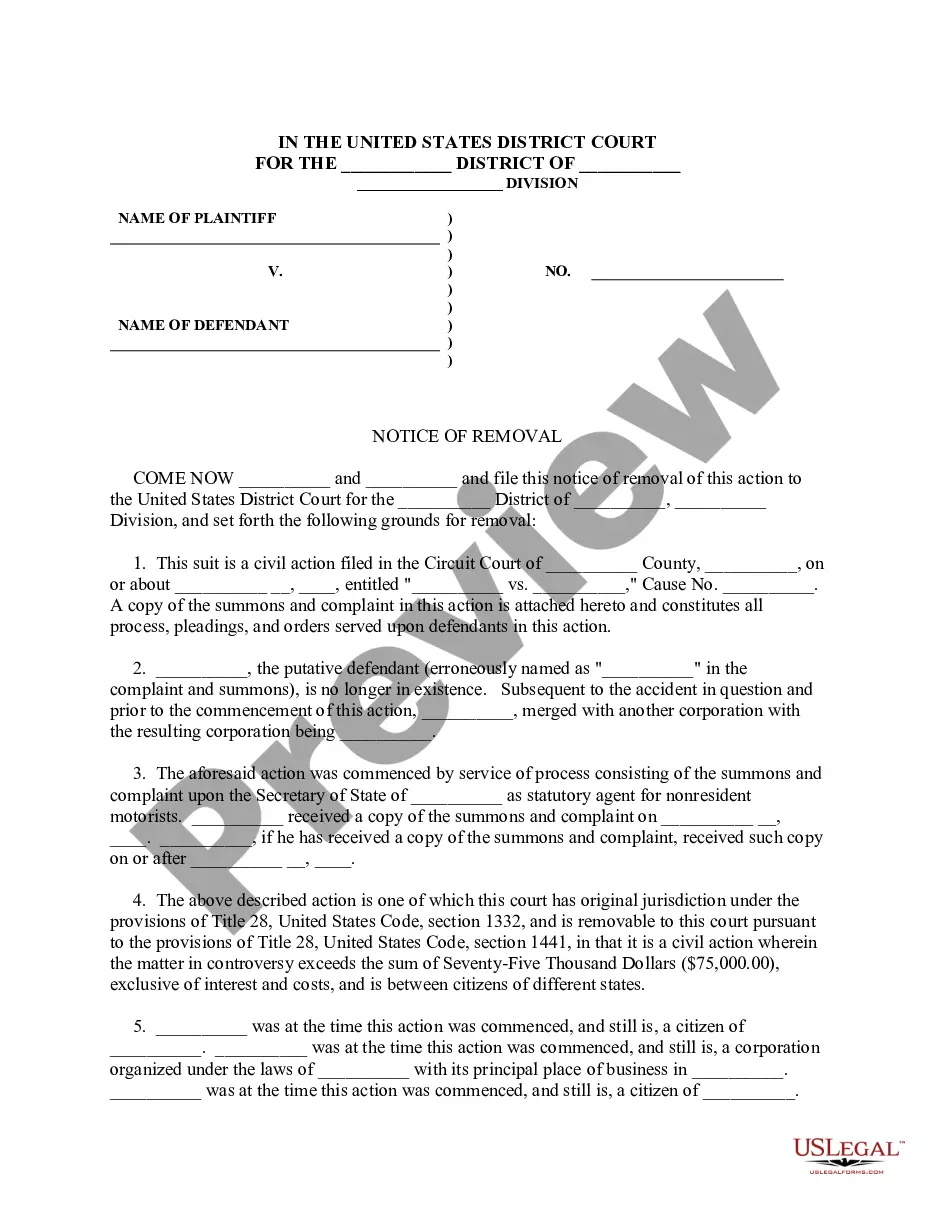
Notice Of Removal Template With The Roll In Minnesota
Description

Get your form ready online
Our built-in tools help you complete, sign, share, and store your documents in one place.
Make edits, fill in missing information, and update formatting in US Legal Forms—just like you would in MS Word.
Download a copy, print it, send it by email, or mail it via USPS—whatever works best for your next step.
Sign and collect signatures with our SignNow integration. Send to multiple recipients, set reminders, and more. Go Premium to unlock E-Sign.
If this form requires notarization, complete it online through a secure video call—no need to meet a notary in person or wait for an appointment.
We protect your documents and personal data by following strict security and privacy standards.

Make edits, fill in missing information, and update formatting in US Legal Forms—just like you would in MS Word.

Download a copy, print it, send it by email, or mail it via USPS—whatever works best for your next step.

Sign and collect signatures with our SignNow integration. Send to multiple recipients, set reminders, and more. Go Premium to unlock E-Sign.

If this form requires notarization, complete it online through a secure video call—no need to meet a notary in person or wait for an appointment.

We protect your documents and personal data by following strict security and privacy standards.
Looking for another form?
Form popularity
FAQ
Instructions for filing a. Motion. in the Minnesota Court of Appeals. Step 1: Fill out the Motion form. Step 2: Fill out the Affidavit in Support of Motion form. Step 3: Serve your Motion and Affidavit on the opposing parties. Step 4: Proof of Service. Step 5: File the Motion, Affidavit, and Certificate of Service by Mail.
A final order granting or denying a petition for an order for protection is appealable as a final order in a special proceeding. There are other types of orders that are appealable under statutes that apply to specific types of proceedings or under a decision of the Minnesota Supreme Court.
In addition to believable witnesses and compelling arguments, evidence is what can help win cases at trial. An item of evidence introduced in a courtroom proceeding is known as an exhibit, and there are several types of exhibits in court to be familiar with: Legal categorization. Format.
Court filings with exhibits attached as part of the court filing must be submitted to the court at the time of filing with the court (either in person, by mail, or through the eFile and eServe (eFS) System).
Ensure the video is clear, relevant, and legally recorded. Gather required documents and authenticate the video. Submit it in the court-approved format before the deadline. During the hearing, use proper playback equipment and be ready to explain why the video is important to your case.
At the trial stage, you may need to: Fill out an exhibit list with a description and exhibit number or letter. Identify exhibits as physical, electronic, or both. Use specific file naming protocol and sequencing for digital files. Bookmark and annotate PDFs.
Include a typed notation within the body of the legal document where the exhibit should be referenced. Thereafter, assign the exhibit with an identifying number or letter. For instance, this notation can state either "See Exhibit A" or "See Exhibit 1". Label the exhibit with the assigned identifying number or letter.
Service by mail shall be made only by the sheriff or by any other person who is at least 18 years of age who is not a party to the proceeding. Pursuant to Minnesota Statutes 2006, section 518A. 46, subdivision 2, paragraph (c), clause (4), an employee of the county agency may serve documents on the parties.
If you believe the protection order was granted improperly or that it is no longer needed, you can file a motion asking the court to “dissolve” (terminate or cancel) the protection order. After you file the motion, the court will decide whether or not to schedule a hearing.
In Minnesota, family courts handle these orders rather than criminal courts. To contest an OFP, a person must: Ask for a hearing: They can request a court hearing within five days of receiving the temporary order. The person who filed the OFP must receive a notice at least 30 days before the hearing.