Change Of Venue Letter With Case In Middlesex
Description





Get your form ready online
Our built-in tools help you complete, sign, share, and store your documents in one place.
Make edits, fill in missing information, and update formatting in US Legal Forms—just like you would in MS Word.
Download a copy, print it, send it by email, or mail it via USPS—whatever works best for your next step.
Sign and collect signatures with our SignNow integration. Send to multiple recipients, set reminders, and more. Go Premium to unlock E-Sign.
If this form requires notarization, complete it online through a secure video call—no need to meet a notary in person or wait for an appointment.
We protect your documents and personal data by following strict security and privacy standards.
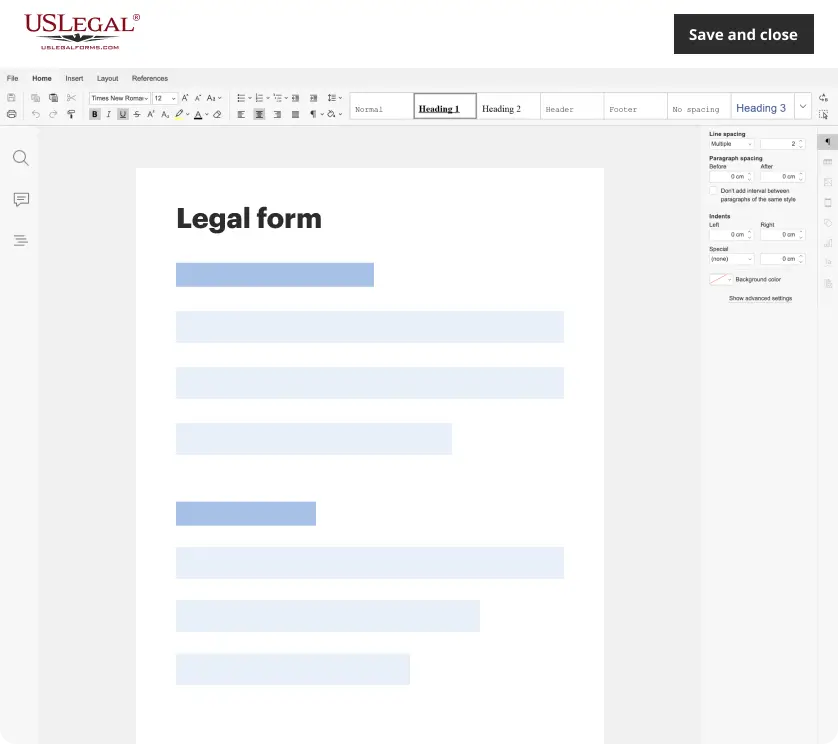
Make edits, fill in missing information, and update formatting in US Legal Forms—just like you would in MS Word.
Download a copy, print it, send it by email, or mail it via USPS—whatever works best for your next step.
Sign and collect signatures with our SignNow integration. Send to multiple recipients, set reminders, and more. Go Premium to unlock E-Sign.

If this form requires notarization, complete it online through a secure video call—no need to meet a notary in person or wait for an appointment.
We protect your documents and personal data by following strict security and privacy standards.
Looking for another form?
Form popularity
FAQ
Requesting a Change of Venue in Immigration Court. In your request for a change of venue, you must provide the date and time of the next hearing in your case. You also must review your Notice to Appear carefully and make sure that you respond to each of the allegations in it.
Moving the case to a different court Step 1: Get the forms. You need two forms. Step 2: Fill out and sign the notice of motion form. You can fill out the notice of motion and affidavit form in neat handwriting in blue or black pen. Step 3: Fill out and sign the Affidavit. Step 4: File the forms at court.
Section 1404(a) of Title 28 provides that: "for the convenience of parties and witnesses, in the interest of justice, a district may transfer any civil action to any other district where it might have been brought." Any party, including plaintiff, may move for a transfer under 28 U.S.C. § 1404(a).
As we will explain below, the law governing the transfer of proceedings from one court to another generally favours the claimant. Therefore, if you want control over the location of the court where your disputes are resolved, provision ought to be made for this in your contracts.
To move your case to another court, you must make a “Motion to Change Venue” in writing, and file one copy with the Court where your case is currently located and another copy with the Department of Homeland Security.
Section 1404(a) of Title 28 provides that: "for the convenience of parties and witnesses, in the interest of justice, a district may transfer any civil action to any other district where it might have been brought." Any party, including plaintiff, may move for a transfer under 28 U.S.C. § 1404(a).
The Court Rules require that a motion for reconsideration of a final order must be filed within 20 days after the Order has been served and must “state with specificity the basis on which it is made, including a statement of the matters or controlling decisions which counsel believes the court has overlooked or as to ...
“Motions for reconsideration are applicable only when the court's order is based on plainly incorrect reasoning, when the court failed to consider evidence, or there is good reason for it to consider new information on an issue decided.” s v. Bahr, 295 N.J. Super. 374, 384-385 (App. Div.
In the Garden State i.e. New Jersey!, a motion for continuance means you're asking the court to postpone or reschedule a hearing or trial. The court might grant this if there's a good cause, like a sudden emergency or new evidence that couldn't have been presented earlier.
The most common type of post-trial motion is a Motion for Reconsideration in which you are asking the judge to reconsider his/her ruling and change one specific part of the court order or the court's overall ruling.

