Exchange Agreement With In Nevada
Description




Form popularity
FAQ
Lack of Liquidity- Exchanging properties continually can tie up funds in real estate, making it hard for an investor to access liquid capital if required. While real estate can be a profitable investment, it's not as liquid as some other assets.
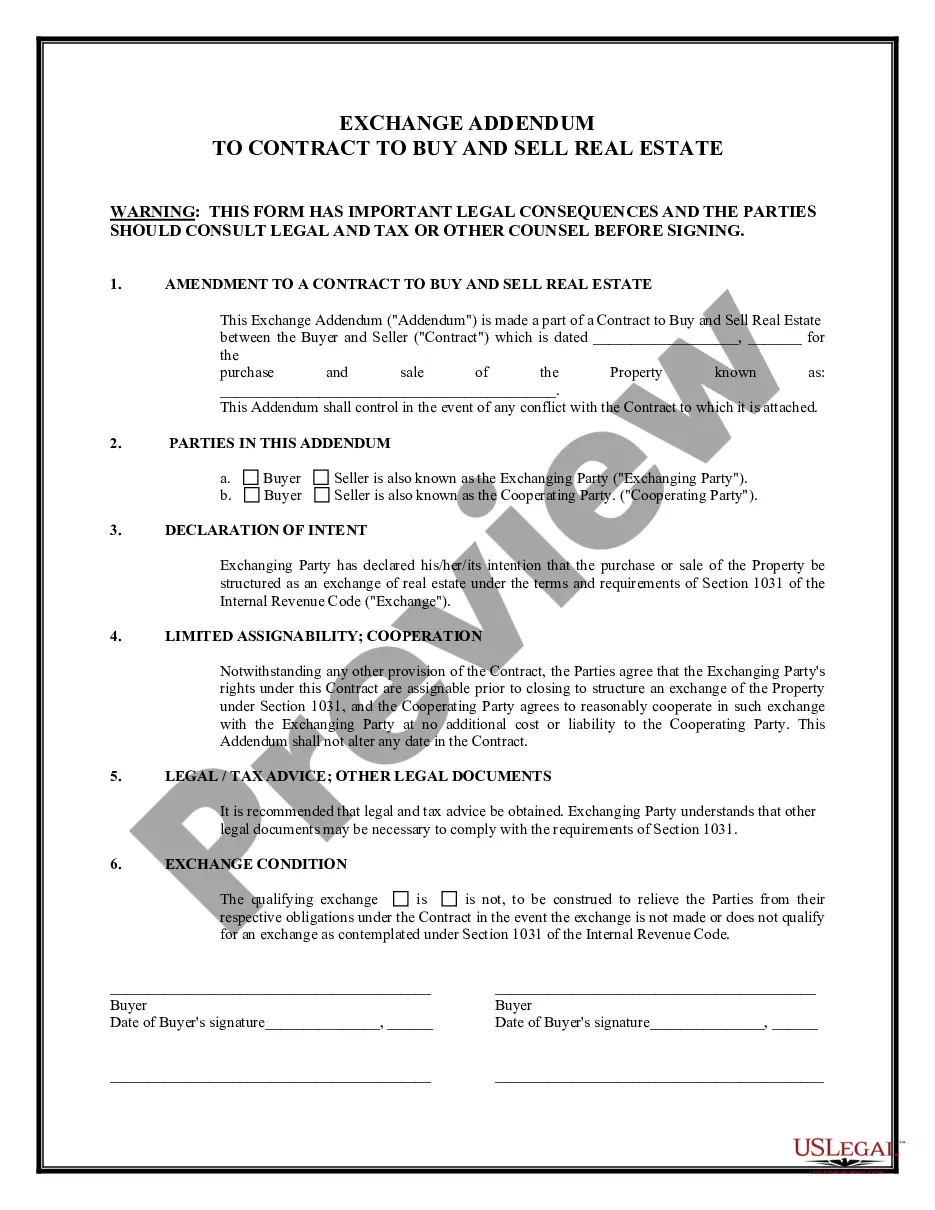
Understanding 1031 Exchange in Nevada A 1031 exchange, named after Section 1031 of the U.S. Internal Revenue Code, allows real estate investors to defer paying capital gains taxes on property sales when reinvesting the proceeds into like-kind property.
The property must be a business or investment property, which means that it can't be personal property. Your home won't qualify for a 1031 exchange. However, a single-family rental property that you own could be exchanged for commercial rental property.
Under the Tax Cuts and Jobs Act, Section 1031 now applies only to exchanges of real property and not to exchanges of personal or intangible property. An exchange of real property held primarily for sale still does not qualify as a like-kind exchange.
How to Do a 1031 Exchange Choose a qualified intermediary to coordinate the exchange. Sell your current real estate property. You have 45 days to identify potential replacement properties. You have 180 days to close on a replacement property. File IRS Form 8824.
Here are examples of properties ineligible for a 1031 exchange: Primary residences: A 1031 exchange is specifically intended for investment or business properties. Personal properties are not eligible. Vacation homes: Vacation homes generally do not qualify if used for personal reasons.
