Texas Partition Agreement With Waiver Of Rights In Kings
Description


Get your form ready online
Our built-in tools help you complete, sign, share, and store your documents in one place.
Make edits, fill in missing information, and update formatting in US Legal Forms—just like you would in MS Word.
Download a copy, print it, send it by email, or mail it via USPS—whatever works best for your next step.
Sign and collect signatures with our SignNow integration. Send to multiple recipients, set reminders, and more. Go Premium to unlock E-Sign.
If this form requires notarization, complete it online through a secure video call—no need to meet a notary in person or wait for an appointment.
We protect your documents and personal data by following strict security and privacy standards.
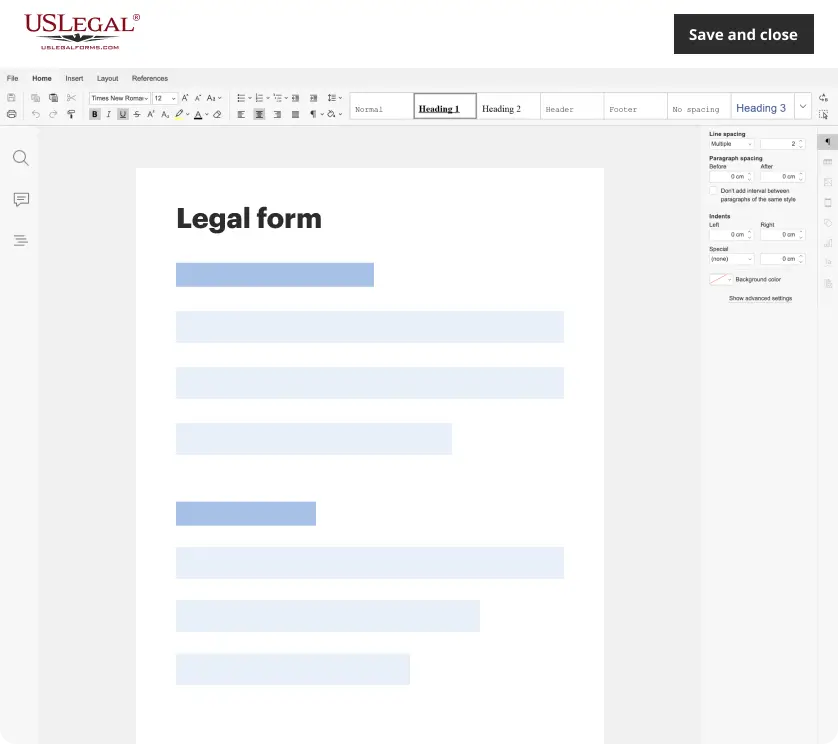
Make edits, fill in missing information, and update formatting in US Legal Forms—just like you would in MS Word.
Download a copy, print it, send it by email, or mail it via USPS—whatever works best for your next step.
Sign and collect signatures with our SignNow integration. Send to multiple recipients, set reminders, and more. Go Premium to unlock E-Sign.

If this form requires notarization, complete it online through a secure video call—no need to meet a notary in person or wait for an appointment.
We protect your documents and personal data by following strict security and privacy standards.
Looking for another form?
Form popularity
FAQ
Potential solutions for dividing inherited property include selling the property and dividing the proceeds, providing siblings with co-ownership, and having one sibling buy out the other siblings.
The process of partition action starts with one or more owners filing a petition in court. The court then examines the real estate details and the owners' interests to decide on the best division method.
Texas is one of nine states that is a community property jurisdiction. In general, this means that any property acquired by a couple during their marriage (with a few exceptions) is equally owned by both spouses. This can have a profound effect on the dissolution of property during divorce proceedings.
The undivided interest encompasses the whole property, and its holders have equal rights to the entire property. The undivided interest is not separated into parts or shares. Thus, no individual co-owner has exclusive rights to any specific portion of the property.
Every co-owner of an interest in the property (no matter how small) must agree in order for a voluntary partition to occur. The remedy when agreement cannot be reached is for one or more of the co-owners to seek a court-ordered division by means of a partition suit.
Property acquired during the marriage (outside of the noted exceptions) is considered community property. The spouses can, however, agree to convert (or “transmute”) community property into separate property. In Texas, this is done via a written agreement establishing a partition or exchange between the parties.
4.102. PARTITION OR EXCHANGE OF COMMUNITY PROPERTY. At any time, the spouses may partition or exchange between themselves all or part of their community property, then existing or to be acquired, as the spouses may desire.
A partition agreement divides, or partitions, a married couple's community estate into two separate estates. It is sometimes called a post-nuptial or post-marital agreement and is similar to a prenuptial agreement, except that it is executed by a married couple.
So b1 to BN is a partition of an event B if the union of b1 to BN is the event B. Another way ofMoreSo b1 to BN is a partition of an event B if the union of b1 to BN is the event B. Another way of saying this pictorially is that it takes the event B. And it splits it up into a bunch of small events.
The actual time it takes from when a partition case is filed to when the land is partitioned physically, by sale, or by set-off varies from case to case. In general, partition cases can take several months or even years to resolve.
