Indiana Warning of Default on Residential Lease
What is this form?
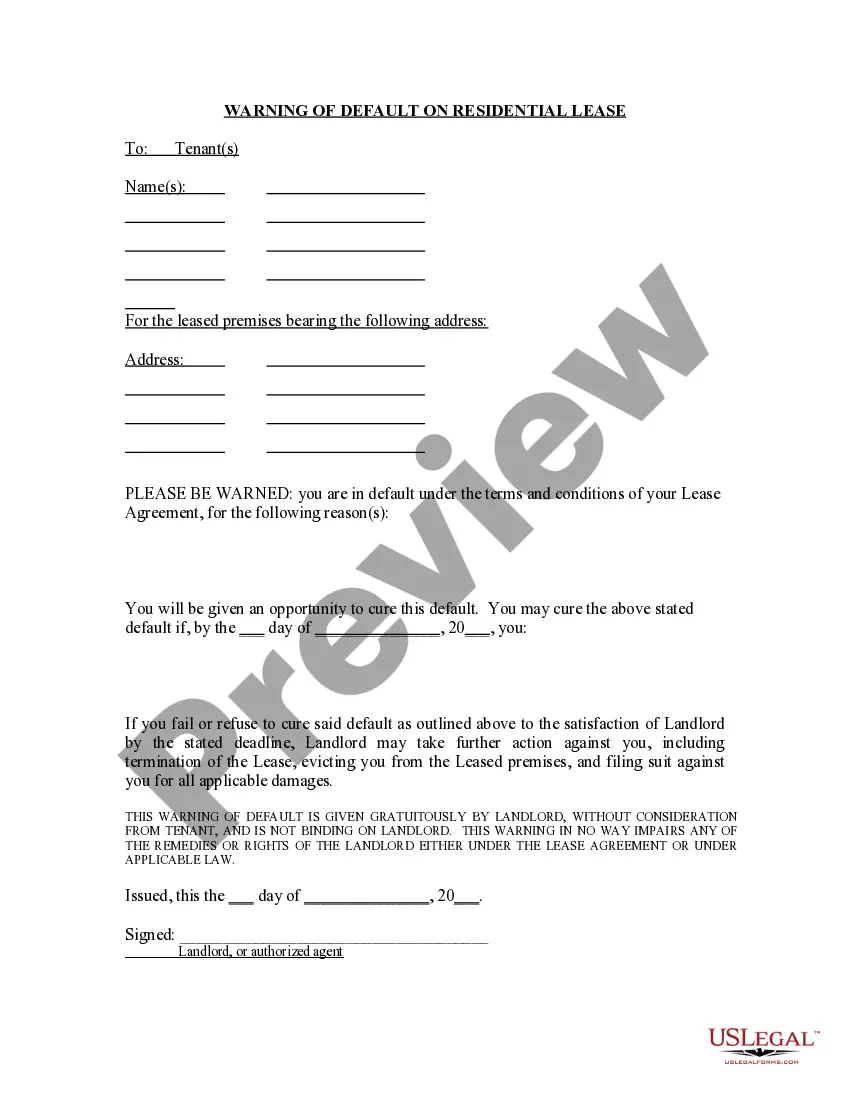
The Warning of Default on Residential Lease is a formal notice from a landlord to a tenant, indicating that the tenant may be in breach of the lease agreement. This form specifically outlines the landlord's concerns and the potential consequences if the tenant does not address the identified issues. Unlike other forms, this document serves as a proactive measure, alerting tenants of their default status before further legal actions are taken.
Form components explained
- Identification of the landlord and tenant.
- Date of issuance of the warning.
- Specific conditions or breaches that constitute the default.
- Statement clarifying that this warning does not limit the landlord's legal rights.
- Signature line for the landlord or authorized agent.



When to use this form
This form should be used when a landlord believes a tenant is in default under their residential lease. Common scenarios include instances of unpaid rent, property damage, or failure to comply with lease terms. By issuing this warning, landlords can formally document the issues and give tenants a chance to remedy the situation before pursuing further legal action.
Who should use this form
This form is intended for:
- Landlords managing residential properties.
- Property managers acting on behalf of landlords.
- Tenants who have received a warning and need clarity about their lease obligations.
Steps to complete this form
- Identify and fill in the names of the landlord and tenant at the beginning of the form.
- Enter the date of issuance to establish a clear timeline.
- Specify the conditions or terms of the lease that have been breached.
- Include a statement indicating that the warning is not legally binding and does not waive any landlord rights.
- Sign the form as the landlord or have the authorized agent sign on behalf of the landlord.
Is notarization required?
This form does not typically require notarization unless specified by local law. However, having the document notarized can add an extra layer of authenticity and may be beneficial in the event of legal disputes.
Get your form ready online
Our built-in tools help you complete, sign, share, and store your documents in one place.
Make edits, fill in missing information, and update formatting in US Legal Forms—just like you would in MS Word.
Download a copy, print it, send it by email, or mail it via USPS—whatever works best for your next step.
Sign and collect signatures with our SignNow integration. Send to multiple recipients, set reminders, and more. Go Premium to unlock E-Sign.
If this form requires notarization, complete it online through a secure video call—no need to meet a notary in person or wait for an appointment.
We protect your documents and personal data by following strict security and privacy standards.

Make edits, fill in missing information, and update formatting in US Legal Forms—just like you would in MS Word.

Download a copy, print it, send it by email, or mail it via USPS—whatever works best for your next step.

Sign and collect signatures with our SignNow integration. Send to multiple recipients, set reminders, and more. Go Premium to unlock E-Sign.

If this form requires notarization, complete it online through a secure video call—no need to meet a notary in person or wait for an appointment.

We protect your documents and personal data by following strict security and privacy standards.
Mistakes to watch out for
- Failing to specify the exact terms of the lease that are in default.
- Not signing the document as required.
- Not dating the notice, which can affect its validity.
- Assuming the warning is the final step without understanding further legal actions may follow.
Benefits of completing this form online
- Easy access and quick download for immediate use.
- Editable templates that allow customization for individual circumstances.
- Reliability of professionally drafted legal content for peace of mind.
Legal use & context
- This warning serves as evidence that the landlord has formally communicated the default status to the tenant.
- It is essential for landlords to follow proper legal procedures to uphold their rights under the lease agreement.
- Failure to issue a warning may hinder the landlord's ability to take further legal action for eviction or damages.
Quick recap
- The Warning of Default alerts tenants to potential lease violations.
- It provides an opportunity for tenants to remedy issues before legal action is pursued.
- Using this form helps maintain legal documentation and can support future claims or disputes.
Looking for another form?


Form popularity
FAQ
You can't be immediately evicted if one of the following applies to you: The CDC Order to temporarily halt certain residential evictions through June 30, 2021.After July 25, 2020, you may be evicted if your landlord has given you 30-days written notice of eviction.
In landlord-tenant law, default refers to the failure of a tenant to timely pay rent due.In general, the landlord is required to give the tenant notice of the default before bringing eviction proceedings or applying security deposit proceeds to the payment in default.
All states, including Indiana, have rules about this issue. Generally speaking, you cannot kick out someone at any time - a sheriff or marshall has to do it, after the person entitled to possession of the premises goes to court.
To evict a tenant early (meaning, before the lease or rental agreement has expired), a landlord must have cause, or a legal reason. The most common causes of eviction are failure to pay rent or violation of the lease or rental agreement.Eviction Notices for Nonpayment of Rent in Indiana has more information.
Breaking Lease in Indiana If you break a lease in Indiana, the landlord can require that you pay rent for the remainder of the term. However, due to the state's requirement that landlords mitigate damages, your landlord is expected to try to find a replacement as soon as possible to let you off the hook.
In Indiana, tenants have the right to put rent money towards repairs in the event a landlord hasn't made repairs within a reasonable time. Tenants also have the right to terminate a lease agreement when premises become uninhabitable.
C.Indiana law requires landlords to give a 30-day notice before filing an eviction action unless the lease states a different notice period or other circumstances apply as defined by Indiana law. For example, a tenant's use of the unit for criminal activity can reduce the landlord's required notice time.
Tenant default occurs when a Tenant breaches one of the tenant's covenants in its lease. Tenant default can arise in a number of different ways but will typically be for one of the following: Non-payment of rent or other sums reserved under the lease.
Indiana has one of the most lenient statutes in the country for eviction for nonpayment of rent: A landlord must typically provide 10 days' notice to pay rent or move before they can file to evict. Most other states have a waiting period of 3 to 7 days before filing.