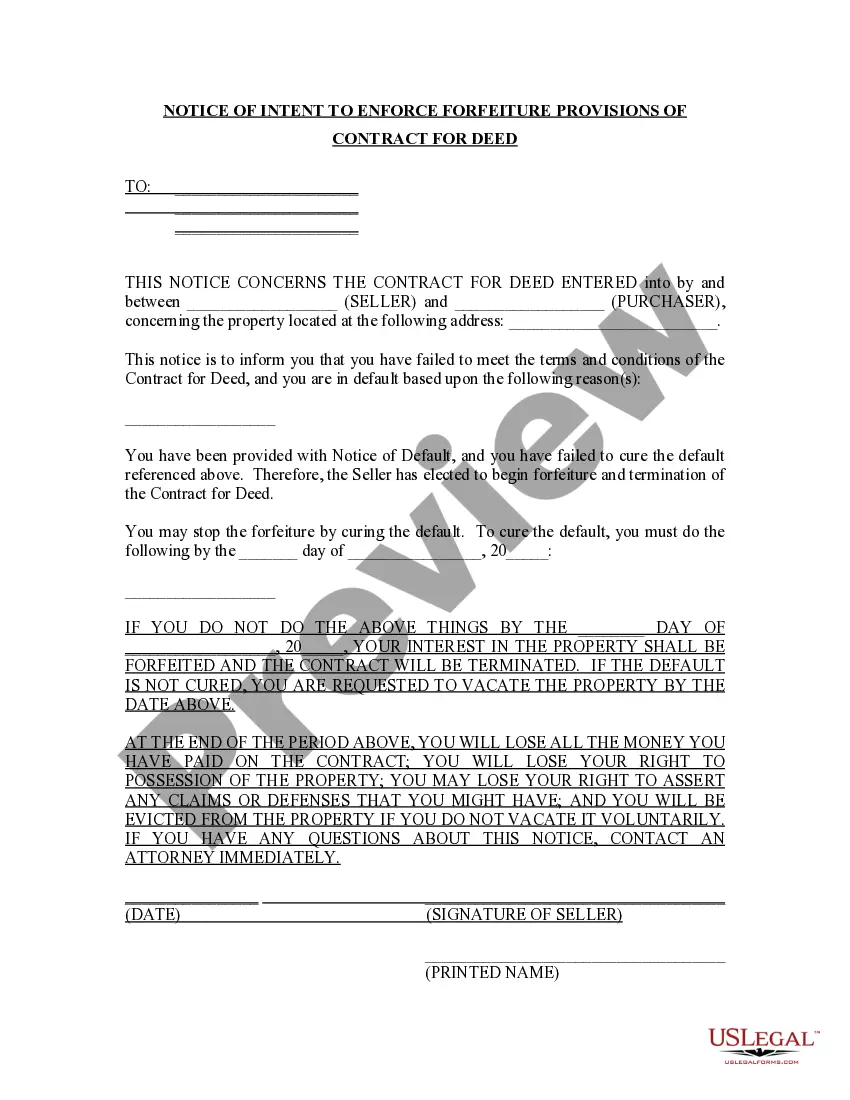
Nebraska Notice of Intent to Enforce Forfeiture Provisions of Contact for Deed
What this document covers
The Notice of Intent to Enforce Forfeiture Provisions of Contract for Deed is a formal document that notifies the buyer of a Contract for Deed that they are in default. This form is essential when the buyer has failed to comply with the agreements laid out in the contract, particularly concerning payment. Unlike other notices, this form specifically addresses the seller's intention to enforce forfeiture remedies, which can lead to the termination of the agreement if the breach is not resolved.
Form components explained
- Identification of the parties involved - specifies the seller and buyer.
- Details of the Contract for Deed - outlines the essential terms and conditions referenced.
- Specific reasons for default - clearly states the grounds on which the buyer is in default.
- Notice period - indicates the time frame within which the buyer has to remedy the default.
- Seller's intent - explicitly expresses the seller's desire to enforce forfeiture provisions.
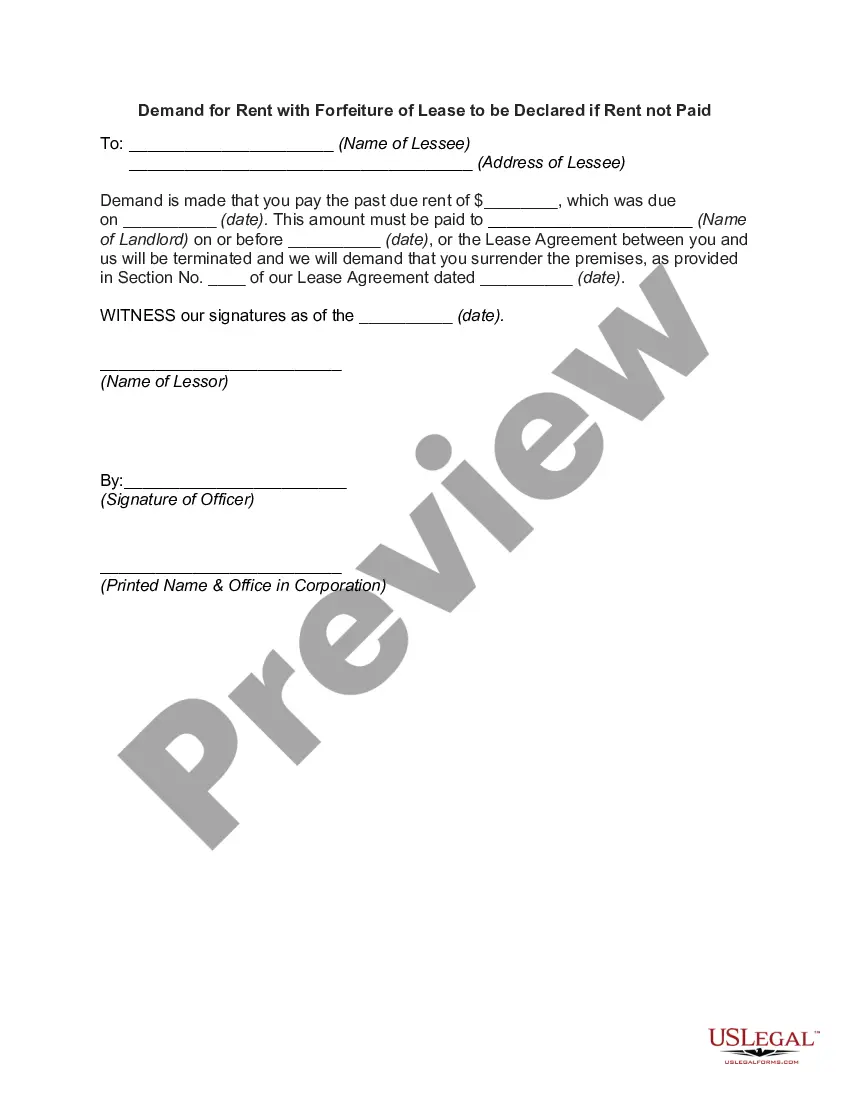

When this form is needed
This form should be used when a buyer of a property under a Contract for Deed is not making payments or is otherwise breaching the contract terms. The seller must issue this notice before pursuing further legal actions related to the contract, such as eviction or terminating the agreement. It is a vital step in protecting the seller's rights under the contract.
Who should use this form
- Sellers of property under a Contract for Deed seeking to enforce their legal rights.
- Real estate agents or attorneys representing sellers in such agreements.
- Buyers who have received this notice and need to understand their rights and obligations.
How to complete this form
- Identify the seller and buyer, ensuring correct spelling of names.
- Provide details about the property covered by the Contract for Deed.
- List specific defaults or breaches the buyer has committed.
- State the deadline for remedying the default, along with any other necessary actions.
- Sign and date the notice before sending it to the buyer.
Is notarization required?
This form does not typically require notarization unless specified by local law. However, verifying the requirements in your specific jurisdiction is crucial to ensure compliance.
Get your form ready online
Our built-in tools help you complete, sign, share, and store your documents in one place.
Make edits, fill in missing information, and update formatting in US Legal Forms—just like you would in MS Word.
Download a copy, print it, send it by email, or mail it via USPS—whatever works best for your next step.
Sign and collect signatures with our SignNow integration. Send to multiple recipients, set reminders, and more. Go Premium to unlock E-Sign.
If this form requires notarization, complete it online through a secure video call—no need to meet a notary in person or wait for an appointment.
We protect your documents and personal data by following strict security and privacy standards.

Make edits, fill in missing information, and update formatting in US Legal Forms—just like you would in MS Word.

Download a copy, print it, send it by email, or mail it via USPS—whatever works best for your next step.

Sign and collect signatures with our SignNow integration. Send to multiple recipients, set reminders, and more. Go Premium to unlock E-Sign.

If this form requires notarization, complete it online through a secure video call—no need to meet a notary in person or wait for an appointment.

We protect your documents and personal data by following strict security and privacy standards.
Avoid these common issues
- Failing to provide a clear description of the defaults.
- Not including the correct names of the parties involved.
- Omitting the deadline for remedying the default.
- Neglecting to send the notice to the correct address.
Advantages of online completion
- Convenience of accessing the form anytime and anywhere.
- Editability allows for customization to suit specific circumstances.
- Reliability of professionally drafted legal documents by licensed attorneys.
What to keep in mind
- The notice serves as a critical first step in enforcing the forfeiture of a contract for deed.
- Completing the form accurately is crucial to ensuring the buyer understands their default and the actions required.
- Using the form online provides convenience and reliability in legal document preparation.
Looking for another form?
Form popularity
FAQ
The seller retains legal title to the real property until the purchaser fully pays off the loan, at which point the seller records a deed transferring legal title to the purchaser. A purchaser under an installment land contract is usually not protected by foreclosure statutes as with a mortgage or deed of trust.
What is the result of courts and legislators limiting sellers' rights to forfeiture under land contracts? The simplicity of the alternative financing through land contracts may be disappearing.
Monetary Damages If the Seller decides to breach the contract and keep their home, they may do so, but the court may order the Buyer receive money for the resulting breach. Generally, the money owed to Buyer may include reimbursing the Buyer with: The buyer's temporary housing costs.
In the first instance, if your deed is not recorded, there is nothing in the public record to stop the seller from conveying the property to another person.The second situation could happen if your seller fails to pay his or her debts and the seller's creditors file liens or judgments against your property.
If a seller defaults, he must return all deposits, plus added reasonable expenses, to the buyer. The other party may also seek to compel the erring party to complete the deal under specific performance. From a buyer's point of view, it is advisable to get the sale agreement registered.
This means that if you default and can?t make your payments, you lose the property and all of the money you have already paid into it (often including repairs and improvements). Unlike a traditional mortgage, a defaulting buyer in a contact for deed may only have 30-60 days to cure the default or move out.
Contact the other party and ask whether they are willing to negotiate the cancellation of the contract. Offer the other party an incentive to cancel the contract for deed.
If a buyer backs out of a transaction without invoking her rights under a contingency, the seller could sue her to force the sale to move forward or for damages. To avoid this risk, most contracts contain a clause that allows the seller to keep the buyer's deposit if the buyer backs out.
A disadvantage to the seller is that a contract for deed is frequently characterized by a low down payment and the purchase price is paid in installments instead of one lump sum. If a seller needs funds from the sale to buy another property, this would not be a beneficial method of selling real estate.