New Hampshire Notice of Dishonored Check - Civil - Keywords: bad check, bounced check
About this form
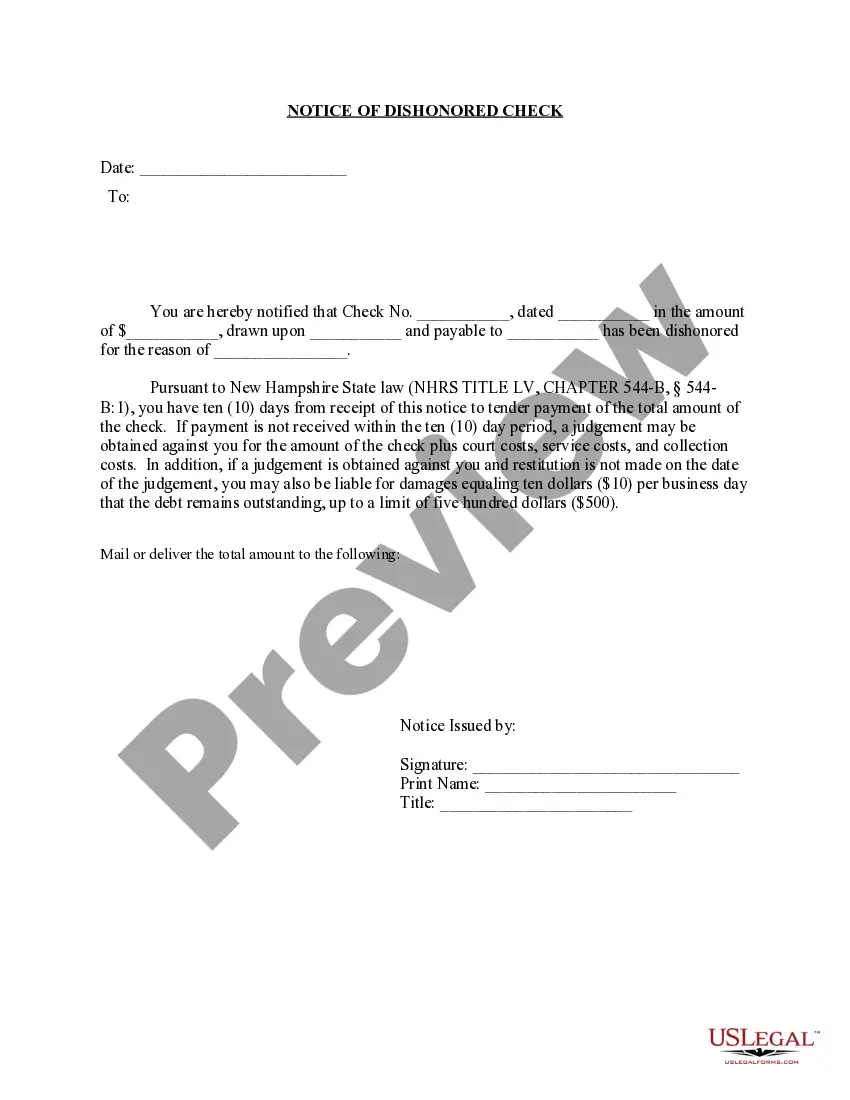
This Notice of Dishonored Check is a formal document that notifies a debtor that a check they issued has bounced, commonly referred to as a bad check. This notice serves the purpose of informing the debtor of their financial obligation and initiating the recovery process before legal actions are pursued. It is crucial for businesses and individuals to understand how this form functions as a legal instrument distinct from other debt recovery methods.
Key components of this form
- Details of the check, including the amount and date.
- Information about the debtor, including name and address.
- A statement regarding the bounced check and its implications.
- Notification period for the debtor to make payment.
- Consequences of failing to pay within the specified timeframe.


When to use this document
This form should be used when a check you received has been returned by the bank due to insufficient funds or the account being closed. It is essential for businesses and individuals to issue this notice promptly to the debtor to seek recovery of the amount owed before taking further legal action.
Who this form is for
This form is intended for:
- Business owners who have received a bounced check from a customer.
- Individuals who have encountered issues with a bad check from another party.
- Debt collectors seeking to notify debtors of their obligations.
Steps to complete this form
- Identify the parties involved, including your name and the debtor's name.
- Enter the check details, including the date issued and the amount.
- State the reason for the dishonor (e.g., insufficient funds, closed account).
- Specify the deadline for payment as per the state law requirements.
- Sign and date the notice to formalize your notification to the debtor.
Notarization requirements for this form
In most cases, this form does not require notarization. However, some jurisdictions or signing circumstances might. US Legal Forms offers online notarization powered by Notarize, accessible 24/7 for a quick, remote process.
Get your form ready online
Our built-in tools help you complete, sign, share, and store your documents in one place.
Make edits, fill in missing information, and update formatting in US Legal Forms—just like you would in MS Word.
Download a copy, print it, send it by email, or mail it via USPS—whatever works best for your next step.
Sign and collect signatures with our SignNow integration. Send to multiple recipients, set reminders, and more. Go Premium to unlock E-Sign.
If this form requires notarization, complete it online through a secure video call—no need to meet a notary in person or wait for an appointment.
We protect your documents and personal data by following strict security and privacy standards.

Make edits, fill in missing information, and update formatting in US Legal Forms—just like you would in MS Word.

Download a copy, print it, send it by email, or mail it via USPS—whatever works best for your next step.

Sign and collect signatures with our SignNow integration. Send to multiple recipients, set reminders, and more. Go Premium to unlock E-Sign.

If this form requires notarization, complete it online through a secure video call—no need to meet a notary in person or wait for an appointment.

We protect your documents and personal data by following strict security and privacy standards.
Common mistakes
- Failing to provide correct details about the check, which can delay the recovery process.
- Not adhering to the state-mandated notification period, possibly affecting legal standing.
- Neglecting to keep a copy of the notice for your records.
Why use this form online
- Convenient access allows you to complete the notice quickly from anywhere.
- Editable templates let you customize the form to fit your specific situation.
- Reliable resources ensure that your form adheres to legal standards.
Legal use & context
- A valid Notice of Dishonored Check serves as evidence of the debtor's awareness of the bounced check.
- Proper use of this form can help in recovering debts without needing to resort to court procedures immediately.
- Following the state guidelines enhances the enforceability of the notice.
Main things to remember
- A Notice of Dishonored Check is essential for notifying the issuer of insufficient funds.
- Timely and accurate completion of the form can support the recovery of funds.
- State laws may dictate specific requirements that must be followed for validity.
Looking for another form?

Form popularity
FAQ
When there are insufficient funds in an account, and a bank decides to bounce a check, it charges the account holder an NSF fee. If the bank accepts the check, but it makes the account negative, the bank charges an overdraft (OD) fee. If the account stays negative, the bank may charge an extended overdraft fee.
The amount of time merchants can allot for you to pay off a bounced check is rooted mainly in state laws. Familiarize yourself with your state's law and act accordingly in terms of paying of the bad check. In general, laws allow for bad check writers to be given anywhere from two to three years to pay their debt.
Writing a bad check, also known as a hot check, is illegal. Banks normally charge a fee to anyone who writes a bad check unintentionally. The punishment for trying to pass a bad check intentionally ranges from a misdemeanor to a felony.
Whether you write or receive a bounced check also called a nonsufficient funds, or NSF, check it will cost you. Write one and you'll owe your bank an NSF fee of between $27 and $35, and the recipient of the check is permitted to charge a returned-check fee of between $20 and $40 or a percentage of the check amount.
As defined under California Penal Code Section 476a, writing a check while knowing that funds are insufficient can be charged as a misdemeanor offense that can result in sentence of up to one year in county jail.
Balance your checking account so that you know how much you have to spend. Review account balances before you spend. Use a budget so that you know where every dollar goes before you even get it. Stop electronic payments if they're tripping you up.
If a cheque bounces due to insufficient funds or any other technical reason, such as signature mismatch, their respective banks charges for both the defaulter and the payee. The penalty charges for cheque outward return are close to Rs. 300 for most banks, while charges for cheque inward return are about Rs. 100.
When there are insufficient funds in an account, and a bank decides to bounce a check, it charges the account holder an NSF fee. If the bank accepts the check, but it makes the account negative, the bank charges an overdraft (OD) fee. If the account stays negative, the bank may charge an extended overdraft fee.