New Mexico Revocation of Transfer on Death Deed or TOD - Beneficiary Deed for Individual to Individual
What this document covers
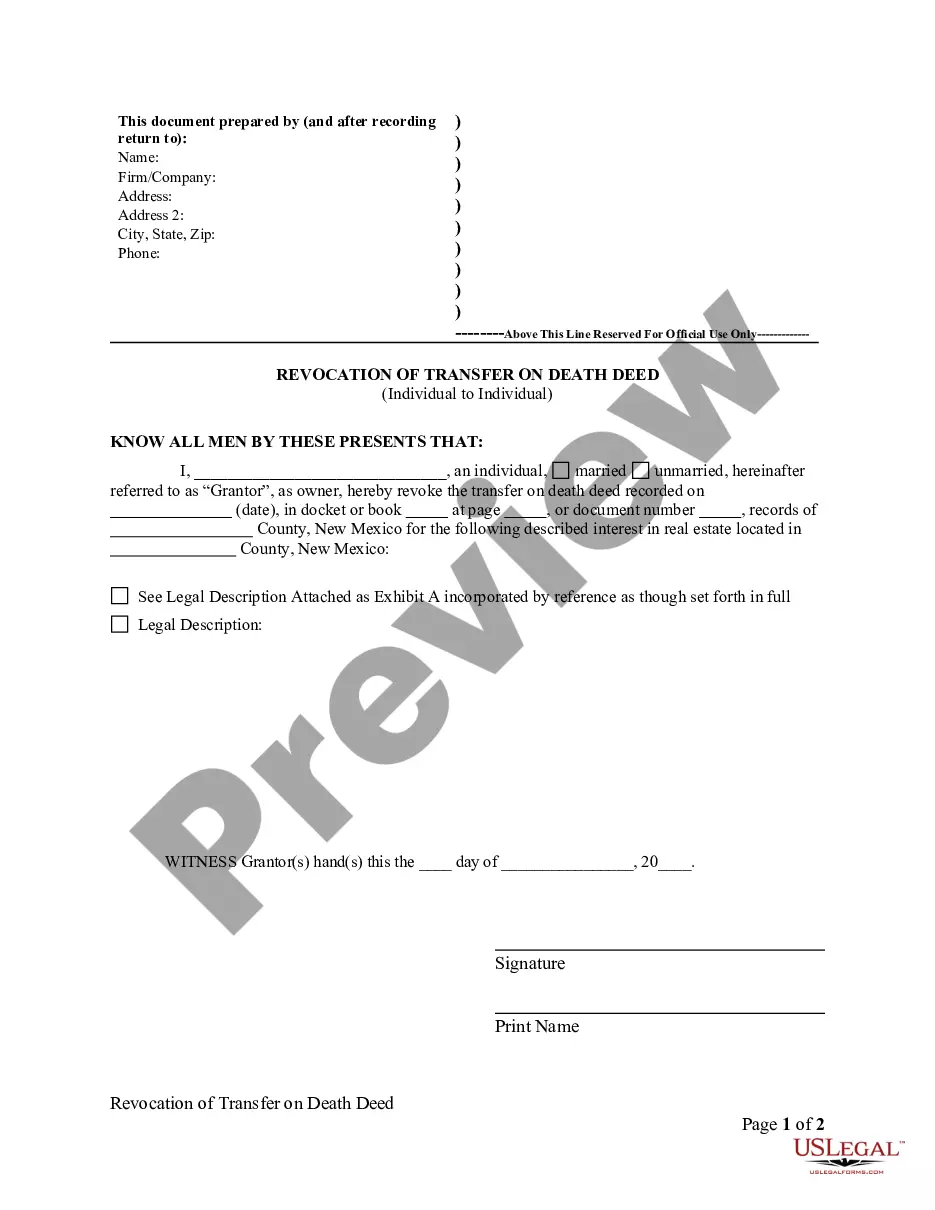
The Revocation of Transfer on Death Deed or TOD - Beneficiary Deed allows an individual to formally revoke a previously executed transfer on death deed. Unlike other estate planning documents, this specific form terminates the beneficiary designation before the owner's death. It is critical for individuals who wish to change their estate plans without the need for consent from the beneficiary.
Key components of this form
- Description of the property being revoked.
- Identification of the original transfer on death deed.
- Details of the record owner making the revocation.
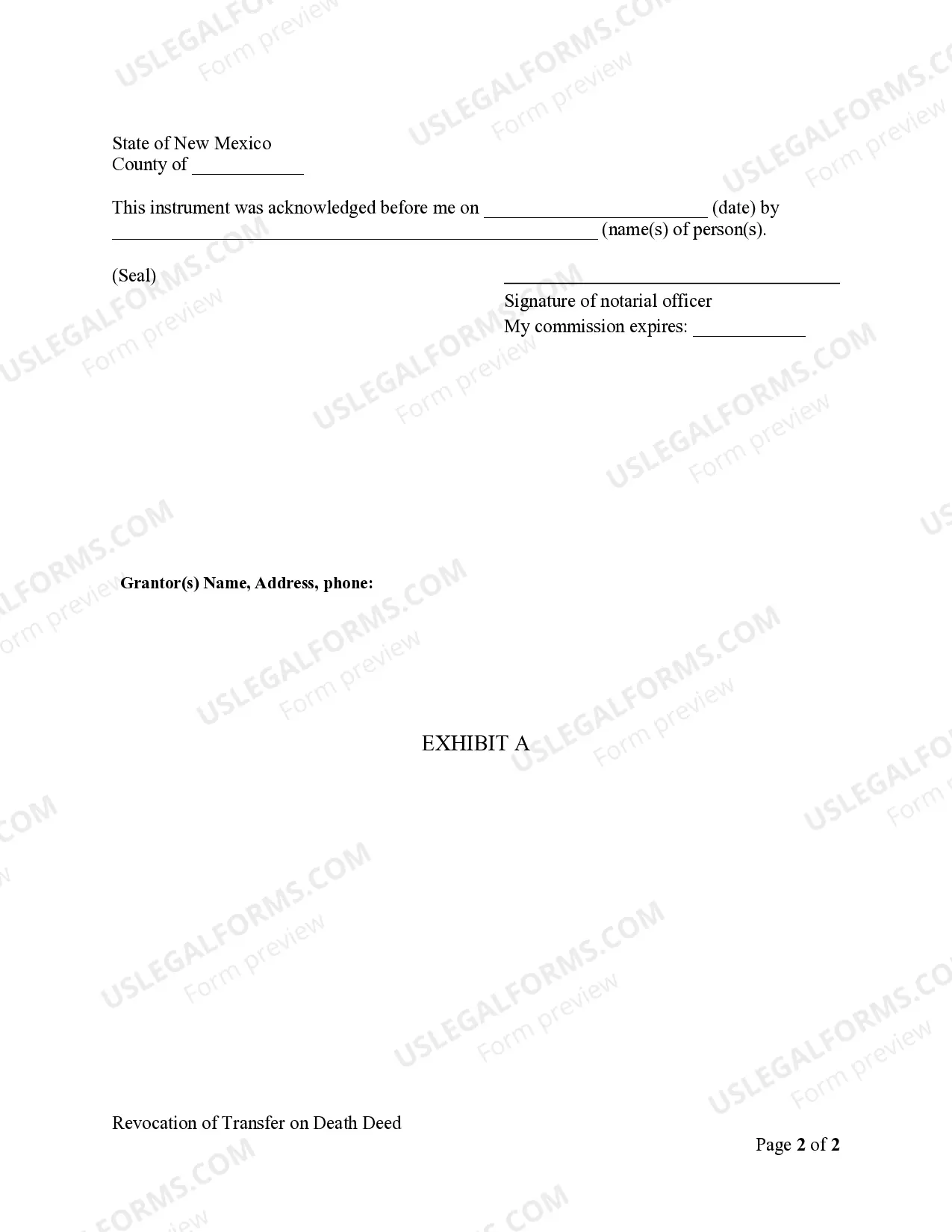
- Signature requirements for the recording in county clerk's office.





Common use cases
Use this form when you want to revoke a previously registered transfer on death deed. This situation may arise if you decide to change the designated beneficiary, sell the property, or amend your estate planning strategy. It is advisable to complete this revocation before your passing to ensure clarity of your wishes regarding the property.
Who needs this form
- Individuals who are the record owners of real property.
- Those who have previously executed a transfer on death deed.
- People seeking to alter their estate plans regarding specific properties.
Completing this form step by step
- Identify the property you are revoking the transfer on death deed for.
- Include a reference to the original transfer on death deed.
- Fill in your full name and contact information as the record owner.
- Sign the form in the presence of a notary (if applicable).
- File the completed form with the county clerk in the relevant jurisdiction.
Does this form need to be notarized?
This form must be notarized to be legally valid. US Legal Forms provides integrated online notarization, available 24/7 through a secure video call, ensuring legal equivalence without the need to travel.
Get your form ready online
Our built-in tools help you complete, sign, share, and store your documents in one place.
Make edits, fill in missing information, and update formatting in US Legal Forms—just like you would in MS Word.
Download a copy, print it, send it by email, or mail it via USPS—whatever works best for your next step.
Sign and collect signatures with our SignNow integration. Send to multiple recipients, set reminders, and more. Go Premium to unlock E-Sign.
If this form requires notarization, complete it online through a secure video call—no need to meet a notary in person or wait for an appointment.
We protect your documents and personal data by following strict security and privacy standards.

Make edits, fill in missing information, and update formatting in US Legal Forms—just like you would in MS Word.

Download a copy, print it, send it by email, or mail it via USPS—whatever works best for your next step.

Sign and collect signatures with our SignNow integration. Send to multiple recipients, set reminders, and more. Go Premium to unlock E-Sign.

If this form requires notarization, complete it online through a secure video call—no need to meet a notary in person or wait for an appointment.

We protect your documents and personal data by following strict security and privacy standards.
Mistakes to watch out for
- Failing to record the revocation in the appropriate county office.
- Not including property details or references to the original deed.
- Assuming a revocation is effective without proper documentation.
Advantages of online completion
- Convenience of immediate access and download from your home.
- Edit the form easily to suit your specific circumstances.
- Reliable, attorney-reviewed templates ensure legal compliance.
Key takeaways
- The Revocation of Transfer on Death Deed is crucial for those wishing to change their beneficiary designations for real estate.
- It can be executed without the consent of the beneficiaries, providing a straightforward approach to estate planning.
- Proper filing and acknowledgment are essential for the revocation to be legally binding.
Looking for another form?
Form popularity
FAQ
Overall, New Mexico's statutory transfer on death deed is a flexible estate planning tool that allows owners of real property in the state to convey a potential future interest in real property to one or more beneficiaries.
You can contest that too, it turns out. The same legal principles that allow a will contest forgery, fraud, undue influence, for example also apply to changes in beneficiary designation.It's not unusual for someone to have a large portion of his or her assets in beneficiary designated accounts.
Get a Deed Form or Prepare Your Own. You can buy a state-specific TOD deed form for your state or type up your own document. Name the Beneficiary. Describe the Property. Sign the Deed. Record the Deed.
200dA transfer-on-death account set up for your mutual funds or securities directs who receives the funds after your passing. A TOD designation supersedes a will.Your beneficiaries can't touch the account while you're alive, and you're free to change beneficiaries or close the accounts at any time.
Receiving an inheritance can be an unexpected windfall. In fact, transfer on death accounts are exposed to all the same income and capital gains taxes when the account owner is alive, as well as estate and inheritance taxes upon the owner's death.
Because transfer-on-death beneficiary deeds do not become effective until you pass away, someone can challenge the validity of the deed after you die.Or, beneficiaries and family members can sue each other to take the property entirely. In this case, a court proceeding may be required to resolve the issue.
A transfer on death (TOD) account will avoid probate because assets transfer automatically to a beneficiary when the owner dies.
The bottom line: you have the right to contest a TOD Deed, just as you can a Will or Trust, but in many cases that will be no easy task.
A TOD designation supersedes a will. For bank accounts, you can set up a similar account known as payable-on-death, sometimes referred to as a Totten trust. Your beneficiaries can't touch the account while you're alive, and you're free to change beneficiaries or close the accounts at any time.