New York Quitclaim Deed from Individual to Corporation
What this document covers
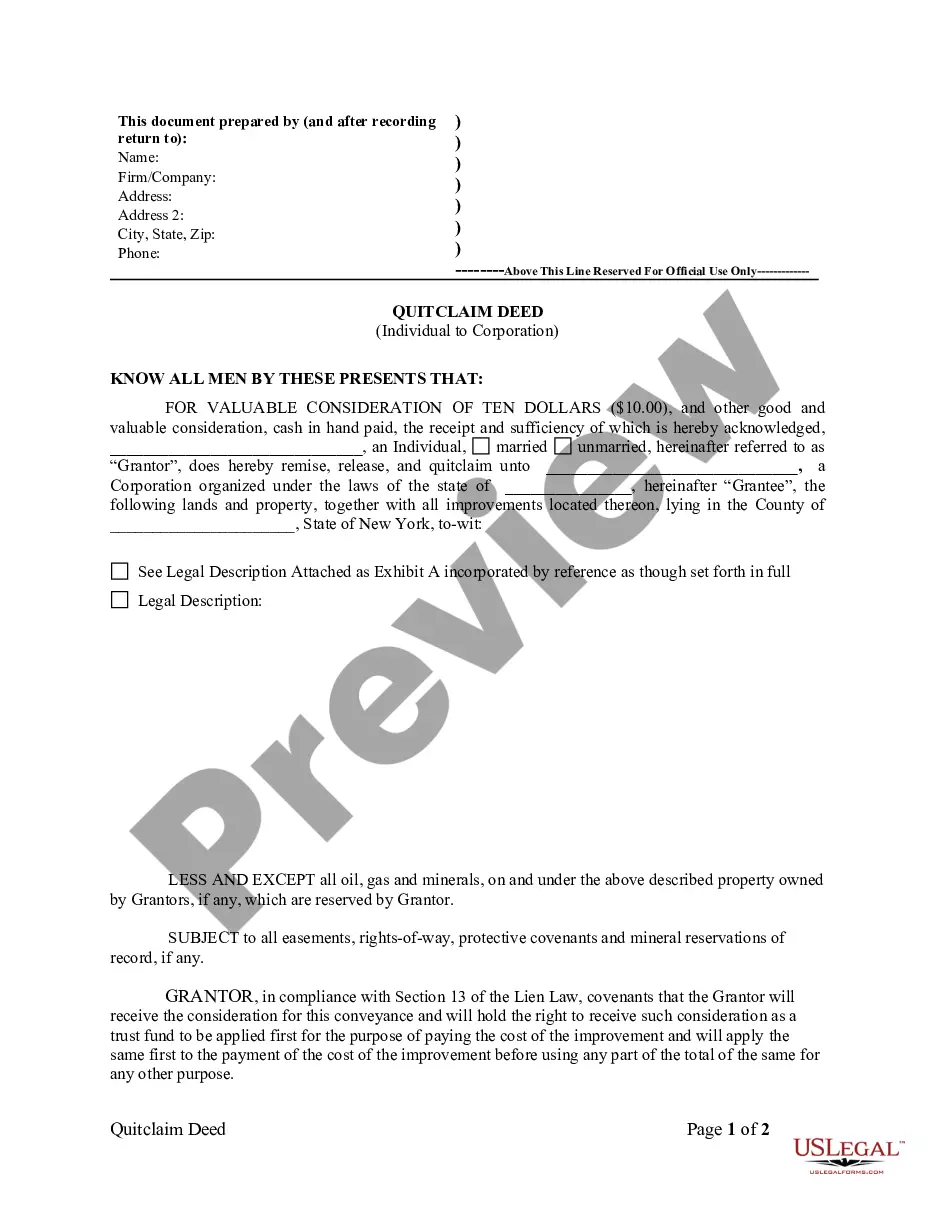
The Quitclaim Deed from Individual to Corporation is a legal document that allows an individual (the grantor) to transfer their ownership interest in a property to a corporation (the grantee) without making any warranties about the property title. This deed is particularly useful for situations where ownership needs to be transferred quickly and does not require the same level of scrutiny as a warranty deed. Unlike other deed types, a quitclaim deed does not guarantee that the grantor holds valid title to the property nor does it protect the grantee from potential claims against the property.
Key parts of this document
- Identification of the grantor and grantee: Names and details of the individual transferring the property and the corporation receiving it.
- Description of the property: Clear legal description of the property being transferred, often referenced as an exhibit.
- Reservation clause: Indicates that any oil, gas, and minerals beneath the property are retained by the grantor.
- Covenant of consideration: Statement confirming that the grantor will receive a defined consideration for the conveyance.
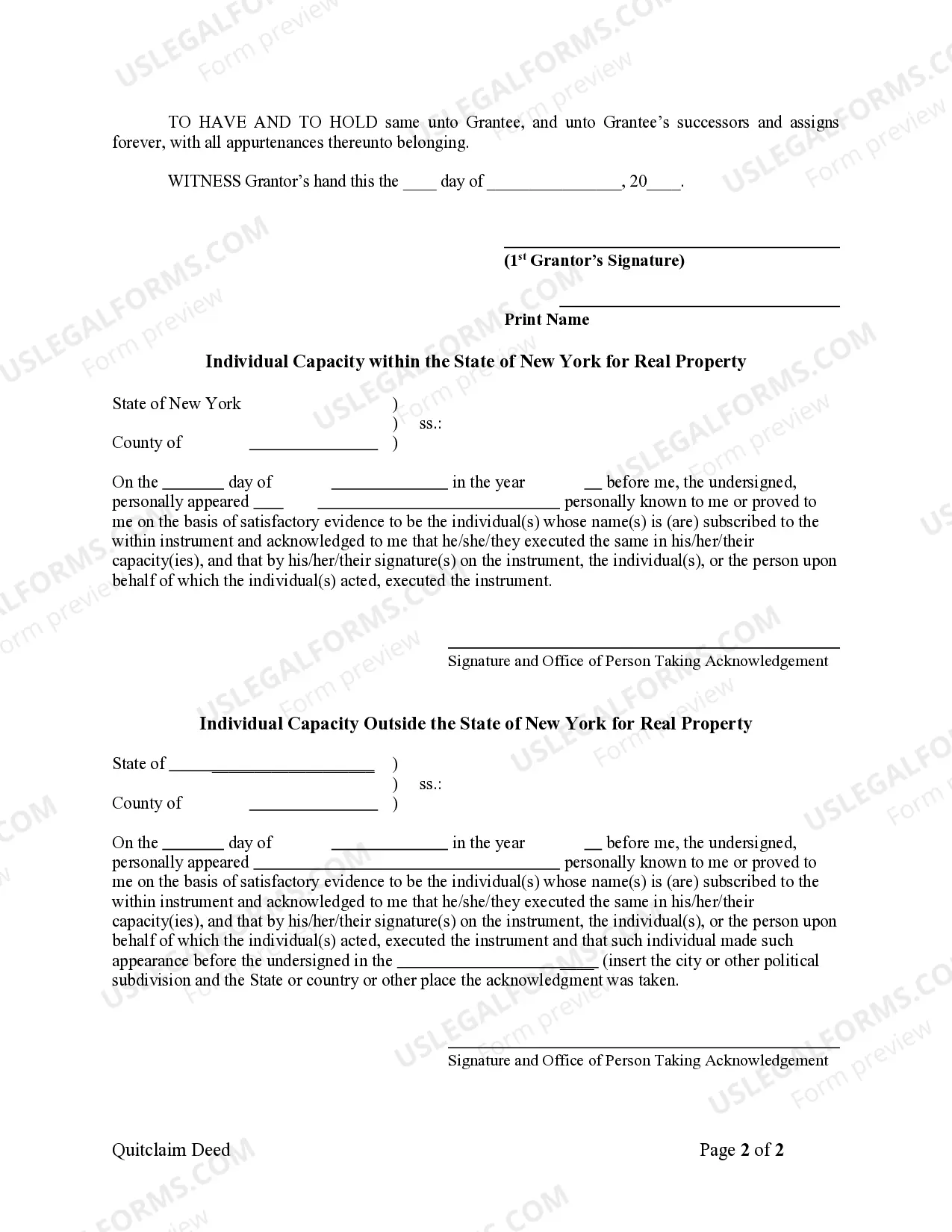
- Execution sections: Areas for signatures, dates, and witness information as required for legal validity.



Common use cases
This form is ideal when an individual wants to transfer property ownership to a corporation without specific warranties. Common situations include transferring assets into a business entity for liability protection, estate planning, or facilitating business operations. It is particularly suitable for non-complex transactions where quick transfers are needed.
Who can use this document
- Individuals who own real estate and wish to transfer it to a corporation.
- Business owners looking to consolidate property under their corporate entity.
- Real estate investors managing properties through a corporate structure.
- Legal professionals assisting clients with property transfers.
Steps to complete this form
- Identify the parties: Enter the full legal names of the grantor (individual) and grantee (corporation).
- Specify the property: Provide a complete legal description of the property being transferred.
- Include the consideration: State the amount or value received for the property transfer.
- Sign the deed: Ensure the grantor signs the deed in the presence of witnesses, if required.
- File with the county: Submit the completed quitclaim deed to the local county recorder's office.
Does this form need to be notarized?
This form does not typically require notarization unless specified by local law. However, having the deed notarized can enhance its legitimacy and ensure a smoother recording process with the county.
Get your form ready online
Our built-in tools help you complete, sign, share, and store your documents in one place.
Make edits, fill in missing information, and update formatting in US Legal Forms—just like you would in MS Word.
Download a copy, print it, send it by email, or mail it via USPS—whatever works best for your next step.
Sign and collect signatures with our SignNow integration. Send to multiple recipients, set reminders, and more. Go Premium to unlock E-Sign.
If this form requires notarization, complete it online through a secure video call—no need to meet a notary in person or wait for an appointment.
We protect your documents and personal data by following strict security and privacy standards.

Make edits, fill in missing information, and update formatting in US Legal Forms—just like you would in MS Word.

Download a copy, print it, send it by email, or mail it via USPS—whatever works best for your next step.

Sign and collect signatures with our SignNow integration. Send to multiple recipients, set reminders, and more. Go Premium to unlock E-Sign.

If this form requires notarization, complete it online through a secure video call—no need to meet a notary in person or wait for an appointment.

We protect your documents and personal data by following strict security and privacy standards.
Common mistakes to avoid
- Failing to provide a accurate legal description of the property.
- Not including the reservation clause for oil, gas, and minerals.
- Missing signatures or failing to have witnesses present when signing.
- Neglecting to file the deed with the appropriate local authority.
Benefits of using this form online
- Immediate access: Download and complete the form at your convenience.
- Editability: Easily modify the form to fit specific needs.
- Guidance: Provided templates are drafted by licensed attorneys for added reliability.
- Time-saving: Skip office visits and manage your legal documents from home.
Legal use & context
- This quitclaim deed transfers ownership without guarantees or warranties regarding the title.
- While useful for many types of property transfers, it may not be suitable where title issues are present.
- Always consult with a legal professional if unsure about the implications of using a quitclaim deed in your situation.
What to keep in mind
- The Quitclaim Deed from Individual to Corporation is designed for transferring property ownership with less formality than other deed types.
- It is crucial to complete the form correctly and understand local regulations related to property transfers.
- This form is most beneficial in straightforward transactions or when transferring property to a business entity.
Looking for another form?
Form popularity
FAQ
How to Quitclaim Deed to LLC. A quitclaim deed to LLC is actually a very simple process. You will need a deed form and a copy of the existing deed to make sure you identify titles properly and get the legal description of the property.
But you might be wondering if an owner can transfer a deed to another person without a real estate lawyer. The answer is yes. Parties to a transaction are always free to prepare their own deeds.A quitclaim deed, for example, is far simpler than a warranty deed.
Fees to File a Quitclaim Deed in New York As of 2018, the basic fee for filing a quitclaim deed of residential or farm property is $125, while the fee for all other property is $250. These fees are for the RP-5217 form.
Quitclaim deeds are most often used to transfer property between family members. Examples include when an owner gets married and wants to add a spouse's name to the title or deed, or when the owners get divorced and one spouse's name is removed from the title or deed.
Fill in the deed form. Print it out. Have the grantor(s) sign and get the signature(s) notarized. Complete a transfer tax form, Form TP-584. Complete and print out Form RP-5217 (or, if you are in New York City, Form RP-5217NYC).
However, there are substantial downsides associated with transferring your primary home into an LLC.If you are using your personal residence for estate planning purposes, a qualified personal residence trust (QPRT) may be more effective than transferring your property to a limited liability company.
The drawback, quite simply, is that quitclaim deeds offer the grantee/recipient no protection or guarantees whatsoever about the property or their ownership of it. Maybe the grantor did not own the property at all, or maybe they only had partial ownership.
A quitclaim deed is a legal instrument that is used to transfer interest in real property.The owner/grantor terminates (quits) any right and claim to the property, thereby allowing the right or claim to transfer to the recipient/grantee.