Wisconsin Public Demand for Payment by Corporation
What is this form?
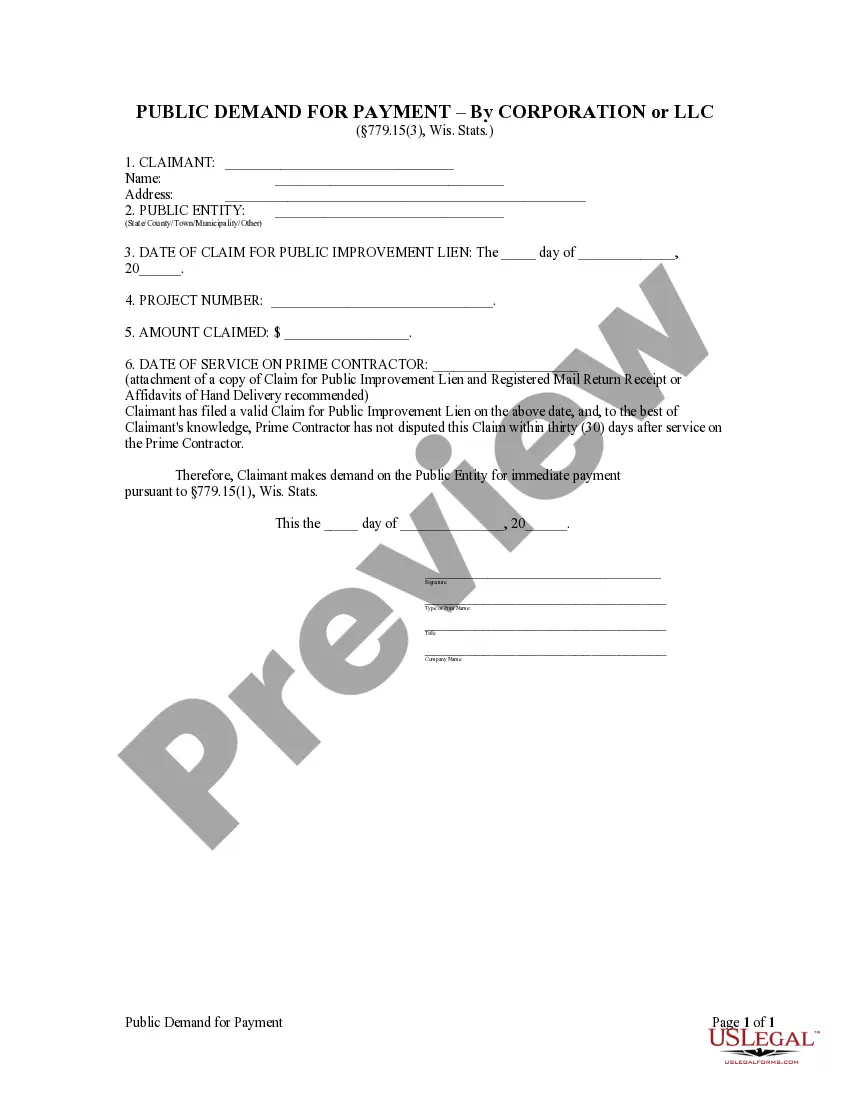
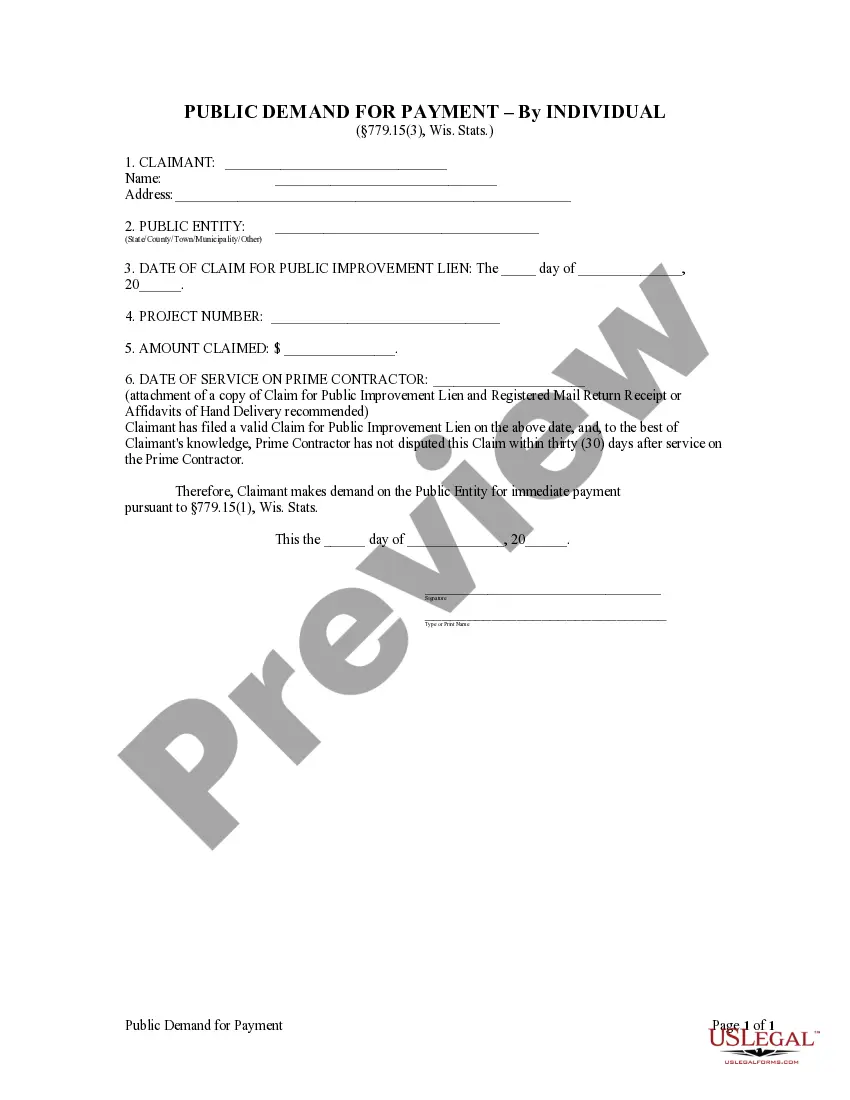
This Public Demand for Payment by Corporation form is a legal notice used in construction projects. It allows contractors to formally demand payment from a public entity when they have provided labor or materials but have not received payment. This form is different from other notices as it specifically addresses claims related to public improvement projects and outlines the process for notifying the relevant public entity regarding outstanding payments.
Main sections of this form
- Claimant details: Includes the name and address of the entity making the demand.
- Public entity information: Specifies the governmental body responsible for the project.
- Date of claim: Indicates when the demand for payment is made.
- Project number: Identifies the specific construction project related to the claim.
- Amount claimed: States the total amount owed to the claimant.
- Date of service on prime contractor: Records when the demand was delivered to the contractor.
- Claimant's signature: Confirms the demand's authenticity.

Situations where this form applies
Intended users of this form
- Prime contractors who have provided services or materials on a public construction project.
- Companies that have not received payment from a public entity after fulfilling their contractual obligations.
- Contractors who need to formally document their demand for payment to protect their rights.
Steps to complete this form
- Identify the claimant: Fill in the name and address of the entity making the demand.
- Specify the public entity: Indicate the name of the state, county, or municipality related to the project.
- Enter the date of the claim: Write the date you are making the demand for payment.
- Provide the project number: Include the unique identifier for the construction project.
- State the amount claimed: Clearly indicate the total sum that you are demanding for payment.
- Document the date of service: Note when the demand was delivered to the prime contractor.
- Sign and date the form: Ensure the form is signed by an authorized representative and include your title and corporation name.
Is notarization required?
In most cases, this form does not require notarization. However, some jurisdictions or signing circumstances might. US Legal Forms offers online notarization powered by Notarize, accessible 24/7 for a quick, remote process.
Get your form ready online
Our built-in tools help you complete, sign, share, and store your documents in one place.
Make edits, fill in missing information, and update formatting in US Legal Forms—just like you would in MS Word.
Download a copy, print it, send it by email, or mail it via USPS—whatever works best for your next step.
Sign and collect signatures with our SignNow integration. Send to multiple recipients, set reminders, and more. Go Premium to unlock E-Sign.
If this form requires notarization, complete it online through a secure video call—no need to meet a notary in person or wait for an appointment.
We protect your documents and personal data by following strict security and privacy standards.

Make edits, fill in missing information, and update formatting in US Legal Forms—just like you would in MS Word.

Download a copy, print it, send it by email, or mail it via USPS—whatever works best for your next step.

Sign and collect signatures with our SignNow integration. Send to multiple recipients, set reminders, and more. Go Premium to unlock E-Sign.

If this form requires notarization, complete it online through a secure video call—no need to meet a notary in person or wait for an appointment.

We protect your documents and personal data by following strict security and privacy standards.
Mistakes to watch out for
- Not providing complete information in the claimant or public entity sections.
- Failing to serve the demand within the required timeframe of ten days.
- Not including relevant project numbers related to the claim.
- Omitting necessary signatures or dates, rendering the form invalid.
Benefits of using this form online
- Convenience: Download the form instantly from anywhere without the need for a physical visit.
- Editability: Fill in the form digitally, ensuring accuracy and clarity.
- Reliability: Access legally sound forms drafted by licensed attorneys, ensuring compliance with state-specific laws.
Legal use & context
- This form is used to establish a formal notice for payment claims on public improvements.
- Failure to file the demand properly may compromise your rights to receive payment.
- Understanding the legal context can significantly aid in enforcing your rights effectively.
Looking for another form?
Form popularity
FAQ
An LLC can achieve pass-through taxation status without any of those restrictions. LLCs also offer more income tax choices in how you are taxed. By default, LLCs enjoy pass-through taxation under IRS rules. However, by making an IRS election, you could have your LLC taxed as a C corporation or an S Corporation.
LLC owners must pay self-employment taxes for all income. S-corp owners may pay less on this tax, provided they pay themselves a "reasonable salary." LLCs can have an unlimited number of members, while S-corps are limited to 100 shareholders.
In an LLC, individuals with an ownership share are called members. In a corporation, they are called shareholders. One of the advantages an LLC has over a corporation is that in many states, a creditor cannot collect a member's dividends, whereas in a corporation dividends can be collected from shareholders.
One of the main reasons to form a corporation or LLC for a small business is to avoid personal liability for the business' debts. As we mentioned earlier, corporations and LLCs have their own legal existence. It's the corporation or LLC that owns the business, its assets, debts, and liabilities.
Probably the most obvious advantage to forming an LLC is protecting your personal assets by limiting the liability to the resources of the business itself. In most cases, the LLC will protect your personal assets from claims against the business, including lawsuits.There is also the tax benefit to an LLC.
A limited liability company (LLC) is not a separate tax entity like a corporation; instead, it is what the IRS calls a "pass-through entity," like a partnership or sole proprietorship.The LLC itself does not pay federal income taxes, although some states impose an annual tax on LLCs.
Because distributions are taxed at both the corporate and the shareholder level, C corporations and their shareholders often end up paying more in taxes than S corporations or LLCs.