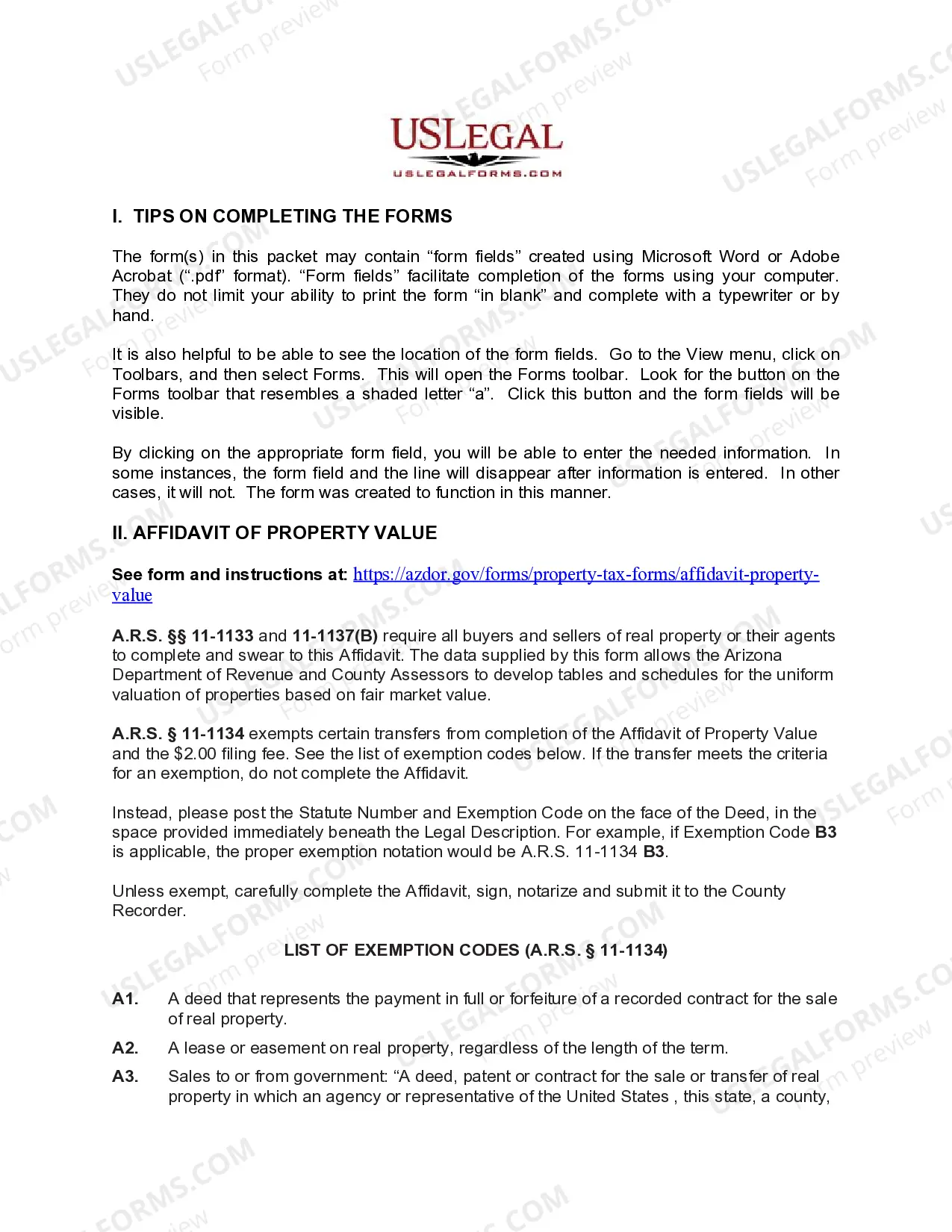
Arizona Transfer on Death Deed or TOD - Beneficiary Deed for Husband and Wife to Individual
What this document covers
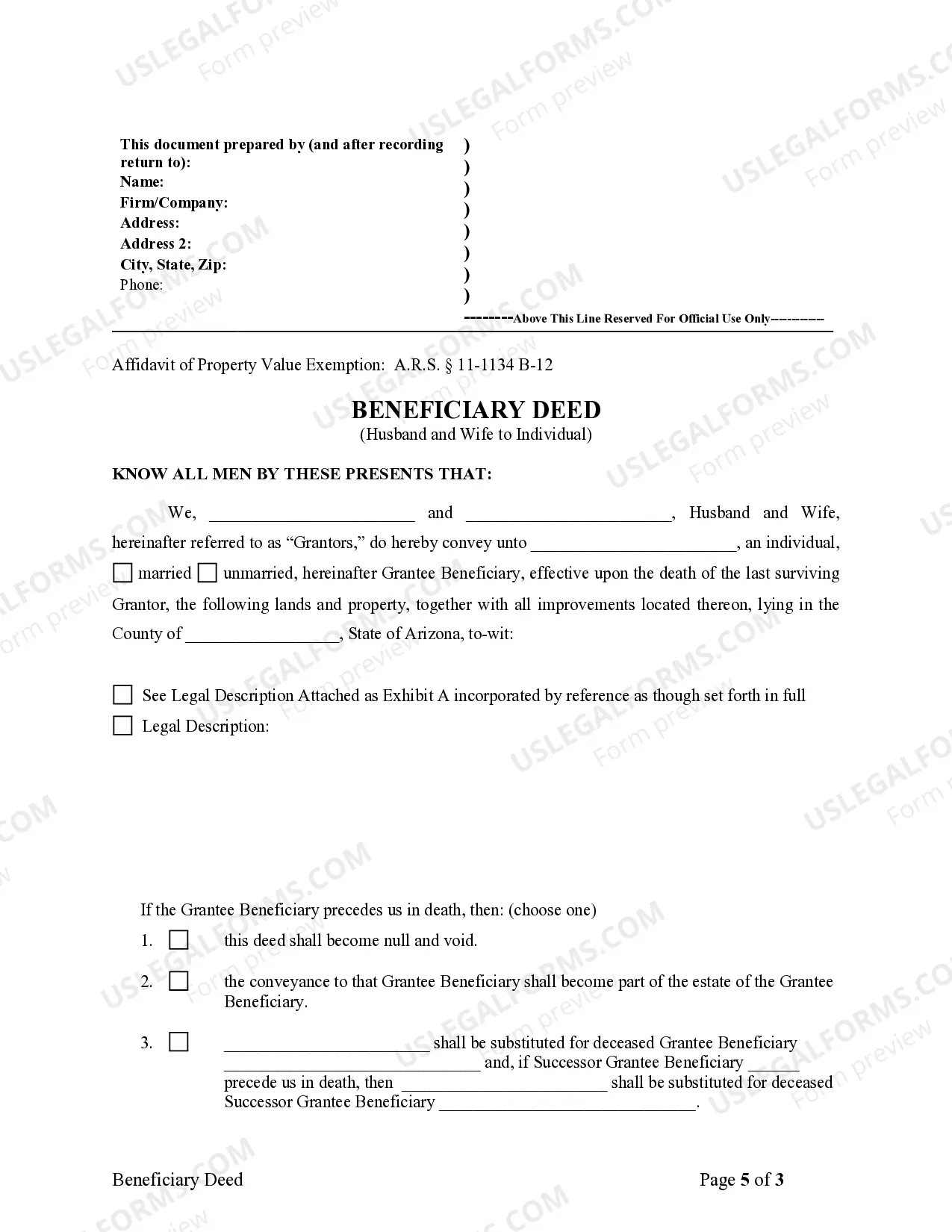
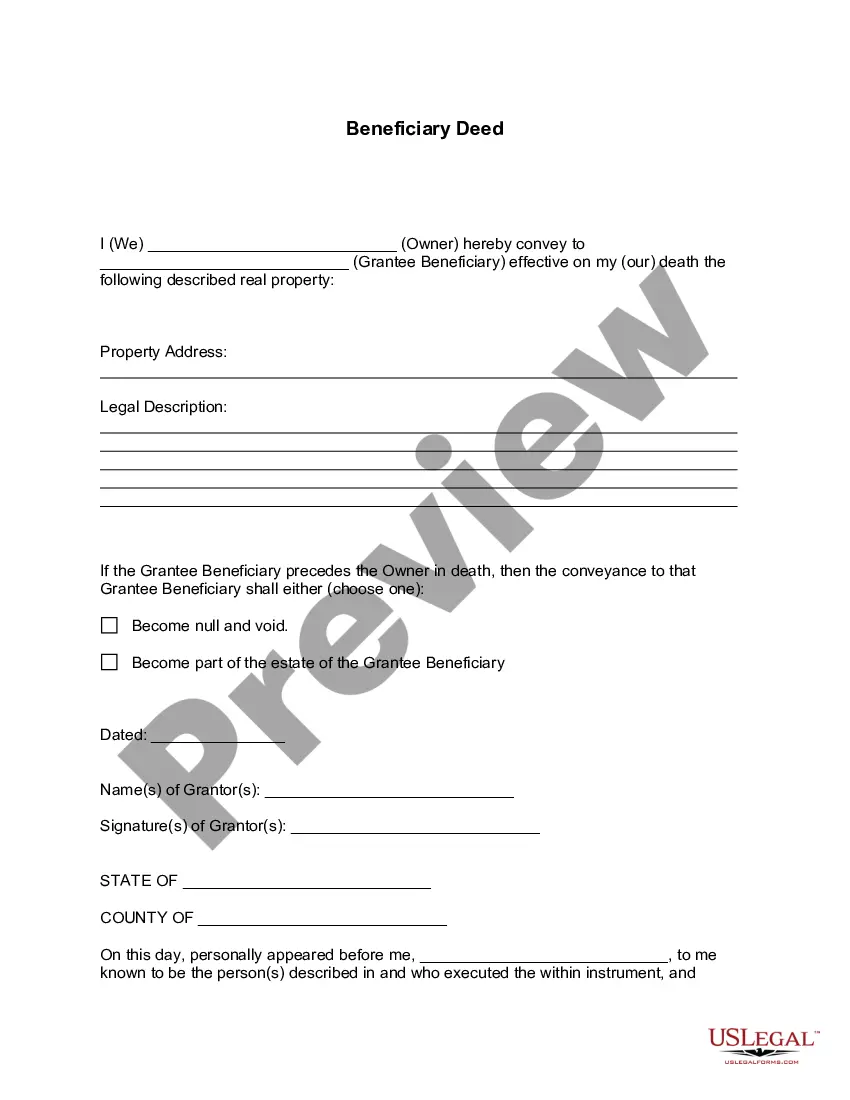
The Transfer on Death Deed (TOD) for Husband and Wife to Individual is a legal document used in Arizona to facilitate the transfer of real estate ownership upon the death of the last surviving grantor. Unlike a traditional deed, this form does not convey any current ownership interests, allowing the grantors to keep control of the property during their lifetime. The main advantage of using this TOD deed is to avoid the probate process, which can be time-consuming and costly for heirs.
Main sections of this form
- Identification of the grantors (husband and wife) and the grantee (individual beneficiary).
- Legal description of the property being transferred, referenced in an attached exhibit.
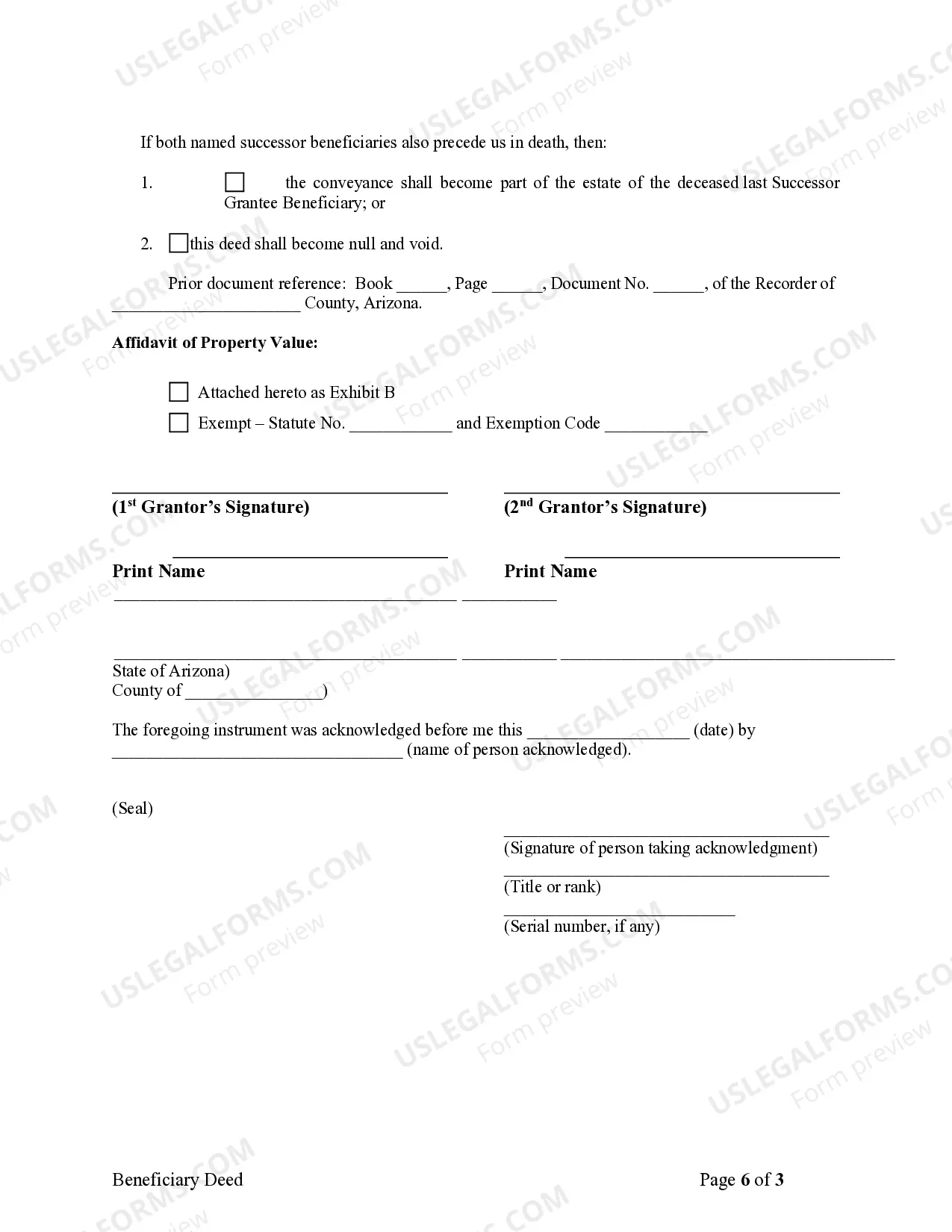
- Provisions for successor beneficiaries in the event the primary grantee predeceases the grantors.
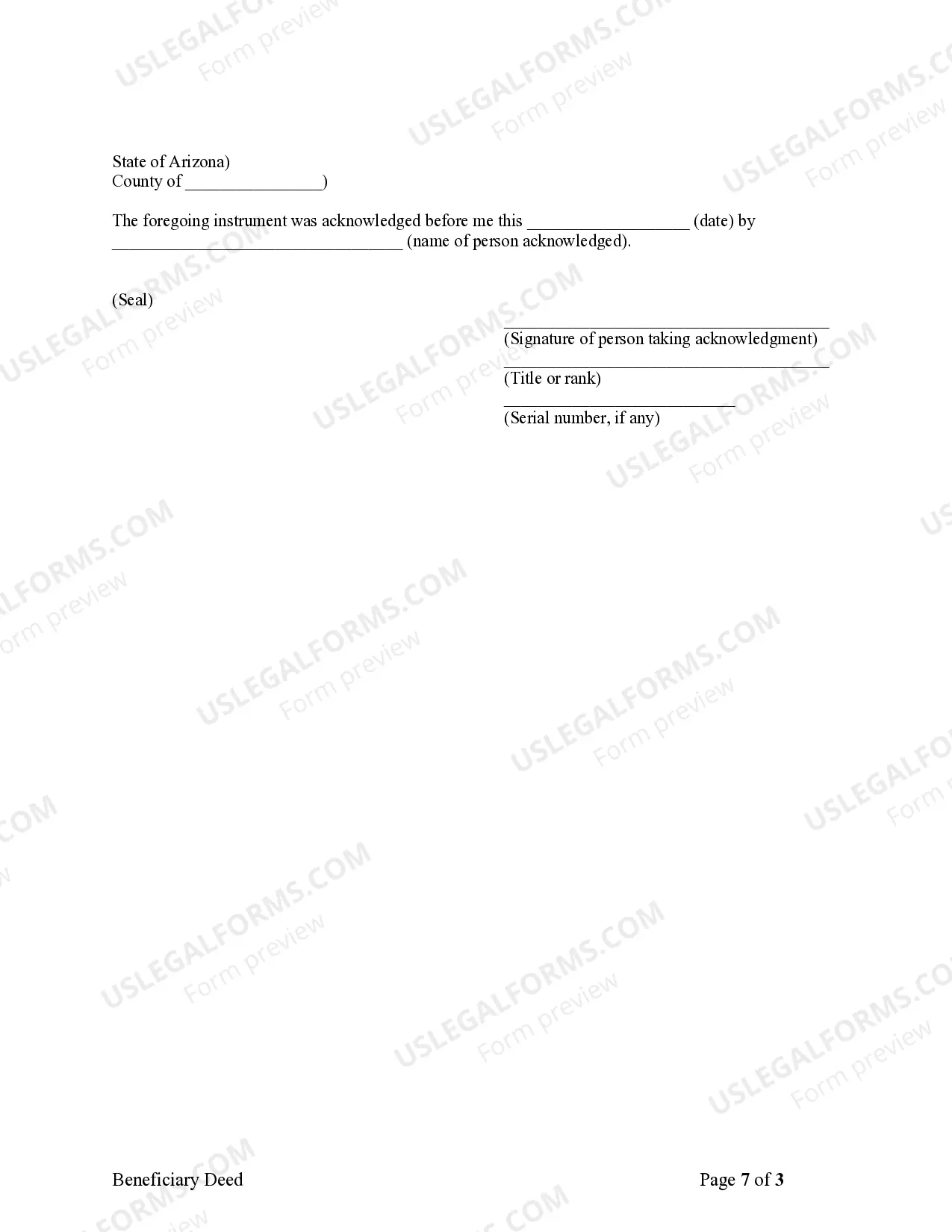
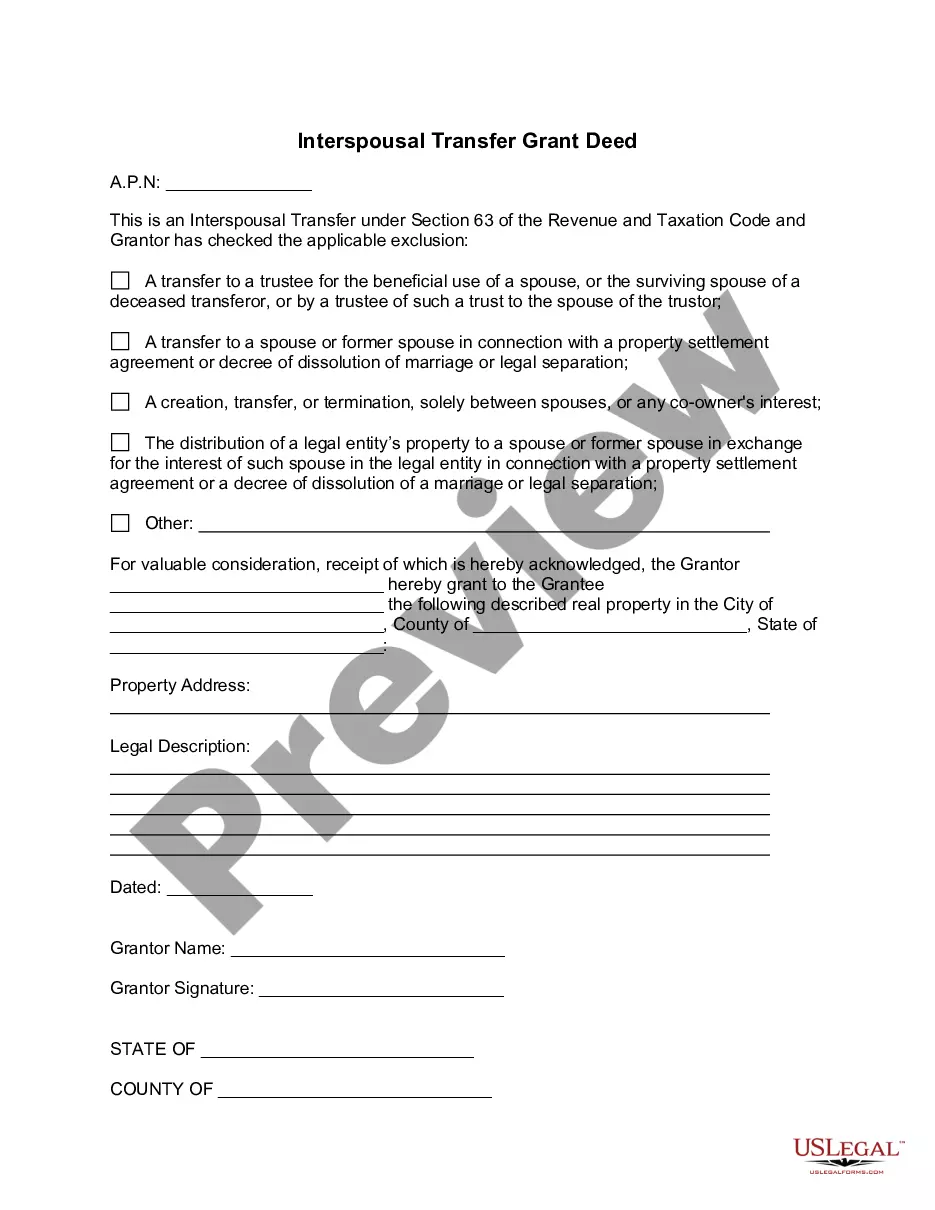
- Signatures of both grantors and a notary public for validation.
- Reference to prior ownership documents to establish clear title.




When this form is needed
This form is ideally used when a married couple wants to ensure that their property is directly transferred to an individual beneficiary upon the death of the last surviving spouse. It is particularly useful for homeowners looking to minimize their estate's exposure to probate, thereby simplifying the transition of property ownership for their heirs.
Who this form is for
- Married couples who jointly own real estate and wish to designate a specific individual to inherit property.
- Individuals looking to avoid the probate process for their real estate assets.
- Homeowners in Arizona seeking a straightforward way to transfer property to a beneficiary upon death.
Instructions for completing this form
- Identify the parties involved by entering the full names of both grantors and the individual grantee.
- Specify the property to be transferred by providing its legal description, as detailed in an attached exhibit.
- Include the signatures of both grantors in the designated areas at the end of the document.
- Have the document notarized by a licensed notary public to ensure legal validity.
- Reference previous property documentation to establish the continuity of ownership.
Notarization requirements for this form
This form needs to be notarized to ensure legal validity. US Legal Forms provides secure online notarization powered by Notarize, allowing you to complete the process through a verified video call, available anytime.
Get your form ready online
Our built-in tools help you complete, sign, share, and store your documents in one place.
Make edits, fill in missing information, and update formatting in US Legal Forms—just like you would in MS Word.
Download a copy, print it, send it by email, or mail it via USPS—whatever works best for your next step.
Sign and collect signatures with our SignNow integration. Send to multiple recipients, set reminders, and more. Go Premium to unlock E-Sign.
If this form requires notarization, complete it online through a secure video call—no need to meet a notary in person or wait for an appointment.
We protect your documents and personal data by following strict security and privacy standards.

Make edits, fill in missing information, and update formatting in US Legal Forms—just like you would in MS Word.

Download a copy, print it, send it by email, or mail it via USPS—whatever works best for your next step.

Sign and collect signatures with our SignNow integration. Send to multiple recipients, set reminders, and more. Go Premium to unlock E-Sign.

If this form requires notarization, complete it online through a secure video call—no need to meet a notary in person or wait for an appointment.

We protect your documents and personal data by following strict security and privacy standards.
Avoid these common issues
- Failing to clearly identify the legal description of the property.
- Not obtaining notarization, which is essential for legal enforceability.
- Neglecting to specify successor beneficiaries, which can lead to complications in the event of multiple deaths.
- Not updating the deed if the grantors' circumstances change (e.g., divorce or changes in beneficiaries).
Why use this form online
- Convenience of downloading and completing the form from anywhere, at any time.
- Editability allows users to make necessary changes easily before finalizing.
- Reliability of using a form drafted by licensed attorneys, ensuring compliance with legal standards.
- Transparent process with clear guidance on completing the form correctly.
Main things to remember
- The Transfer on Death Deed allows married couples to transfer property to a chosen beneficiary upon death without going through probate.
- It is essential to correctly identify all parties and provide a legal description of the property to avoid ambiguity.
- Notarization is a required step to finalize and validate the deed for legal purposes.
Looking for another form?
Form popularity
FAQ
To transfer a property deed from a deceased relative in Arizona, begin by obtaining a copy of the death certificate. Next, file an Affidavit of Death along with the property deed with the county recorder's office. If applicable, make sure to check if a Transfer on Death Deed or TOD - Beneficiary Deed for Husband and Wife to Individual was executed, as this can greatly simplify the transfer process.
When a spouse dies in Arizona, the surviving spouse typically inherits the house if they were joint owners. In cases where a Transfer on Death Deed exists, the designated beneficiary will receive the property directly. Therefore, it's essential to consider an Arizona Transfer on Death Deed or TOD - Beneficiary Deed for Husband and Wife to Individual to ensure your wishes are clearly stated.
Yes, Arizona does allow for Transfer on Death Deeds, making it simple to pass property to your beneficiaries without going through probate. This type of deed is particularly beneficial for couples, as it streamlines the transition of ownership. Utilizing an Arizona Transfer on Death Deed or TOD - Beneficiary Deed for Husband and Wife to Individual can provide peace of mind knowing your property will transfer as intended.
To remove a deceased spouse from a deed in Arizona, you need to file an Affidavit of Death with the county recorder's office. This document provides proof of death and allows you to update the property records. It is advisable to consult with an attorney for guidance on completing this process, ensuring that your Arizona Transfer on Death Deed or TOD - Beneficiary Deed for Husband and Wife to Individual is correctly amended.
A TOD deed and a beneficiary deed serve similar purposes, but there are distinct differences. An Arizona Transfer on Death Deed or TOD - Beneficiary Deed for Husband and Wife to Individual transfers property automatically upon death to the named beneficiary, avoiding probate. In contrast, a traditional beneficiary deed may allow for more complex distributions, possibly requiring additional legal considerations depending on the specific terms.
One significant disadvantage of an Arizona Transfer on Death Deed or TOD - Beneficiary Deed for Husband and Wife to Individual is that it may not provide the same level of control as a will. If the owner of the property changes their mind or wants to change beneficiaries, they must execute a new deed. Additionally, creditors can still pursue the property after death, which may not prevent financial issues.
Yes, an Arizona Transfer on Death Deed or TOD - Beneficiary Deed for Husband and Wife to Individual must be recorded to be effective. Recording the deed ensures that it is legally recognized and informs others about the intended inheritance. Without recording, the beneficiary deed may not be valid upon the death of the property owner. Using a reliable platform like uslegalforms can simplify the process and ensure that your deed is properly executed and recorded.
To change the deed on a house after the death of a spouse in Arizona, you may need to execute a new deed that reflects the change in ownership. If your spouse left a Transfer on Death Deed, the property automatically transfers to you, making this a straightforward process. However, if not, engaging with resources like uslegalforms can assist you in completing the necessary steps efficiently.
Transferring a property deed in Arizona involves preparing a new deed that clearly states the transfer details. This deed must be signed, notarized, and recorded with the county assessor’s office. For spouses wishing to ensure smooth transitions, a Transfer on Death Deed is ideal, as it simplifies the transfer process.
If you inherit property in Arizona via a Beneficiary Deed, you may not have to go through probate. The property generally transfers directly to you upon the deceased’s passing. However, it's essential to review the deed's terms to understand any specific conditions or requirements that may apply.