Arizona Petition for Removal of Personal Representative
What this document covers
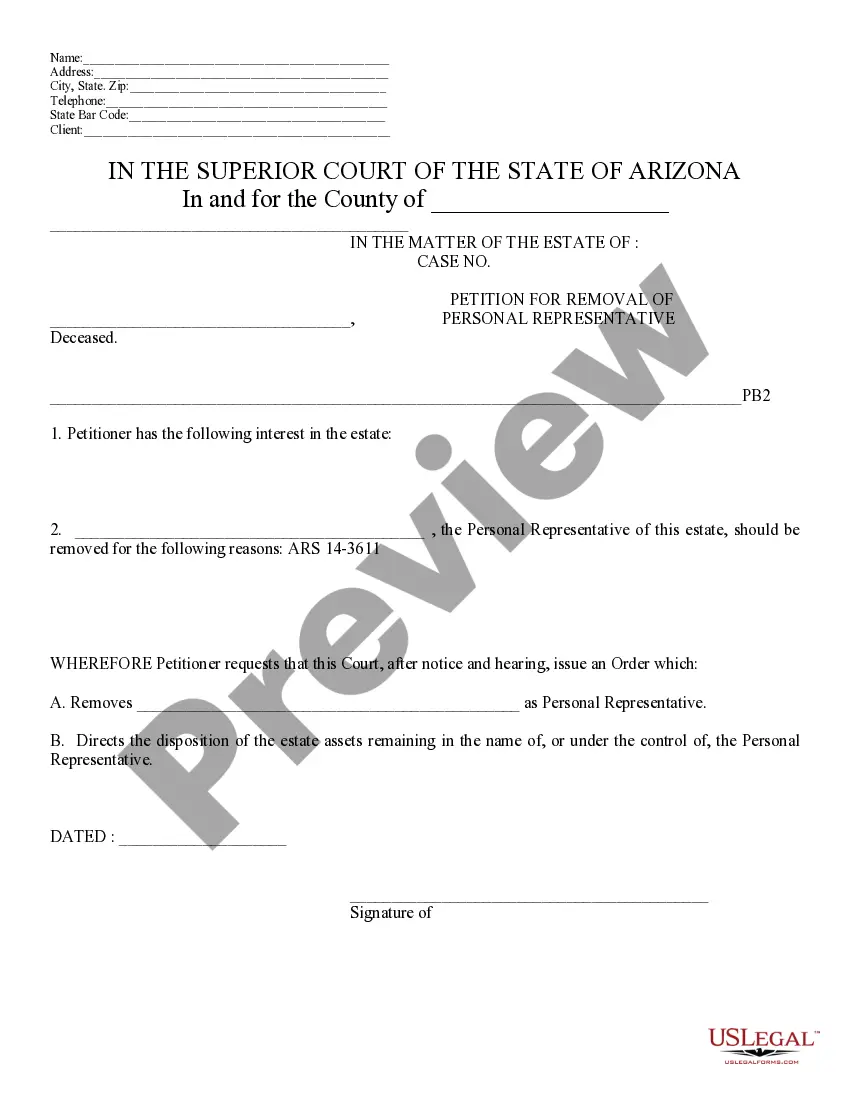
The Petition for Removal of Personal Representative is a legal document used in Arizona to formally request the court to remove an appointed personal representative from managing an estate. This form is essential for individuals who believe that the personal representative is not fulfilling their duties or has acted improperly. Unlike other estate management forms, this specific petition focuses solely on the removal of the personal representative, outlining the reasons and legal basis for the request.
Key components of this form
- Petitioner's interest in the estate: Details why the petitioner is pursuing the removal.
- Reasons for removal: Outlines the justifications for seeking the personal representative's removal, citing relevant laws.
- Request for court order: Formal request for the court to take specified actions regarding the removal and disposition of estate assets.
- Signature section: Space for the petitioner to sign and date the petition.
When to use this document
This form is typically used when a petitioner believes that a personal representative is not acting in the best interests of the estate or its beneficiaries. Scenarios may include instances of mismanagement of assets, failure to communicate with beneficiaries, or engaging in fraudulent activities. It is crucial to use this form when there are legitimate concerns that require judicial intervention to protect the estate and its interests.
Who should use this form
Individuals who may benefit from this form include:
- Beneficiaries of an estate concerned about the actions of the personal representative.
- Family members or legal heirs wishing to contest the management of the estate.
- Petitioners seeking to ensure that the estate is managed properly and transparently.
How to prepare this document
- Identify the petitioner: Provide your name and contact information at the top of the form.
- State your interest: Clearly outline your interest in the estate in the appropriate section.
- Specify the reasons for removal: Detail the issues with the current personal representative, citing specific laws if applicable.
- Request the court's action: Indicate what you want the court to do regarding the personal representative and the estate assets.
- Sign and date the petition: Ensure to sign and date the document before submitting it to the court.
Notarization requirements for this form
This form needs to be notarized to ensure legal validity. US Legal Forms provides secure online notarization powered by Notarize, allowing you to complete the process through a verified video call, available anytime.
Get your form ready online
Our built-in tools help you complete, sign, share, and store your documents in one place.
Make edits, fill in missing information, and update formatting in US Legal Forms—just like you would in MS Word.
Download a copy, print it, send it by email, or mail it via USPS—whatever works best for your next step.
Sign and collect signatures with our SignNow integration. Send to multiple recipients, set reminders, and more. Go Premium to unlock E-Sign.
If this form requires notarization, complete it online through a secure video call—no need to meet a notary in person or wait for an appointment.
We protect your documents and personal data by following strict security and privacy standards.

Make edits, fill in missing information, and update formatting in US Legal Forms—just like you would in MS Word.

Download a copy, print it, send it by email, or mail it via USPS—whatever works best for your next step.

Sign and collect signatures with our SignNow integration. Send to multiple recipients, set reminders, and more. Go Premium to unlock E-Sign.

If this form requires notarization, complete it online through a secure video call—no need to meet a notary in person or wait for an appointment.

We protect your documents and personal data by following strict security and privacy standards.
Typical mistakes to avoid
- Failing to clearly state the reasons for removal, leading to a lack of supporting evidence.
- Omitting necessary contact information or details about your interest in the estate.
- Not signing or dating the petition before submission.
Benefits of using this form online
- Convenience: Download and complete the form at your own pace from anywhere.
- Editability: Customize the form easily to fit your specific situation and requirements.
- Reliability: Access professionally drafted templates that meet legal standards.
Legal use & context
- The form must be completed accurately to ensure it is accepted by the court.
- It is advisable to consult with a legal professional to ensure all relevant laws are respected.
- The submission of this form may initiate a court hearing, wherein the reasons for removal will be examined.
Key takeaways
- The Petition for Removal of Personal Representative is vital for addressing mismanagement within an estate.
- Correctly completing the form is crucial to ensure successful court intervention.
- Online resources provide convenience and accessibility for users needing this form.
Looking for another form?
Form popularity
FAQ
In Arizona, a personal representative generally has six months to one year to settle an estate, depending on its complexity. While this timeline can vary, it is crucial for a personal representative to communicate effectively with heirs and creditors throughout the process. If delays occur, you might want to consider an Arizona Petition for Removal of Personal Representative to ensure that the estate is managed properly and in a timely manner.
Rule 51 in Arizona probate outlines guidelines for the administration of estates and the responsibilities of personal representatives. This rule ensures that representatives perform their duties efficiently and transparently. If you believe a personal representative is not adhering to these rules, you may file an Arizona Petition for Removal of Personal Representative to seek accountability and protect the interests of the estate.
In Arizona, a personal representative’s compensation depends on the estate's value and complexity. Typically, they may receive a percentage of the estate, often ranging from 2% to 4%. Understanding the compensation structure is crucial, particularly if you're considering submitting an Arizona Petition for Removal of Personal Representative due to dissatisfaction with these fees or the representative's performance.
When someone dies without a will in Arizona, the state’s intestacy laws determine the heirs. Generally, the surviving spouse and children inherit first, followed by parents, siblings, and then more distant relatives. If no eligible relatives exist, the estate may escheat to the state. Understanding your rights in this situation can be complex, but the Arizona Petition for Removal of Personal Representative can clarify the roles and responsibilities of responsible parties.
The priority for appointment as a personal representative in Arizona follows a specific order defined by state law. Typically, the surviving spouse is first, followed by adult children, parents, siblings, and other relatives. If no relatives are available, the court can appoint an interested party or a professional fiduciary. Should changes be necessary, the Arizona Petition for Removal of Personal Representative allows for modifications to this appointment.
To prove your status as executor of an estate without a will, you will need to petition the court for a letter of appointment. This may involve presenting evidence that demonstrates your relationship to the deceased and your capacity to manage their estate. The court will review your petition and issue a ruling based on Arizona’s intestacy laws. If disputes arise, the Arizona Petition for Removal of Personal Representative can assist in addressing any concerns.
In Arizona, if there is no will, you can become an executor by petitioning the court to appoint you as a personal representative. This typically involves submitting the appropriate paperwork and possibly notifying other interested parties. The court will then assess your petition and decide based on the state's laws. If you need guidance through this process, the Arizona Petition for Removal of Personal Representative can facilitate the necessary steps.
A letter of appointment of personal representative in Arizona is a legal document issued by the court. This document formally recognizes an individual as the personal representative of an estate. It grants them the authority to handle the estate's affairs, including settling debts and distributing assets. If you need to remove a personal representative, consider utilizing the Arizona Petition for Removal of Personal Representative for an effective legal process.