Arizona Notice of Hearing
Understanding this form
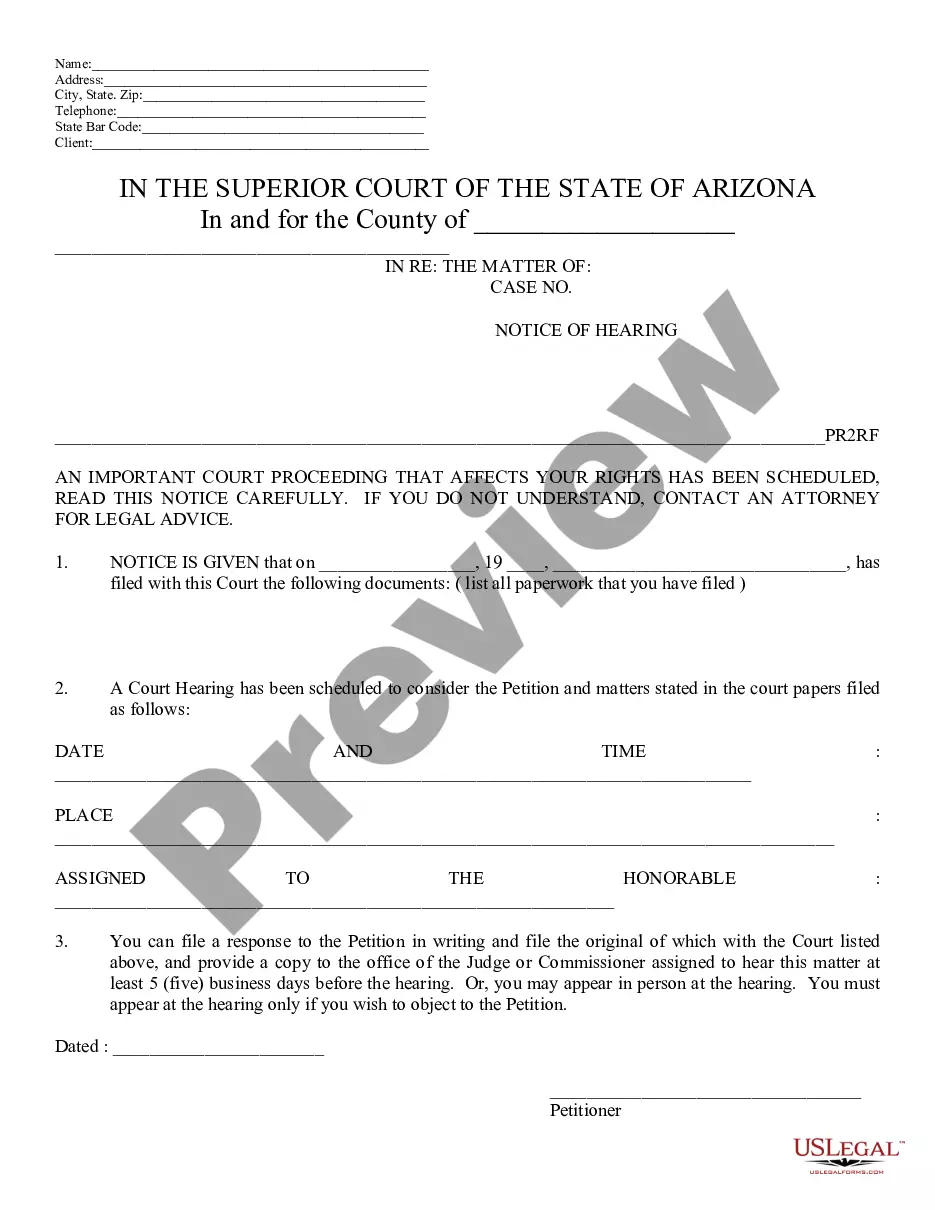
The Notice of Hearing is a legal document that officially informs a party about an upcoming court proceeding. It provides essential details regarding the case, including the date, time, and purpose of the hearing. This form is crucial to ensure that all parties involved in a legal matter are adequately notified and can respond appropriately. Unlike other legal notices, this specific form focuses on court hearings and is tailored to comply with Arizona's legal standards.
Form components explained
- Addresses of the involved parties for correspondence.
- The details of the court where the case is filed.
- The date and time of the scheduled hearing.
- The name of the judge or commissioner assigned to the case.
- Instructions for responding to the notice, including deadlines.

When to use this form
This form should be used when a party is required to notify others about a scheduled court hearing related to a petition or request filed in court. It is commonly used in family law cases, civil litigation, or any situation where a court hearing directly impacts the parties' rights or obligations.
Who should use this form
- Petitioners involved in legal proceedings who must notify other parties of a hearing.
- Attorneys representing clients in court cases requiring formal notice.
- Individuals seeking to ensure all parties have notification to avoid delays in court proceedings.
How to prepare this document
- Enter the addresses and contact information for all parties involved at the top of the form.
- Specify the county and the name of the superior court where the case is filed.
- Fill in the date of the hearing and the details about the petition filed with the court.
- Indicate the name of the assigned judge or commissioner.
- Provide instructions for how other parties can respond before the hearing date.
Is notarization required?
This form does not typically require notarization to be legally valid. However, some jurisdictions or document types may still require it. US Legal Forms provides secure online notarization powered by Notarize, available 24/7 for added convenience.
Get your form ready online
Our built-in tools help you complete, sign, share, and store your documents in one place.
Make edits, fill in missing information, and update formatting in US Legal Forms—just like you would in MS Word.
Download a copy, print it, send it by email, or mail it via USPS—whatever works best for your next step.
Sign and collect signatures with our SignNow integration. Send to multiple recipients, set reminders, and more. Go Premium to unlock E-Sign.
If this form requires notarization, complete it online through a secure video call—no need to meet a notary in person or wait for an appointment.
We protect your documents and personal data by following strict security and privacy standards.

Make edits, fill in missing information, and update formatting in US Legal Forms—just like you would in MS Word.

Download a copy, print it, send it by email, or mail it via USPS—whatever works best for your next step.

Sign and collect signatures with our SignNow integration. Send to multiple recipients, set reminders, and more. Go Premium to unlock E-Sign.

If this form requires notarization, complete it online through a secure video call—no need to meet a notary in person or wait for an appointment.

We protect your documents and personal data by following strict security and privacy standards.
Mistakes to watch out for
- Failing to include all required details about the court and hearing, leading to confusion.
- Not providing sufficient notice time for all parties, which may lead to legal challenges.
- Forgetting to file the notice with the court after completion.
Why complete this form online
- Convenience of downloading and completing the Notice of Hearing from home.
- Template provided by licensed attorneys ensuring it meets legal standards.
- Ability to edit, customize, and print the form as needed.
Looking for another form?
Form popularity
FAQ
The Arizona Notice of Hearing is a legal document used in family law conservatorship matters to inform a party about an upcoming court hearing. It provides essential details such as the hearing date and time, the court handling the case, the judge or commissioner, and any deadlines for responding. It ensures all parties are properly notified per Arizona standards.
To fill out the notice, enter the addresses of the involved parties for correspondence, the court where the case is filed, the scheduled date and time of the hearing, the name of the judge or commissioner, and the instructions for responding including any deadlines. The form components guide this completion and help meet Arizona requirements.
The notice should list the addresses of the involved parties for correspondence so each recipient can receive it. It is typically used by petitioners, attorneys, or others who must ensure all parties in a conservatorship matter are properly notified to avoid delays.
The notice includes instructions for responding to the notice, with deadlines to act. This helps ensure interested parties know when to respond and what steps to take to participate in the hearing, consistent with Arizona family law practices in conservatorship cases.
The notice must include the court details where the case is filed and the judge or commissioner assigned to the case. These components identify the exact proceeding and ensure the notice reaches the correct court and official.
This form is tailored to Arizona family law conservatorship proceedings, so it emphasizes court and judge or commissioner details specific to conservatorships, and provides response deadlines and instructions aligned with that context rather than a generic notice.