California Release of Lien
Overview of this form
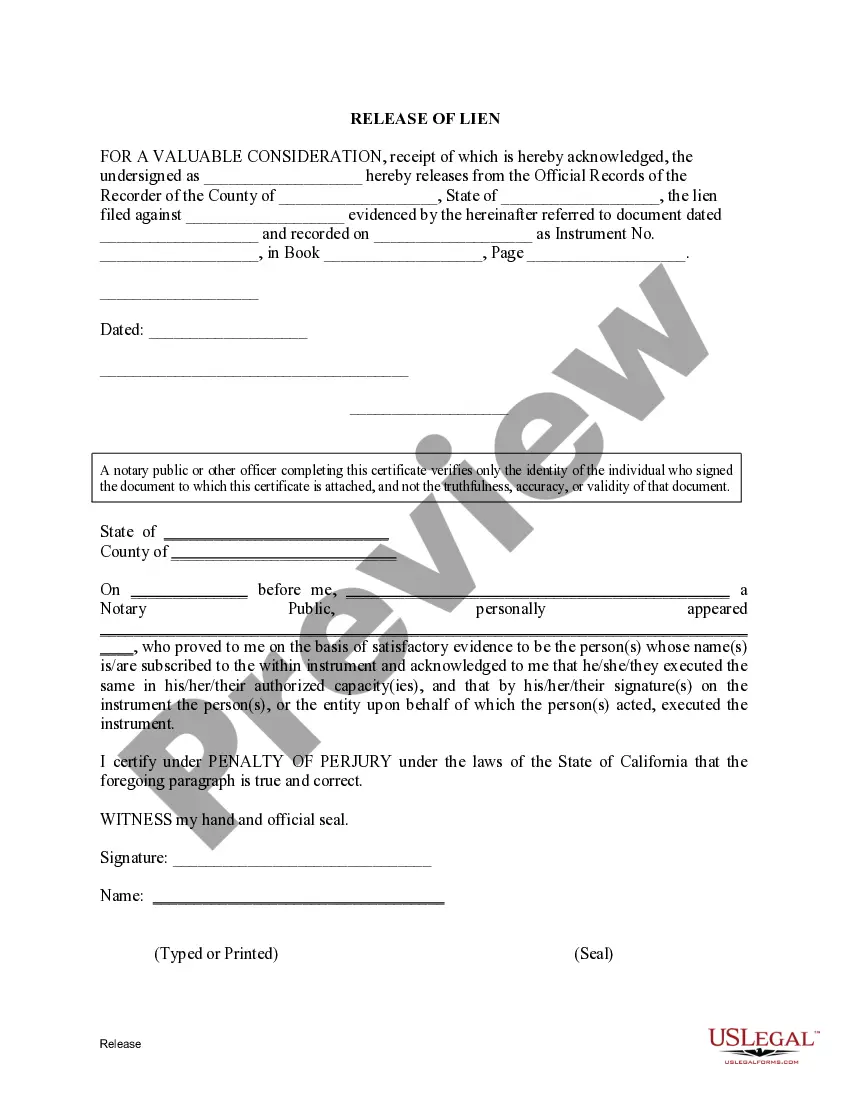
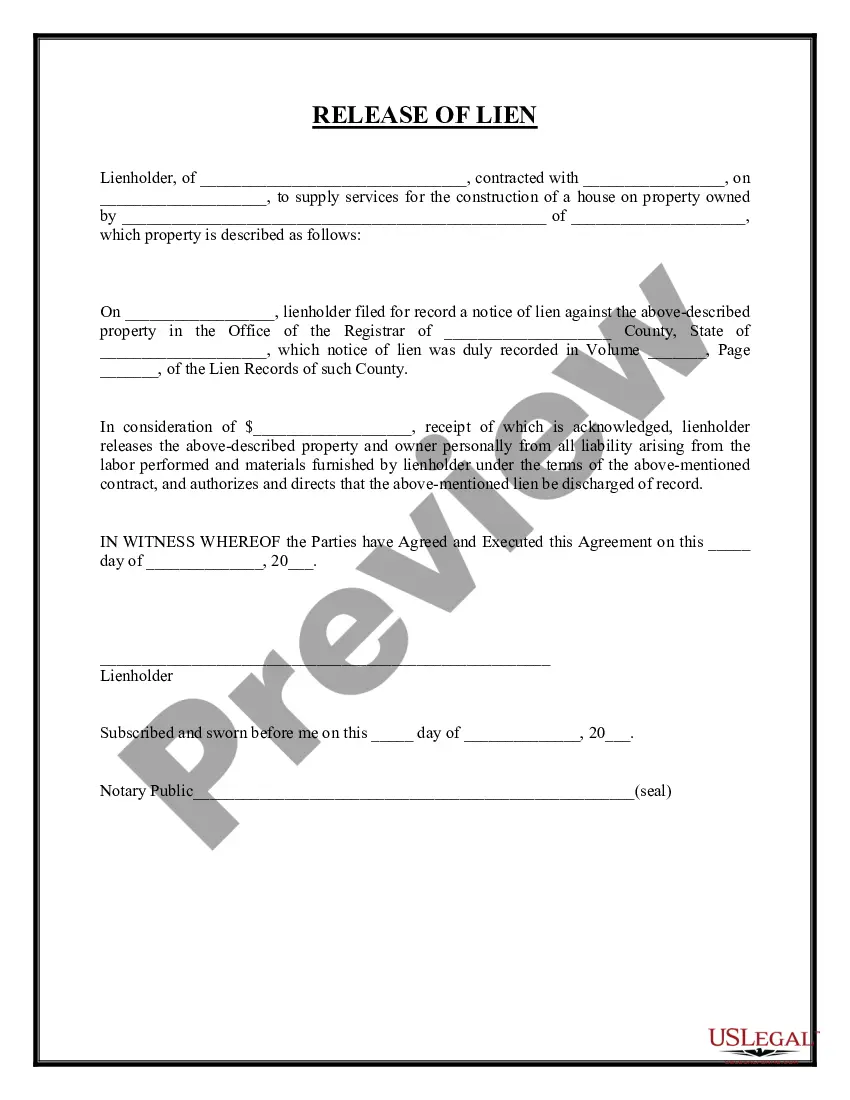
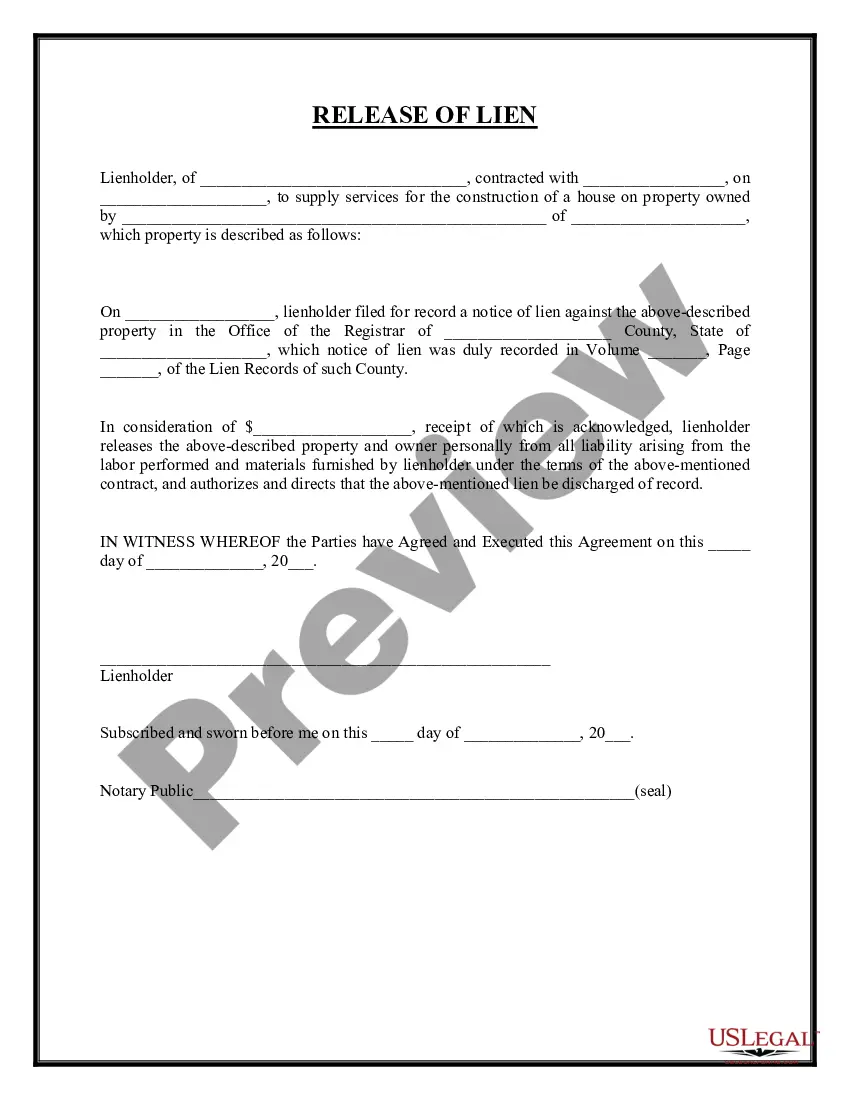
The Release of Lien is a legal document that officially cancels a lien previously placed on a property. This form is used by a claimant to release their claim against a property after they have received full payment or have resolved the underlying obligation. This differs from other forms, such as a Notice of Lien, which initiates a claim rather than terminates it.
Form components explained
- Parties involved: Identification of the lienholder and property owner.
- Legal description: Detailed information about the property associated with the lien.
- Document references: Recording details of the original lien, including dates and instrument numbers.
- Notary acknowledgment: Certification by a notary public verifying the identities of those signing the document.
- Date of release: The effective date when the lien is officially released.
When to use this form
This form is commonly used after a financial obligation has been satisfied, such as after making the final payment on a mortgage or other secured loan. It is essential whenever a lien must be officially removed from public records to clear the title of a property, which may be necessary for selling or refinancing the property.
Who needs this form
- Property owners who have paid off a debt secured by a lien.
- Claimants or lienholders who wish to cancel a lien they filed.
- Agents or attorneys acting on behalf of the property owner or claimants.
Completing this form step by step
- Identify the parties involved by entering the names of the lienholder and property owner.
- Provide a legal description of the property associated with the lien.
- Include the original lienâs document details, such as the date and instrument number.
- Have the document signed and dated by the lienholder.
- Obtain a notary acknowledgment to verify the identities of all signers.
Does this document require notarization?
Yes, this form must be notarized to be legally valid. Notarization helps ensure the authenticity of the signatures and the integrity of the document. US Legal Forms offers integrated online notarization that is available 24/7 through secure video calls, ensuring you can complete your form without traveling.
Get your form ready online
Our built-in tools help you complete, sign, share, and store your documents in one place.
Make edits, fill in missing information, and update formatting in US Legal Forms—just like you would in MS Word.
Download a copy, print it, send it by email, or mail it via USPS—whatever works best for your next step.
Sign and collect signatures with our SignNow integration. Send to multiple recipients, set reminders, and more. Go Premium to unlock E-Sign.
If this form requires notarization, complete it online through a secure video call—no need to meet a notary in person or wait for an appointment.
We protect your documents and personal data by following strict security and privacy standards.

Make edits, fill in missing information, and update formatting in US Legal Forms—just like you would in MS Word.

Download a copy, print it, send it by email, or mail it via USPS—whatever works best for your next step.

Sign and collect signatures with our SignNow integration. Send to multiple recipients, set reminders, and more. Go Premium to unlock E-Sign.

If this form requires notarization, complete it online through a secure video call—no need to meet a notary in person or wait for an appointment.

We protect your documents and personal data by following strict security and privacy standards.
Common mistakes to avoid
- Failing to include all necessary details of the original lien.
- Not obtaining a notary signature, if required.
- Incorrectly identifying the parties involved in the lien release.
- Not filing the form with the appropriate county recorder's office.
Why use this form online
- Convenience: Download the form anytime from your home.
- Customizable: Edit the form to fit your specific needs.
- Legal assurance: Forms are drafted by licensed attorneys to ensure compliance with legal standards.
Summary of main points
- The Release of Lien cancels a claim against a property that has been fulfilled.
- Fill out the form completely and accurately to avoid delays or legal issues.
- Notarization is essential for the form's validity.
Looking for another form?
Form popularity
FAQ
California Civil Code section 8416 Failure to serve the Mechanic's Lien and Notice of Mechanic's Lien on the owner, or alternatively if the owner cannot be served on the lender or direct contractor, shall cause the Mechanic's Lien to be unenforceable as a matter of law (Civil Code Section 8024(d)).
In California, it is required that a mechanics lien be enforced within 90 days from the date on which the lien was recorded. If this 90-day time period passes without an action being commenced to enforce the lien, the lien expires.
From an owner's perspective, a lien is a security interest registered against the title to your property. Any lien placed on the property, even though its validity must be proven in a court of law, will have the power to stop your project.
The cost for these bonds is between 2-3% of the value of the lien inclusive of court costs. So if a mechanics lien is filed for $500,000.
When a lien is bonded off, a payment bond is available to pay off the lien. This provides a guarantee for payment to the construction firm and allows the property owner to be able to sell, finance or transfer the property without fear of a lien on the title.
A lien release is a document that is filed in the public land records as the official notice that the lien is removed. Once payment has been received, a contractor has a duty to remove any lien that was filed against the property.
The bond shall be in an amount equal to 125 percent of the amount of the claim of lien or 125 percent of the amount allocated in the claim of lien to the real property to be released. The bond shall be executed by an admitted surety insurer.