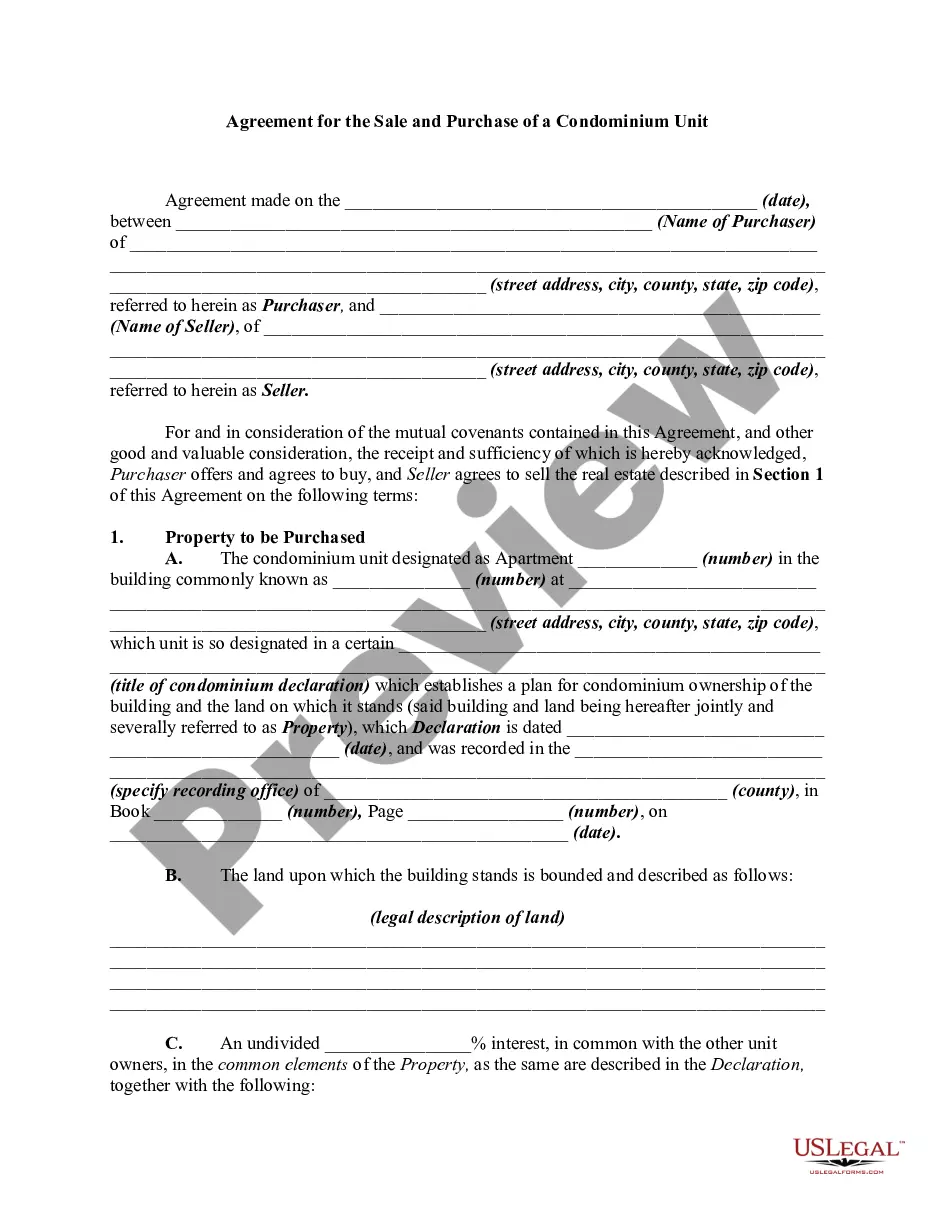
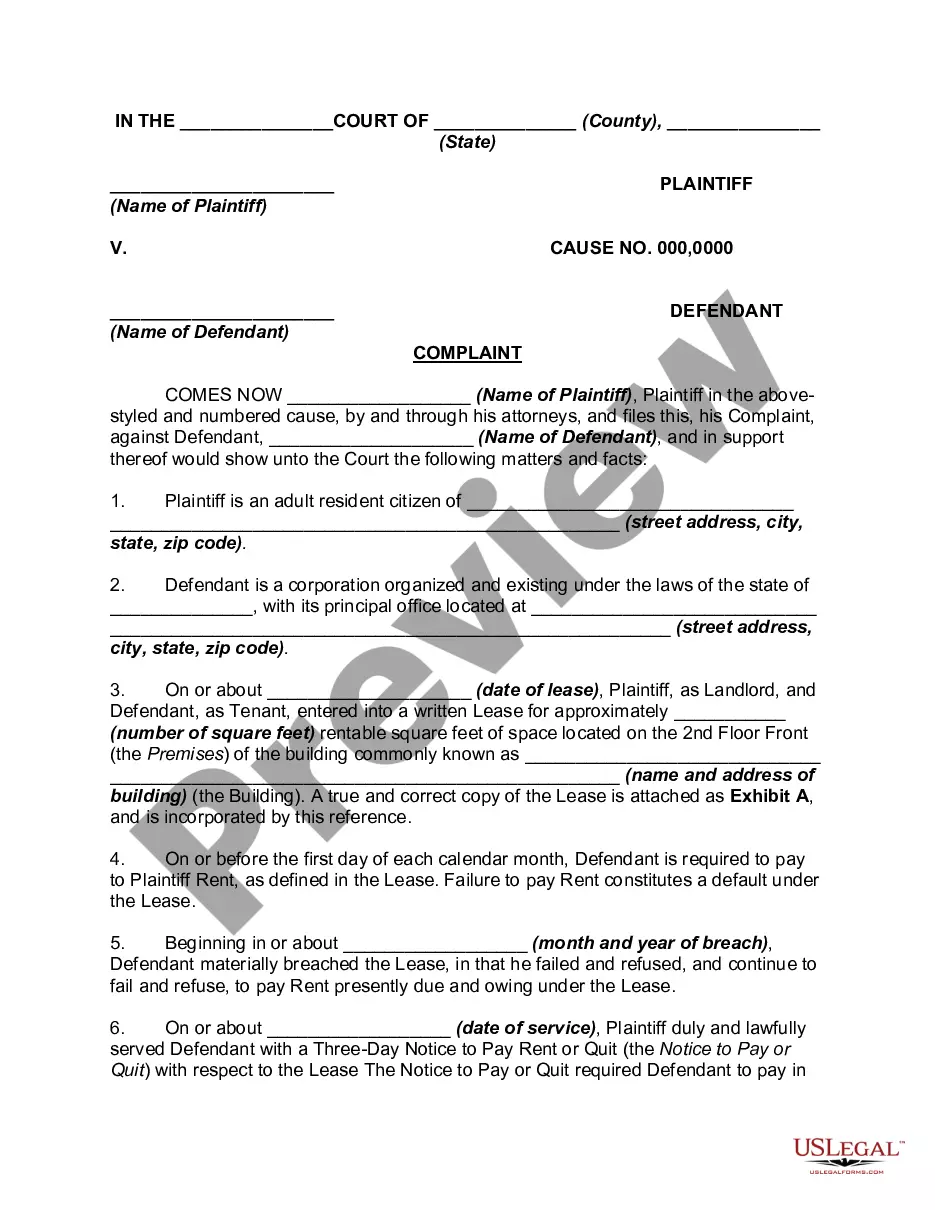
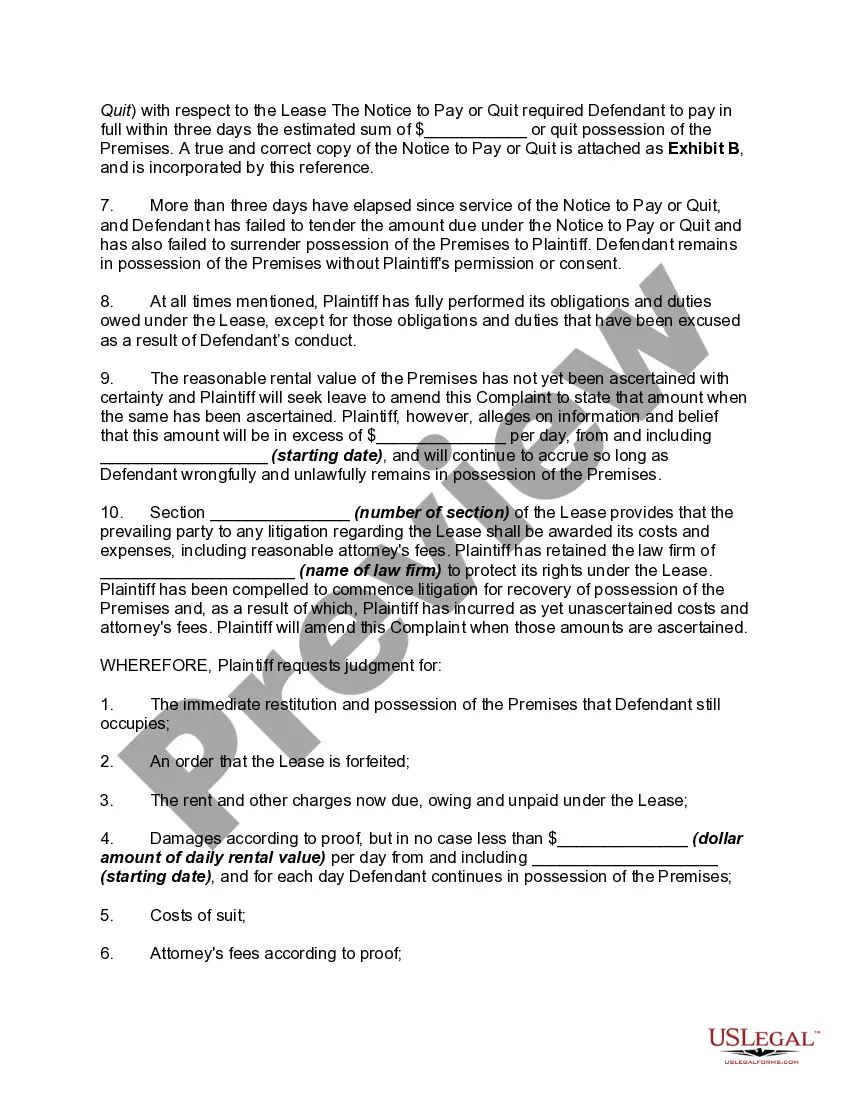
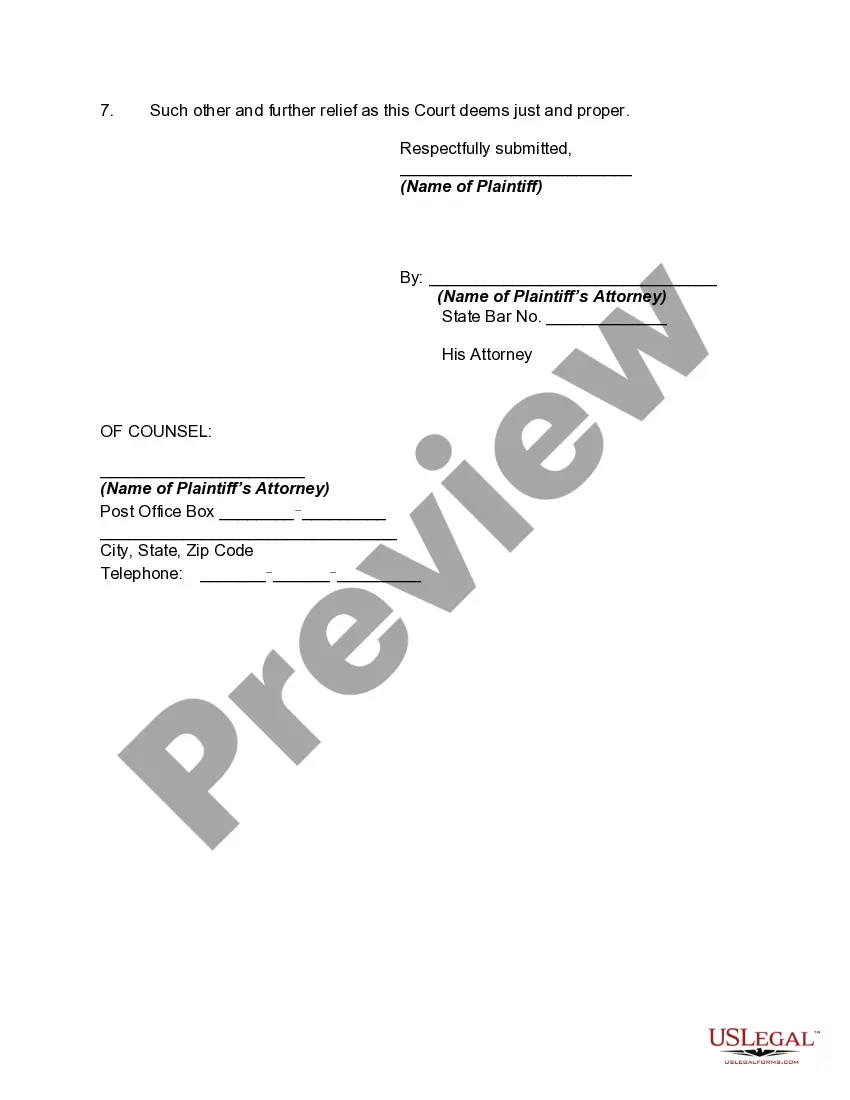
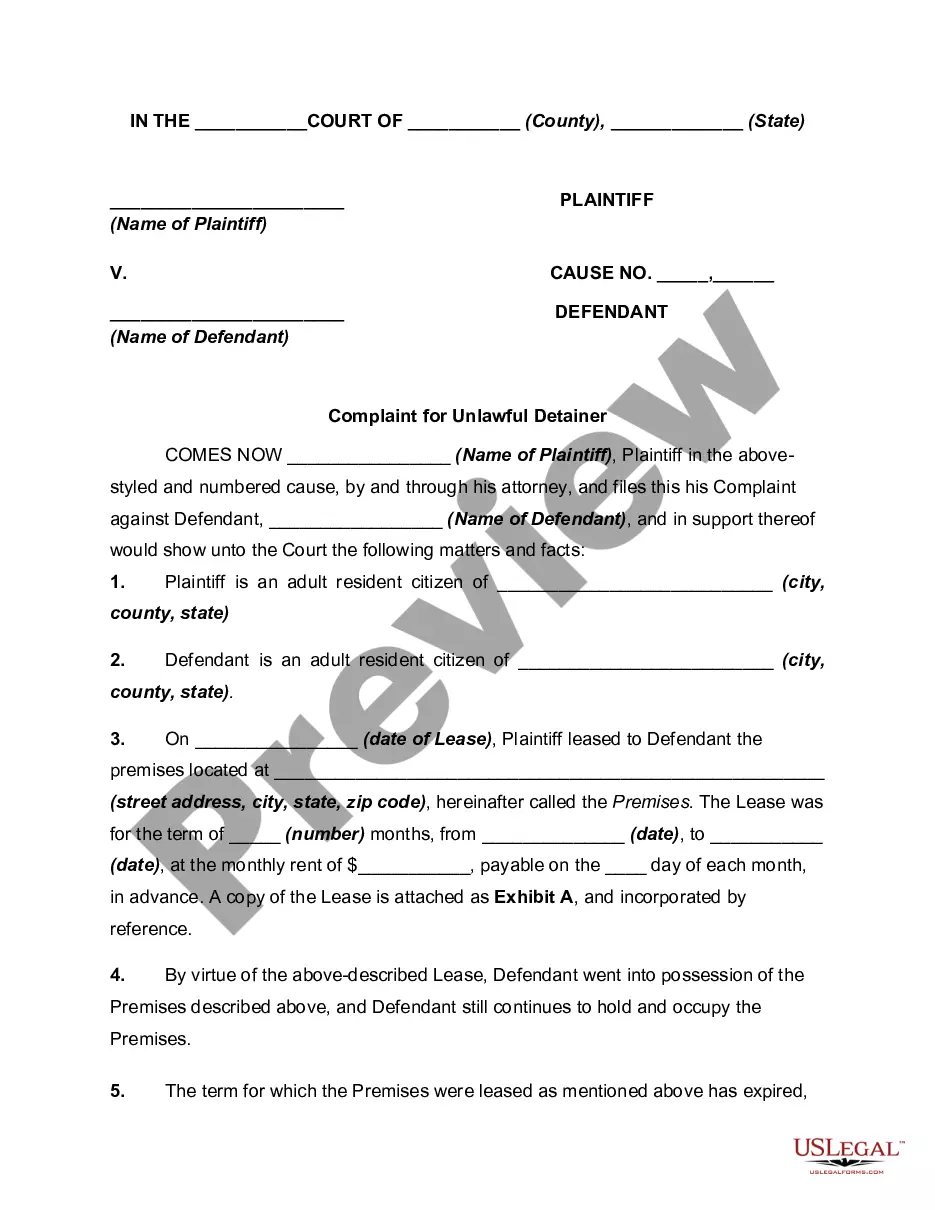
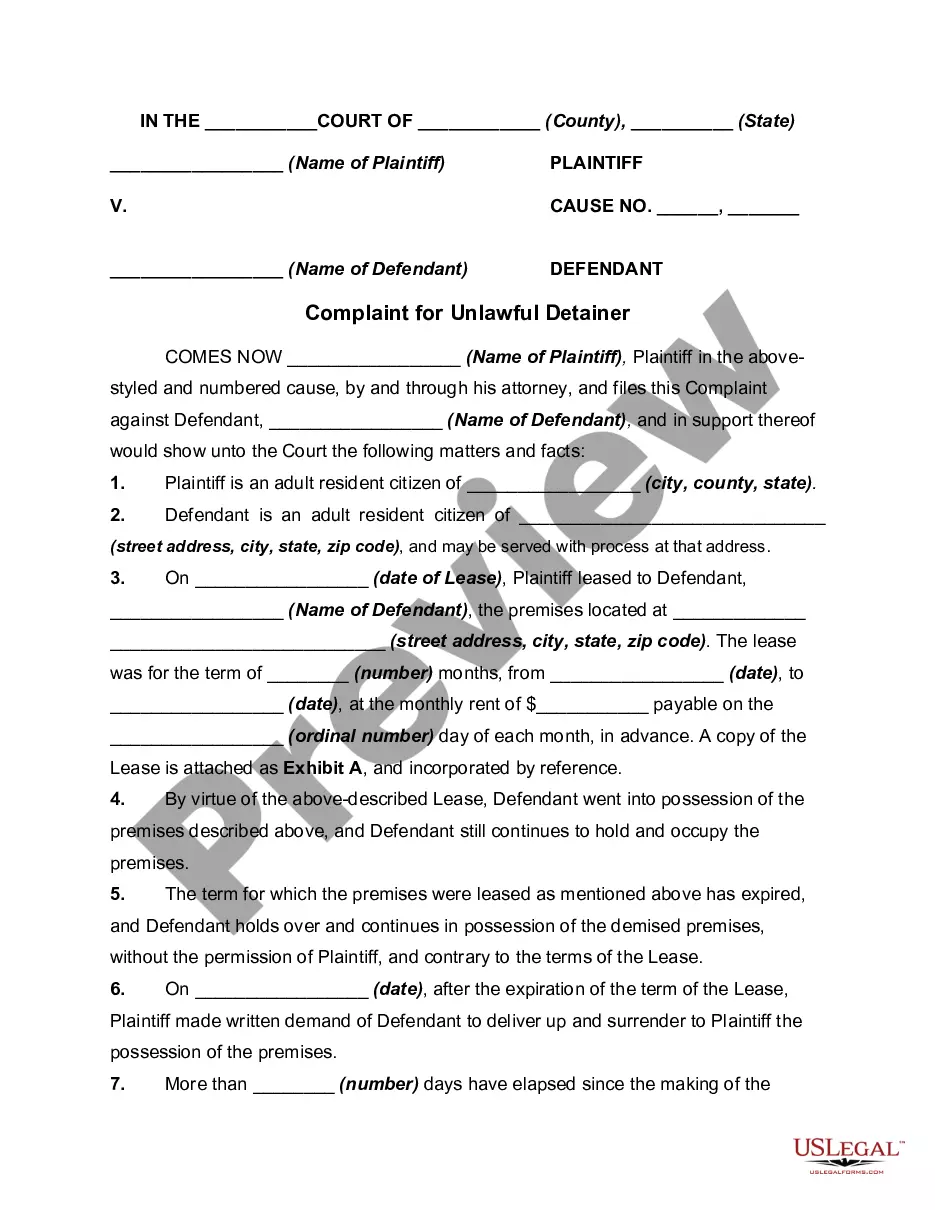
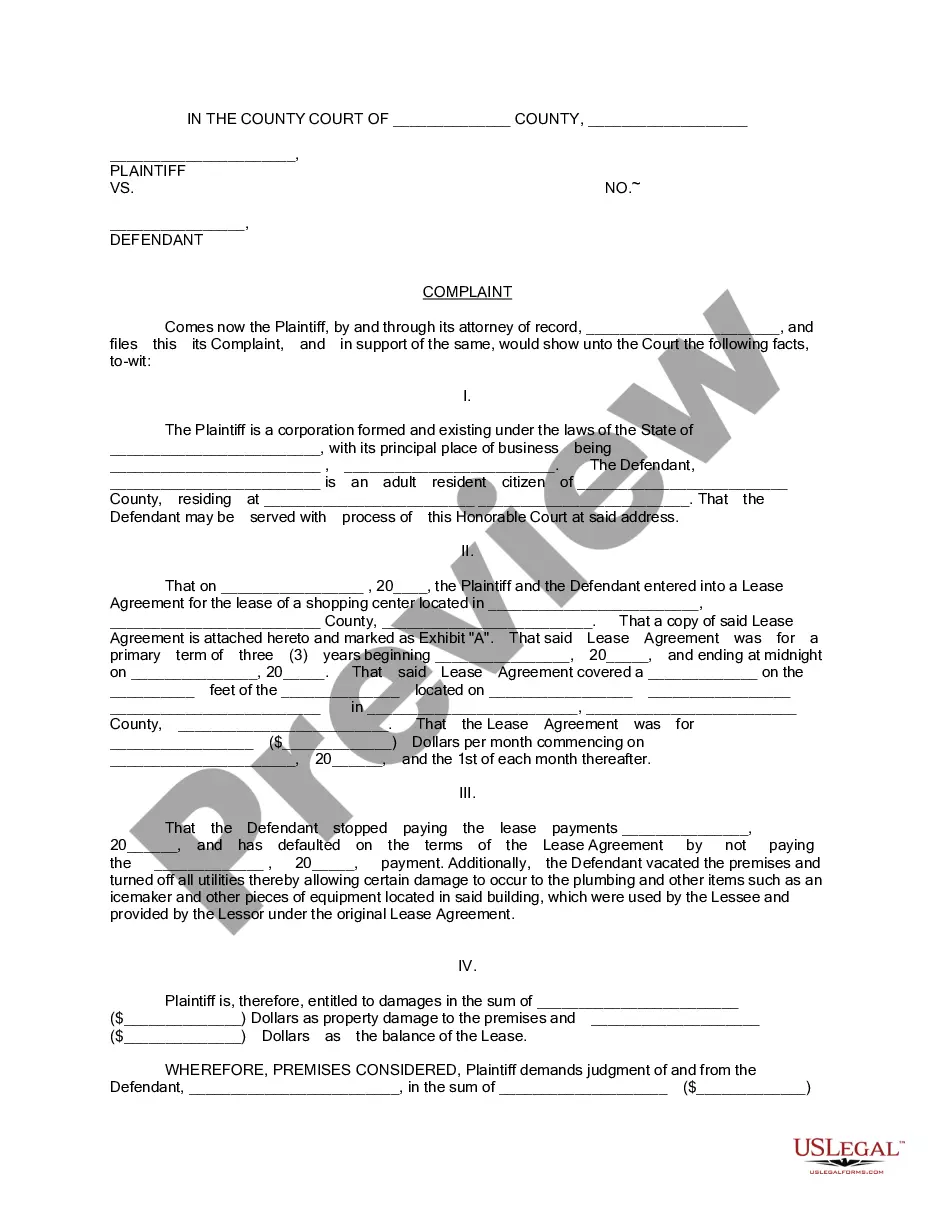
The following form is a complaint that adopts the notice pleadings format of the Federal Rules of Civil Procedure, which have been adopted by most states in one form or another.
California Complaint for Unlawful Detainer by Commercial Tenants to Recover Possession, Past-Due Rent, Rental Value of Premises, and Attorney's Fees and Costs -
State:
Multi-State
Category:
Control #:
US-02778BG
Format:
Word;
Rich Text
162 downloads
Description
Free preview
Get your form ready online
Our built-in tools help you complete, sign, share, and store your documents in one place.
Built-in online Word editor
Make edits, fill in missing information, and update formatting in US Legal Forms—just like you would in MS Word.
Export easily
Download a copy, print it, send it by email, or mail it via USPS—whatever works best for your next step.
E-sign your document
Sign and collect signatures with our SignNow integration. Send to multiple recipients, set reminders, and more. Go Premium to unlock E-Sign.
Notarize online 24/7
If this form requires notarization, complete it online through a secure video call—no need to meet a notary in person or wait for an appointment.
Store your document securely
We protect your documents and personal data by following strict security and privacy standards.

Make edits, fill in missing information, and update formatting in US Legal Forms—just like you would in MS Word.

Download a copy, print it, send it by email, or mail it via USPS—whatever works best for your next step.

Sign and collect signatures with our SignNow integration. Send to multiple recipients, set reminders, and more. Go Premium to unlock E-Sign.

If this form requires notarization, complete it online through a secure video call—no need to meet a notary in person or wait for an appointment.

We protect your documents and personal data by following strict security and privacy standards.
Looking for another form?
How to fill out Complaint For Unlawful Detainer By Commercial Tenants To Recover Possession, Past-Due Rent, Rental Value Of Premises, And Attorney's Fees And Costs -?
US Legal Forms - among the greatest libraries of authorized types in America - delivers an array of authorized papers layouts you can acquire or print out. Utilizing the web site, you can get thousands of types for company and person uses, categorized by groups, claims, or keywords.You will find the newest variations of types such as the California Complaint for Unlawful Detainer by Commercial Tenants to Recover Possession, Past-Due Rent, Rental Value of Premises, and Attorney's Fees and Costs - in seconds.
If you already have a monthly subscription, log in and acquire California Complaint for Unlawful Detainer by Commercial Tenants to Recover Possession, Past-Due Rent, Rental Value of Premises, and Attorney's Fees and Costs - through the US Legal Forms catalogue. The Acquire option can look on every develop you look at. You gain access to all in the past delivered electronically types inside the My Forms tab of the accounts.
If you want to use US Legal Forms initially, here are straightforward instructions to get you started:
- Be sure you have selected the proper develop to your metropolis/area. Select the Review option to examine the form`s information. Read the develop outline to ensure that you have chosen the appropriate develop.
- If the develop doesn`t fit your demands, make use of the Research discipline near the top of the display screen to get the one which does.
- If you are satisfied with the shape, verify your selection by clicking the Get now option. Then, pick the prices strategy you want and offer your references to register for the accounts.
- Procedure the deal. Utilize your credit card or PayPal accounts to complete the deal.
- Choose the formatting and acquire the shape on the product.
- Make adjustments. Complete, modify and print out and sign the delivered electronically California Complaint for Unlawful Detainer by Commercial Tenants to Recover Possession, Past-Due Rent, Rental Value of Premises, and Attorney's Fees and Costs -.
Each design you included with your bank account does not have an expiration particular date which is yours permanently. So, in order to acquire or print out another copy, just proceed to the My Forms portion and then click on the develop you want.
Gain access to the California Complaint for Unlawful Detainer by Commercial Tenants to Recover Possession, Past-Due Rent, Rental Value of Premises, and Attorney's Fees and Costs - with US Legal Forms, by far the most comprehensive catalogue of authorized papers layouts. Use thousands of skilled and express-distinct layouts that satisfy your small business or person demands and demands.
Form popularity
FAQ
In order to trigger a fixed break clause, you will have to give the required notice to the landlord before the break date. For example, a written notice 6 months before the break date. Once notice has been given, the lease will end on the break date.
You can only forfeit a tenancy if the lease contains a forfeiture clause. The safest way when it comes to evicting a commercial tenant is by commencing a possession claim in the County Court. This process however can take some months.
If the landlord has already filed the unlawful detainer papers at court, and the tenant moves out before the trial, the landlord has 2 choices: Dismiss the case, or. Ask the court to convert the case to a regular civil case for damages to collect back rent in the amount requested in the unlawful detainer complaint.
Landlords can refuse a commercial lease renewal on fault grounds, grounds with statutory compensation, or on the grounds of offering alternative accommodation.
The law normally provides that if the tenant is in violation of the lease, the landlord must give the tenant a 3-day notice to correct the violation to avoid eviction. Commercial leases will often provide that if the tenant is in violation of the lease, a notice of more than 3 days must be given.
If the tenant fails to timely retrieve the personal property, how it is disposed of will depend on its estimated value. If the landlord or property manager reasonably believes the personal property has a total resale value of less than $700.00, the landlord may keep or dispose of the personal property in any way.
Who has the burden of proof in an unlawful detainer in California? California landlords must prove illegal detainer cases. The landlord is the plaintiff and must prove that the tenant broke the lease or rental agreement to justify eviction under California law. The landlord needs proof.
Contrast this with commercial evictions Commercial property owners can evict tenants for breaching the terms of the lease. These breaches run the gamut but the lion's share of commercial eviction actions arise from rent defaults.