Colorado Notice to Terminate Income Assignment
What this document covers
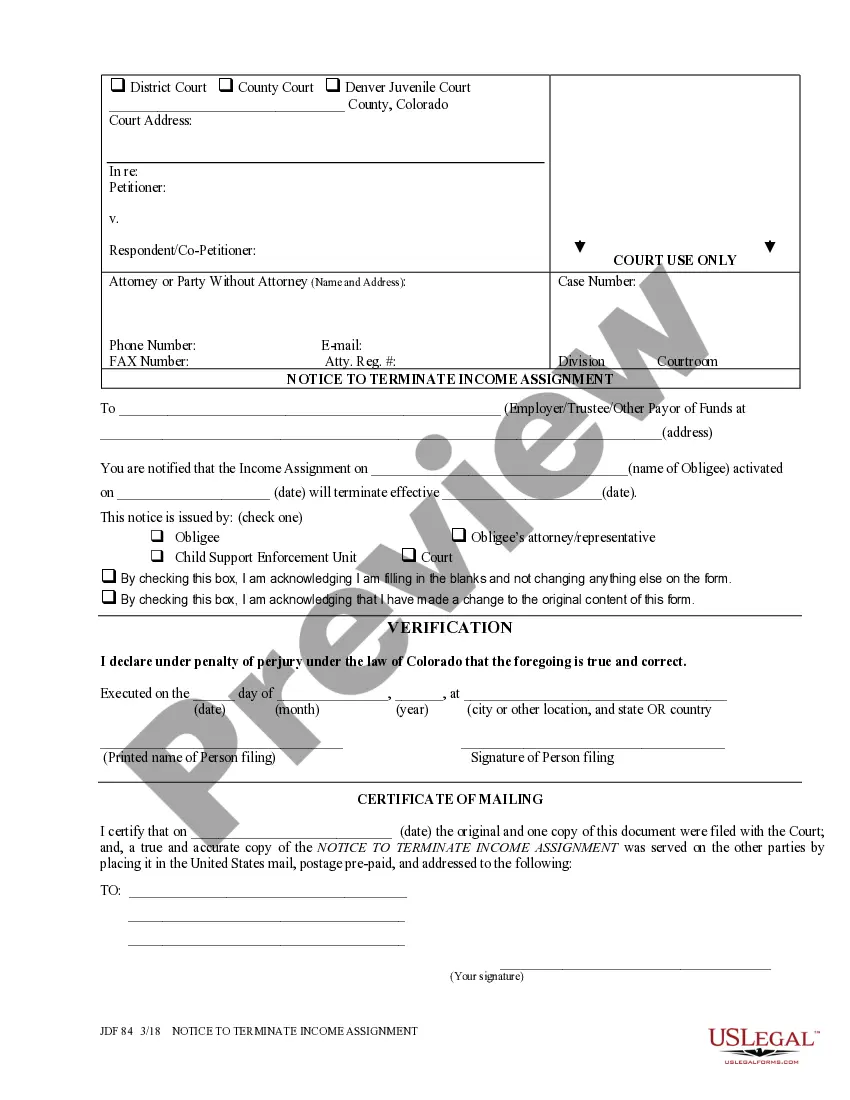
The Notice to Terminate Income Assignment is an official form from the Colorado State Judicial Branch, designed to formally notify the relevant parties that an income assignment is being terminated. This form is essential for those who need to end a previously established income withholding arrangement, ensuring compliance with state laws and regulations.
Key components of this form
- Identification of the employer or payor of funds.
- Date and city of execution.
- Details for the certificate of mailing, confirming delivery to all parties.
- Space for the signature of the individual submitting the notice.
When to use this document
This form should be used when an individual no longer wishes to have a portion of their income assigned to a creditor or for other obligations. This may occur after settling a debt, when financial circumstances change, or when the original agreement is no longer applicable.
Who needs this form
- Individuals currently subject to an income assignment.
- Debtors seeking to end an income withholding for child support, alimony, or other debts.
- Attorneys representing clients in financial disputes regarding income assignments.
Steps to complete this form
- Identify the employer or payor of funds by entering their name and address.
- Fill in the date and location where the form is executed.
- Complete the certificate of mailing section to confirm service of the notice to relevant parties.
- Sign the document to validate your request for termination.
Is notarization required?
This form usually doesn’t need to be notarized. However, local laws or specific transactions may require it. Our online notarization service, powered by Notarize, lets you complete it remotely through a secure video session, available 24/7.
Get your form ready online
Our built-in tools help you complete, sign, share, and store your documents in one place.
Make edits, fill in missing information, and update formatting in US Legal Forms—just like you would in MS Word.
Download a copy, print it, send it by email, or mail it via USPS—whatever works best for your next step.
Sign and collect signatures with our SignNow integration. Send to multiple recipients, set reminders, and more. Go Premium to unlock E-Sign.
If this form requires notarization, complete it online through a secure video call—no need to meet a notary in person or wait for an appointment.
We protect your documents and personal data by following strict security and privacy standards.

Make edits, fill in missing information, and update formatting in US Legal Forms—just like you would in MS Word.

Download a copy, print it, send it by email, or mail it via USPS—whatever works best for your next step.

Sign and collect signatures with our SignNow integration. Send to multiple recipients, set reminders, and more. Go Premium to unlock E-Sign.

If this form requires notarization, complete it online through a secure video call—no need to meet a notary in person or wait for an appointment.

We protect your documents and personal data by following strict security and privacy standards.
Avoid these common issues
- Failing to provide accurate information about the payor or employer.
- Not signing the document, which may render it invalid.
- Neglecting to send copies to all relevant parties, complicating the termination process.
Advantages of online completion
- Convenience of accessing and downloading the form anytime, from anywhere.
- Editable fields allow you to customize the form to fit your specific situation.
- Reliable resources ensuring the form meets all legal requirements.
What to keep in mind
- The Notice to Terminate Income Assignment is necessary for formally ending an income withholding.
- Correct completion and distribution are crucial for legality and effectiveness.
- Utilize the online form for ease and quick adjustments.
Looking for another form?
Form popularity
FAQ
California courts can enforce a child support order by holding the delinquent parent in contempt of court. Being held in contempt means the judge believes you have willfully disobeyed a court order. Contempt can be criminal or civil.
If, under the same circumstances, the child support payment is overdue for longer than 2 years, or the amount exceeds $10,000, the violation is a criminal felony, and convicted offenders face fines and up to 2 years in prison (See 18 U.S.C.
If the delinquent parent is found guilty of contempt for failing to pay child support, the court can order that person to pay fines, perform community service, and/or serve time in jail. The party seeking enforcement in court must file a motion (a written request) for contempt.
The most common way to enforce a child support order is by filing a motion for civil contempt. Filing this motion (written request) tells the court that you have a valid child support order in place, and the noncustodial parent is behind on payments.
The most common way to enforce a child support order is by filing a motion for civil contempt. Filing this motion (written request) tells the court that you have a valid child support order in place, and the noncustodial parent is behind on payments.
If the court finds that someone has the ability to pay support but is willfully not paying it, it can find that the person ordered to pay support is in contempt of court. Being in contempt of court could mean jail time for the person who is not paying the child support.
In this situation, there is a temptation to withhold child support, but this is not allowed. Child support payments and visitation are considered by law to be separate issues.You have an obligation to financially support your children, regardless of any visitation issues.