Colorado Burglary by Breaking and Entering
Description
Get your form ready online
Our built-in tools help you complete, sign, share, and store your documents in one place.
Make edits, fill in missing information, and update formatting in US Legal Forms—just like you would in MS Word.
Download a copy, print it, send it by email, or mail it via USPS—whatever works best for your next step.
Sign and collect signatures with our SignNow integration. Send to multiple recipients, set reminders, and more. Go Premium to unlock E-Sign.
If this form requires notarization, complete it online through a secure video call—no need to meet a notary in person or wait for an appointment.
We protect your documents and personal data by following strict security and privacy standards.

Make edits, fill in missing information, and update formatting in US Legal Forms—just like you would in MS Word.

Download a copy, print it, send it by email, or mail it via USPS—whatever works best for your next step.

Sign and collect signatures with our SignNow integration. Send to multiple recipients, set reminders, and more. Go Premium to unlock E-Sign.

If this form requires notarization, complete it online through a secure video call—no need to meet a notary in person or wait for an appointment.

We protect your documents and personal data by following strict security and privacy standards.
Looking for another form?
How to fill out Burglary By Breaking And Entering?
It is feasible to spend time online searching for the appropriate legal document template that meets the federal and state requirements you need. US Legal Forms offers thousands of legal forms that are reviewed by professionals.
You can easily download or print the Colorado Burglary by Breaking and Entering from their service. If you have a US Legal Forms account, you can Log In and click the Download option. After that, you can complete, edit, print, or sign the Colorado Burglary by Breaking and Entering.
Every legal document template you purchase is yours indefinitely. To obtain another copy of a purchased form, go to the My documents tab and click the relevant option. If you are using the US Legal Forms website for the first time, follow the simple instructions below: First, make sure you have selected the correct document template for the state/city of your choice. Review the form description to ensure you have chosen the right one. If available, use the Preview option to look through the document template as well.
Utilize professional and state-specific templates to address your business or personal needs.
- If you want to get another version of the form, use the Search field to find the template that meets your needs and requirements.
- Once you have found the template you require, click Buy now to proceed.
- Select the payment plan you need, enter your credentials, and register for your account on US Legal Forms.
- Complete the transaction. You can use your credit card or PayPal account to pay for the legal form.
- Choose the format of the document and download it to your device.
- Make edits to your document if possible. You can complete, edit, sign, and print the Colorado Burglary by Breaking and Entering.
- Download and print thousands of document templates using the US Legal Forms website, which provides the largest collection of legal forms.
Form popularity
FAQ
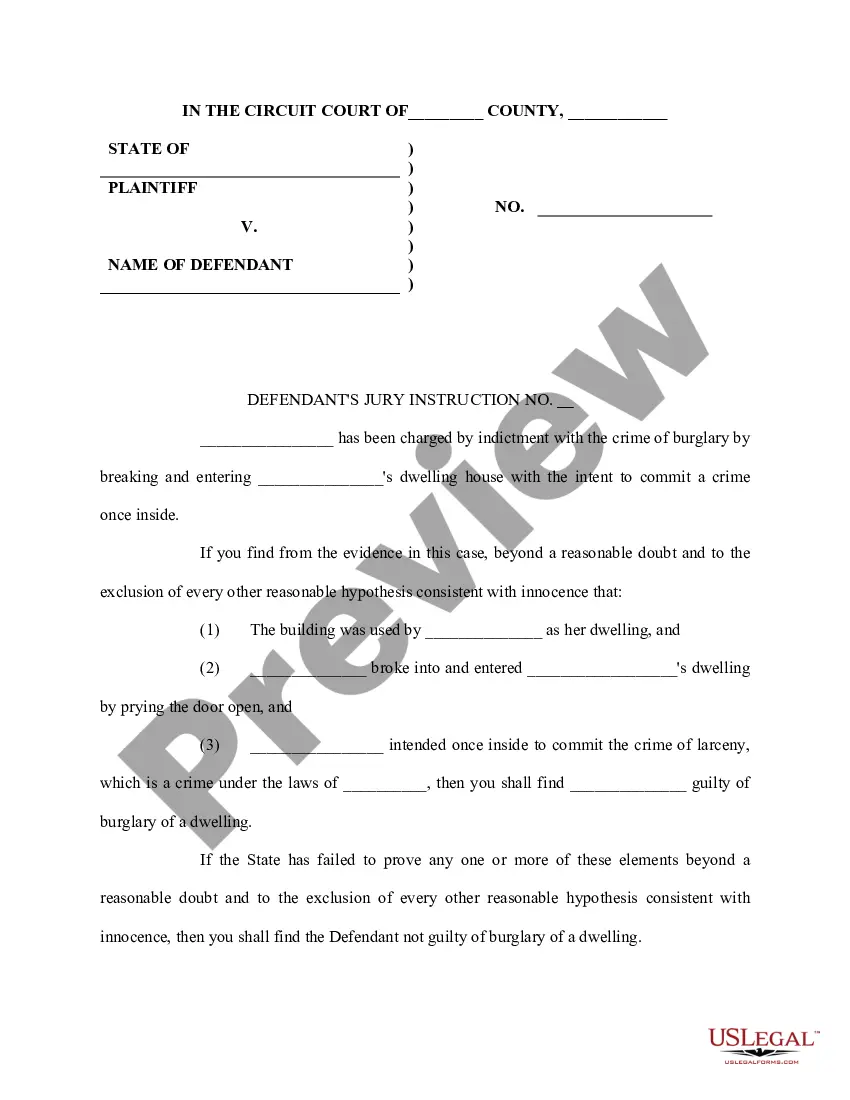
In a nutshell the Colorado crime of Burglary is defined as entering in to a structure (such as a house or business) without permission and with the intent to commit a crime once inside.
The following is a list of the minimum required crime elements for Burglary: ? Person knowingly enters or remains unlawfully (and) ? Building (and) ? Intent to commit crime therein. Is 'breaking and entering' into the building necessary? NO Opening an unlocked door or climbing through an open window is sufficient.
Burglary ? Penal Code 459 Although using force or fraud to gain entry into someone else's property with such intent is considered burglary, forced entry is not required in order to be charged with or convicted of burglary.
Merely reaching an arm into an open window counts as entering because the building's outer boundary was breached. Also note that you can get convicted of burglary even if you do not break into the residence or structure. Simply walking in through an unlocked door or open window would qualify.
As long as there is the intent to commit a crime, it can constitute burglary. There is no breaking and entering requirement. The offender may trespass through an open door. This is different from robbery, which involves the use of force or fear to obtain another person's property.
Intent ? The suspect entering the structure or building must have the intent to commit a theft or felony at the exact moment of entering. There does not have to be a completed theft or felony, only the intent to commit one.
Both trespassing and burglary involve unlawfully entering or remaining on someone else's property. The key difference is that burglary also involves the intent to commit or the actual commission of another crime. Legal defenses against trespass or burglary charges will depend on the circumstances of the case.