Connecticut Notice for Motion for Disclosure of Records
About this form
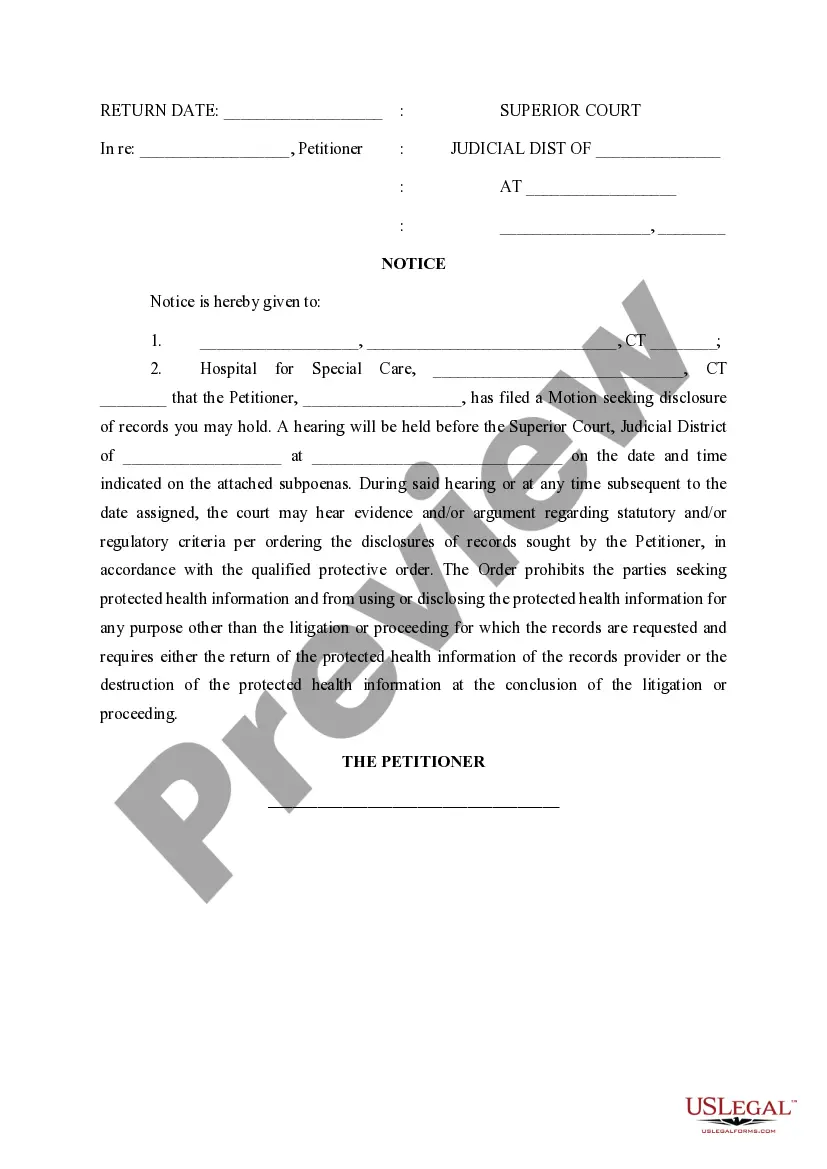
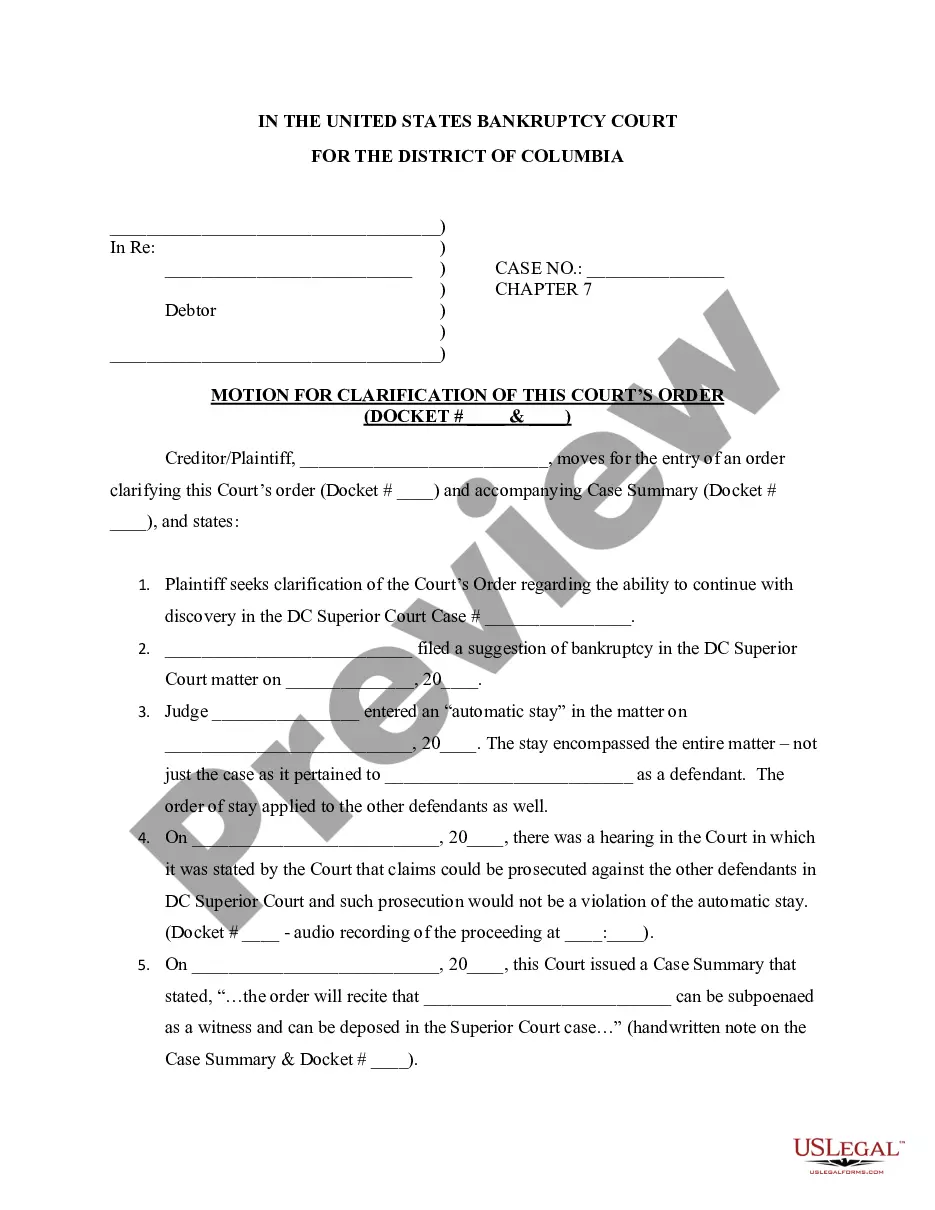
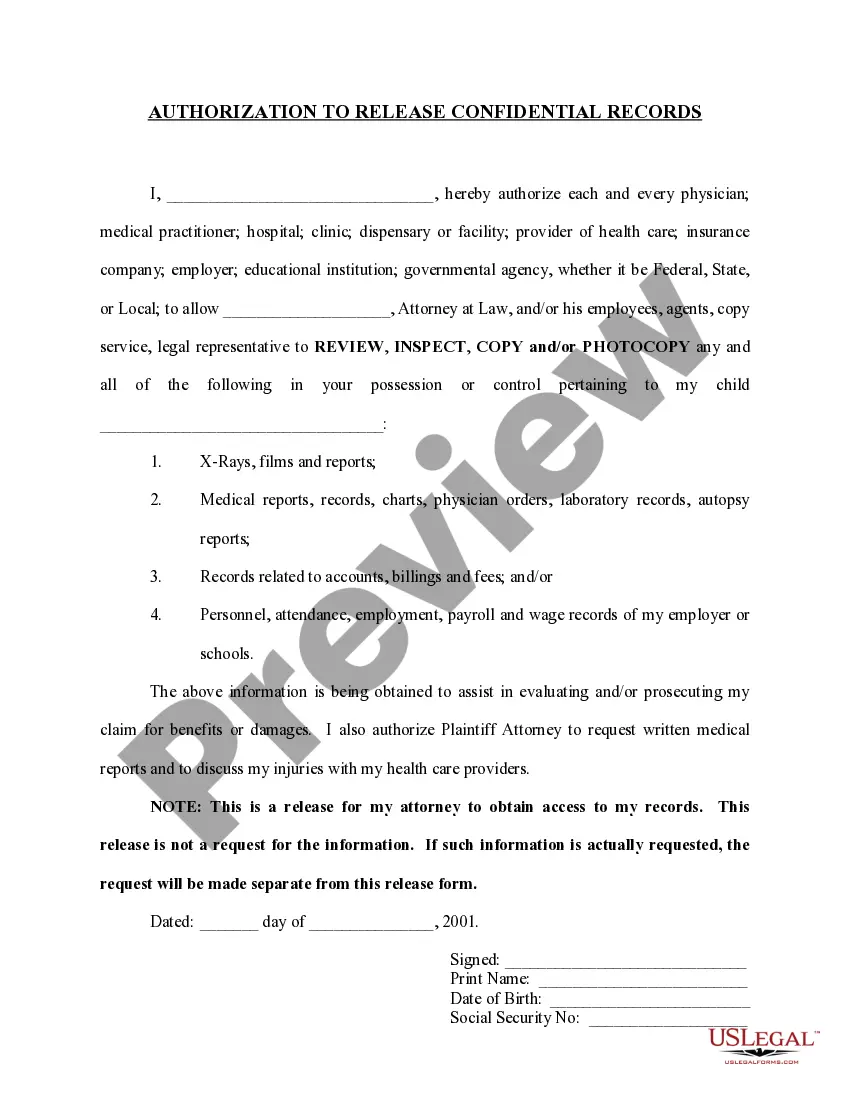
The Notice for Motion for Disclosure of Records is a legal document used in court proceedings. It notifies relevant parties that a petitioner has filed a motion to obtain access to records that may be necessary for a trial. This form is essential for ensuring transparency and allowing both parties to prepare adequately for legal arguments. It differs from other motions by specifically focusing on the disclosure of evidence rather than requesting a ruling or presenting a case.
Main sections of this form
- Return date: Specifies when the court hearing will take place.
- Case details: Includes information about the petitioner and the judicial district.
- Notice recipients: Identifies the individuals and organizations receiving the notice.
- Hearing details: Outlines when and where the court will consider the motion.
- Protective order information: Describes the handling of protected health information related to the records requested.
When to use this form
This form should be used when a petitioner needs to disclose evidence, such as medical records or other documentation, relevant to their case. It is typically required in situations involving health information or other sensitive data that a party may hold, making it crucial to comply with legal standards for privacy and disclosure during court proceedings.
Intended users of this form
- Petitioners involved in court cases requesting disclosure of specific records.
- Attorneys representing clients in matters where evidence disclosure is necessary.
- Records custodians who need to understand their obligations to disclose information legally.
Completing this form step by step
- Enter the return date required by the court.
- Fill in the case details, including the petitionerâs name and the judicial district.
- List the names and addresses of the notice recipients.
- Specify the location and time for the court hearing.
- Include any relevant information concerning the protective order for handling disclosed records.
Notarization requirements for this form
This form does not typically require notarization unless specified by local law. It is advisable to review local requirements to ensure compliance.
Get your form ready online
Our built-in tools help you complete, sign, share, and store your documents in one place.
Make edits, fill in missing information, and update formatting in US Legal Forms—just like you would in MS Word.
Download a copy, print it, send it by email, or mail it via USPS—whatever works best for your next step.
Sign and collect signatures with our SignNow integration. Send to multiple recipients, set reminders, and more. Go Premium to unlock E-Sign.
If this form requires notarization, complete it online through a secure video call—no need to meet a notary in person or wait for an appointment.
We protect your documents and personal data by following strict security and privacy standards.

Make edits, fill in missing information, and update formatting in US Legal Forms—just like you would in MS Word.

Download a copy, print it, send it by email, or mail it via USPS—whatever works best for your next step.

Sign and collect signatures with our SignNow integration. Send to multiple recipients, set reminders, and more. Go Premium to unlock E-Sign.

If this form requires notarization, complete it online through a secure video call—no need to meet a notary in person or wait for an appointment.

We protect your documents and personal data by following strict security and privacy standards.
Common mistakes to avoid
- Failing to include all required recipients in the notice.
- Leaving the return date blank or filling it incorrectly.
- Not specifying the correct court or judicial district.
- Omitting important details about the protective order related to information handling.
Advantages of online completion
- Easy access to customizable templates drafted by legal professionals.
- Ability to download and complete the form at your convenience.
- Instant updates to keep the form compliant with current laws.
Main things to remember
- The Notice for Motion for Disclosure of Records facilitates the sharing of essential evidence in court cases.
- Proper completion of this form is vital to avoid delays in the legal process.
- This form is adaptable for use in various jurisdictions, pending local laws.
Looking for another form?
Form popularity
FAQ
A motion to dismiss includes an introduction stating the purpose, a statement of facts, and legal arguments supporting the dismissal. Each section should clearly present information that supports your position, focusing on jurisdiction, statutory grounds, or failures in the claim. It is crucial to follow specific court rules regarding format and content. When drafting a Connecticut Notice for Motion for Disclosure of Records, remember to incorporate these elements effectively.
Writing a strong motion to dismiss involves clearly stating the legal basis for the dismissal while supporting it with relevant facts and law. It is important to be concise yet thorough, addressing all necessary points without extraneous details. A well-structured motion presents a compelling argument that aligns with court rules. As you prepare a Connecticut Notice for Motion for Disclosure of Records, consider these strategies for a persuasive motion.
Rule 4.2 in Connecticut pertains to service of process, outlining how legal documents must be delivered to parties involved in a lawsuit. It ensures that all parties are informed and have the opportunity to respond appropriately. Compliance with this rule is essential to uphold the fairness of legal proceedings. When working with a Connecticut Notice for Motion for Disclosure of Records, being aware of rule 4.2 can help ensure proper service.
A Motion for disclosure in court requests the release of evidence or information that is crucial to a case. This motion aims to ensure that all parties have access to relevant facts that may impact trial outcomes. By using this motion, you can compel a party to share necessary records or documentation. Incorporating the Connecticut Notice for Motion for Disclosure of Records can streamline this process.
A Motion for clarification in Connecticut serves to resolve ambiguities or uncertainties in court orders or rulings. This motion requests the court to provide clearer guidance on its previous decisions. Effective use of this motion can aid parties in understanding their responsibilities and the court's expectations. Understanding how such motions interact with documents like the Connecticut Notice for Motion for Disclosure of Records can enhance your legal strategy.
The rule 12 motion to dismiss is commonly used to challenge the legal sufficiency of the opponent’s claims. This motion can assert defects in the allegations, such as lack of jurisdiction or failure to state a claim upon which relief can be granted. By filing this motion, a party can seek a quick resolution to the case without proceeding to trial. When preparing a Connecticut Notice for Motion for Disclosure of Records, it is important to be aware of the implications of a rule 12 motion.
The rule 19 motion to dismiss addresses situations where a party is crucial to the case but has not been included in the action. This motion argues that the court cannot proceed without this party. It seeks to preserve the integrity of legal proceedings by ensuring all essential parties are present. If you are preparing a Connecticut Notice for Motion for Disclosure of Records, understanding this motion is vital.
A motion to disclose refers to a formal request made by one party in a legal proceeding to obtain records or information from another party. In the context of the Connecticut Notice for Motion for Disclosure of Records, this motion can be crucial in various legal matters, including real estate transactions, ensuring transparency and informed decision-making.
Connecticut is not classified as a full disclosure state. This means that while sellers must disclose certain conditions of a property, the scope is not as comprehensive as in some full disclosure states. However, utilizing the Connecticut Notice for Motion for Disclosure of Records can help you obtain necessary information to make informed decisions regarding the property.
Connecticut does have specific disclosure requirements for real estate transactions. Sellers must provide buyers with a property disclosure form detailing the condition of the property. By understanding these requirements and utilizing the Connecticut Notice for Motion for Disclosure of Records, you can ensure compliance and protect your interests during the buying process.