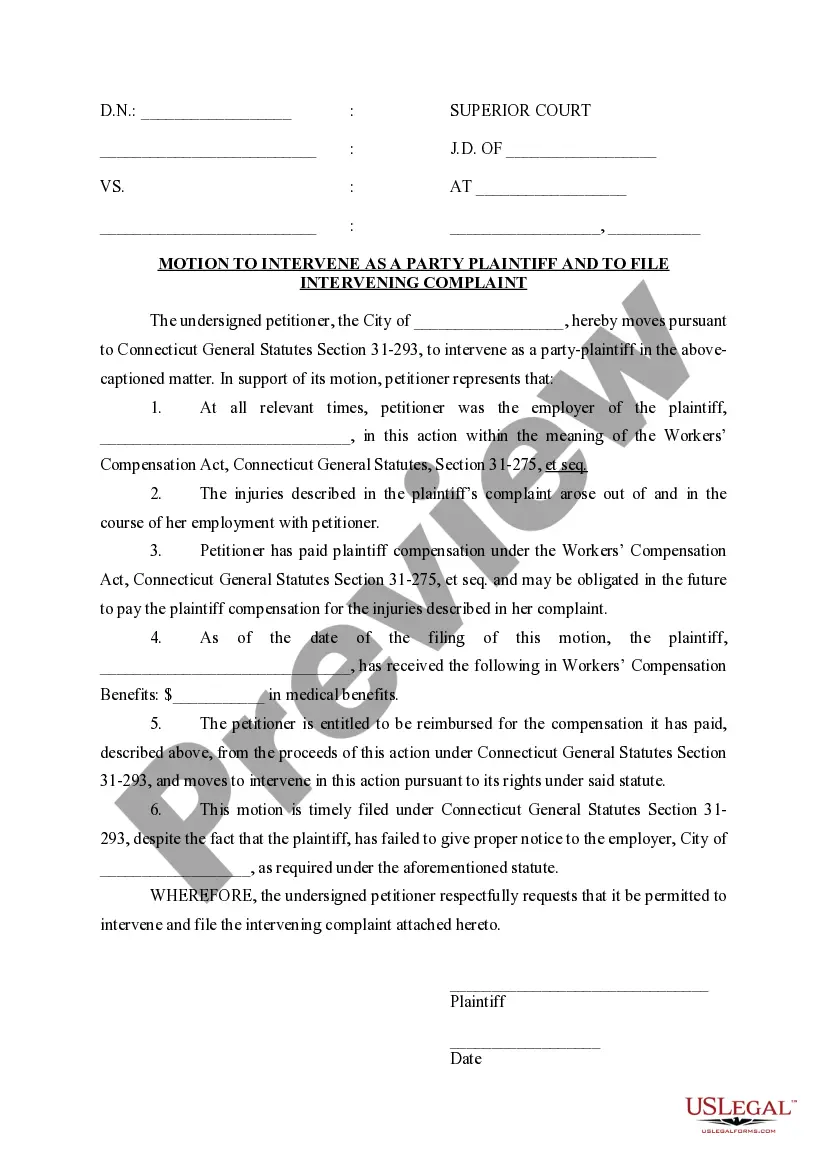
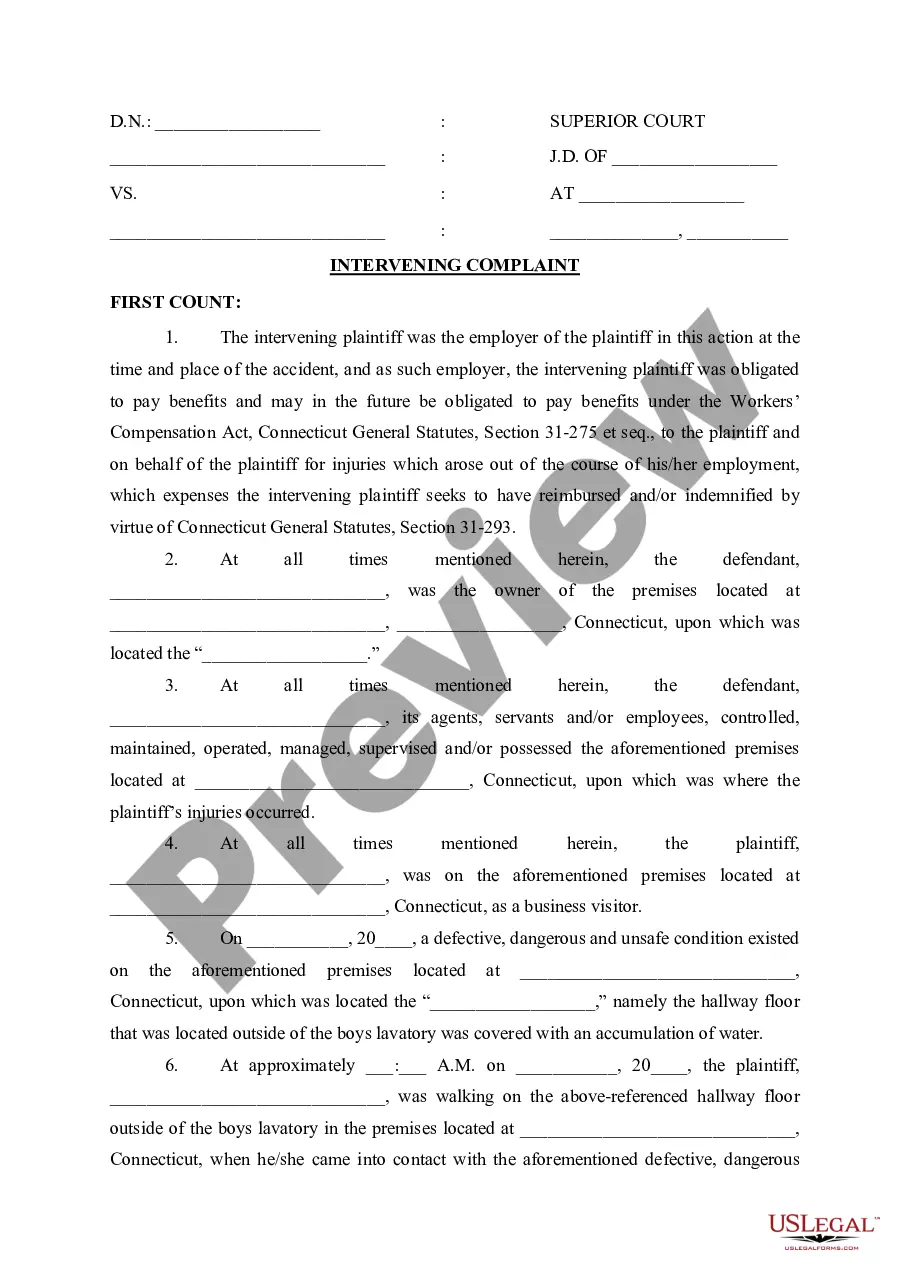
Connecticut Motion to Intervene as a Party Plaintiff and to File Intervening Complaint
What this document covers
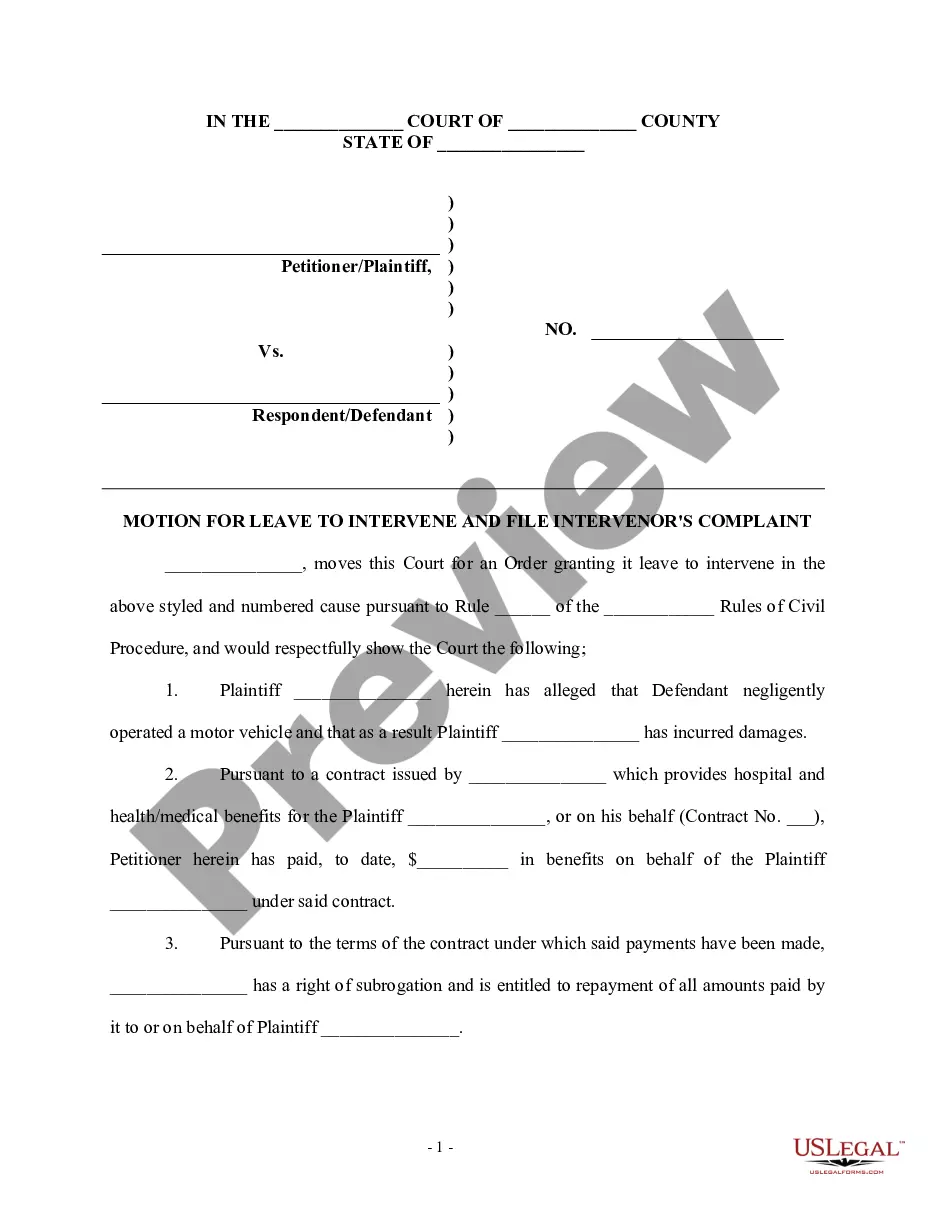
The Motion to Intervene as a Party Plaintiff and to File Intervening Complaint is a legal document used when a third party seeks to join an ongoing lawsuit. This form allows the third party to become actively involved in the case, enabling them to present their claims and interests related to the matter at hand. This type of motion is particularly relevant in workers' compensation cases, where an employer, as a potentially liable party, wishes to intervene to protect their rights and seek reimbursement for any compensation provided to the plaintiff.
Main sections of this form
- Case information section to identify the court and parties involved.
- Statement of facts outlining the employer's relationship to the plaintiff.
- Claims regarding compensation paid under workers' compensation laws.
- Details of past medical benefits provided to the plaintiff.
- Legal basis for the intervention under state statutes.
- Signature block for the petitioner and date of filing.
Situations where this form applies
This form should be used in situations where a third party, typically an employer, needs to assert their legal rights in a lawsuit. For instance, if a former employee files a lawsuit for injuries sustained at work, and the employer has paid for workers' compensation benefits, the employer may need to file this motion to intervene. This ensures that the employer can seek reimbursement from any settlement or judgment awarded to the employee.
Who needs this form
- Employers who are paying workers' compensation benefits to an employee involved in a lawsuit.
- Insurance companies seeking to join a suit to protect their interests.
- Legal representatives of employers who need to intervene in lawsuits for financial claims.
- Any third party with interests related to the outcomes of the case.
How to prepare this document
- Fill in the case information, including court name and case number.
- Provide the name of the plaintiff and any other relevant parties.
- Detail the employment relationship and the nature of the plaintiff's injuries.
- State the compensation paid and any future obligations under the workers' compensation act.
- Sign and date the form to submit it to the court.
Does this document require notarization?
This form does not typically require notarization unless specified by local law. Ensure that you check current state requirements to confirm.
Get your form ready online
Our built-in tools help you complete, sign, share, and store your documents in one place.
Make edits, fill in missing information, and update formatting in US Legal Forms—just like you would in MS Word.
Download a copy, print it, send it by email, or mail it via USPS—whatever works best for your next step.
Sign and collect signatures with our SignNow integration. Send to multiple recipients, set reminders, and more. Go Premium to unlock E-Sign.
If this form requires notarization, complete it online through a secure video call—no need to meet a notary in person or wait for an appointment.
We protect your documents and personal data by following strict security and privacy standards.

Make edits, fill in missing information, and update formatting in US Legal Forms—just like you would in MS Word.

Download a copy, print it, send it by email, or mail it via USPS—whatever works best for your next step.

Sign and collect signatures with our SignNow integration. Send to multiple recipients, set reminders, and more. Go Premium to unlock E-Sign.

If this form requires notarization, complete it online through a secure video call—no need to meet a notary in person or wait for an appointment.

We protect your documents and personal data by following strict security and privacy standards.
Common mistakes to avoid
- Failing to timely file the motion within the required statutory period.
- Not providing sufficient detail about the compensation already paid.
- Missing the necessary signatures or failing to date the form.
- Neglecting to ensure compliance with notice requirements to all parties involved.
Advantages of online completion
- Convenience of accessing and downloading the form from anywhere.
- Editable format allows for easy customization specific to your case.
- Reliable templates that comply with current legal standards and regulations.
- Quick turnaround for filing, helping to expedite the intervention process.
Looking for another form?
Form popularity
FAQ
Intervention in court refers to a procedure that enables a person or entity to join an ongoing legal action. This process is often necessary to ensure that all parties with interests are represented in court. Filing a Connecticut Motion to Intervene as a Party Plaintiff and to File Intervening Complaint allows individuals to make their case known effectively. This action promotes fairness and comprehensive legal considerations.
A motion for intervention is a formal request for a third party to join an existing legal proceeding. This request is critical for individuals who feel directly impacted by the case outcome. By filing a Connecticut Motion to Intervene as a Party Plaintiff and to File Intervening Complaint, a person seeks to safeguard their rights and interests. This motion must be clearly justified for the court to take action.
An intervening cause refers to an event that affects the outcome of a lawsuit after an initial injury has occurred. In this context, a plaintiff may demonstrate how such a cause impacts their case. In relation to a Connecticut Motion to Intervene as a Party Plaintiff and to File Intervening Complaint, understanding these concepts can clarify claims involved in the lawsuit. This ensures that all pertinent issues are addressed effectively.
Intervenor plaintiffs are individuals or entities that join a lawsuit to assert their own claims. They typically file a Connecticut Motion to Intervene as a Party Plaintiff and to File Intervening Complaint to establish their right to participate. This can happen when the existing parties do not fully represent their interests. By becoming intervenor plaintiffs, they can influence the outcome of the matter at hand.
Intervening in a lawsuit allows a third party to enter an ongoing case. This action can be crucial when someone believes they have a stake in the matter being discussed. By filing a Connecticut Motion to Intervene as a Party Plaintiff and to File Intervening Complaint, that individual may protect their interests. This process ensures that all relevant parties have a voice in the legal proceedings.
You should file a motion to intervene whenever you believe your rights or interests may be impacted by an ongoing case. This action is commonly taken before a final judgment is made. If you're looking to take action, utilizing a Connecticut Motion to Intervene as a Party Plaintiff and to File Intervening Complaint can provide you with the necessary tools to protect your interests effectively.
A motion to intervene in an appeal allows a third party to join an appellate case that may affect their interests. This motion ensures that the appellate court considers the intervenor's viewpoint alongside the original parties. When you pursue a Connecticut Motion to Intervene as a Party Plaintiff and to File Intervening Complaint in this context, you strengthen your position in the case.
The federal rule governing motions to intervene is Rule 24 of the Federal Rules of Civil Procedure. This rule outlines the criteria for both intervention as of right and permissive intervention. If you are considering a Connecticut Motion to Intervene as a Party Plaintiff and to File Intervening Complaint, it's crucial to understand these rules to ensure you meet all necessary requirements.
The right to intervene allows individuals or entities to join a legal proceeding when their rights may be impacted. This right often arises in situations where existing parties may not fully represent the interests of the intervenor. Engaging through a Connecticut Motion to Intervene as a Party Plaintiff and to File Intervening Complaint ensures that all relevant voices are heard in court.
An intervenor is a person or organization that joins an ongoing lawsuit to protect their interests. For instance, if a lawsuit involves property rights, a neighboring landowner may intervene to ensure their rights are not affected. In the context of a Connecticut Motion to Intervene as a Party Plaintiff and to File Intervening Complaint, this allows individuals to make their claims relevant to the case.