Connecticut Notice of Assessment/Demand for Payment/Judgment Proceedings
About this form
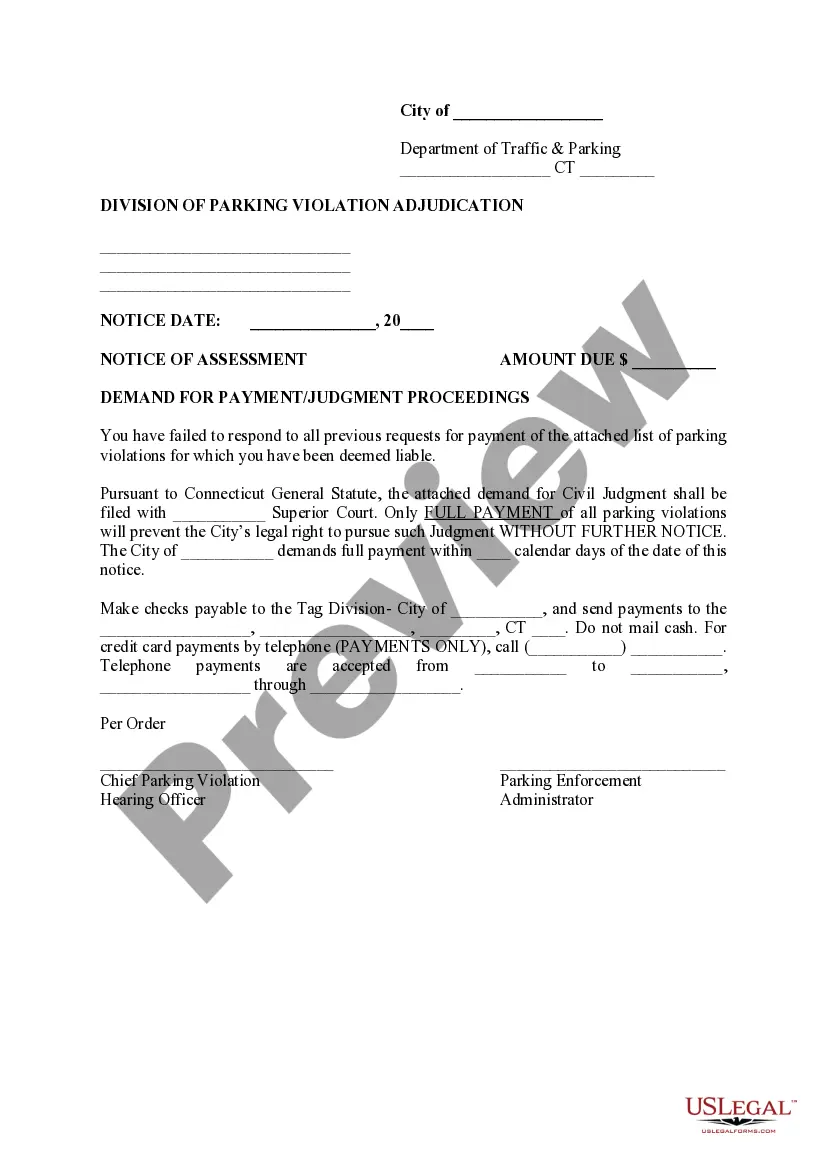
The Notice of Assessment/Demand for Payment/Judgment Proceedings is an official notice issued by the Cityâs Traffic & Parking Department. This form serves to inform individuals who have outstanding parking violations of the total amount due and the potential legal consequences for failure to respond. Unlike other forms related to parking violations, this notice specifically initiates judgment proceedings, emphasizing the urgency for payment to avoid further legal actions.
Main sections of this form
- City and department details: Identifies the relevant city's Traffic & Parking Department.
- Notice date: Specifies the date the notice is issued.
- Amount due: Clearly states the total amount owed for parking violations.
- Demand for payment: Directs the recipient to pay the full amount within a specified number of days.
- Payment instructions: Provides methods for how to make payments, including check and telephone options.
- Official signatures: Includes signatures from the Chief Parking Violation Hearing Officer and Administrator.
When to use this document
This form is needed when an individual has received previous notifications regarding unpaid parking violations but has not responded. It is used by government agencies to formally demand payment and initiate legal proceedings if the individual does not comply. Use this form to ensure that you clearly communicate the owed amount and the potential legal implications of non-payment.
Who this form is for
- Individuals who have received parking violation notices and failed to make payments.
- City or town officials responsible for enforcement of parking violations.
- Legal representatives handling disputes related to parking violations on behalf of clients.
How to prepare this document
- Fill in the name of the City and Traffic & Parking Department at the top of the form.
- Enter the date the notice is issued in the designated section.
- Specify the total amount due for the parking violations.
- Indicate the deadline for payment, providing a specific number of calendar days for compliance.
- Sign and date the form, ensuring that all required signatures are included.
Notarization guidance
This form does not typically require notarization unless specified by local law. Always check local regulations to ensure compliance with legal requirements for enforcement actions.
Get your form ready online
Our built-in tools help you complete, sign, share, and store your documents in one place.
Make edits, fill in missing information, and update formatting in US Legal Forms—just like you would in MS Word.
Download a copy, print it, send it by email, or mail it via USPS—whatever works best for your next step.
Sign and collect signatures with our SignNow integration. Send to multiple recipients, set reminders, and more. Go Premium to unlock E-Sign.
If this form requires notarization, complete it online through a secure video call—no need to meet a notary in person or wait for an appointment.
We protect your documents and personal data by following strict security and privacy standards.

Make edits, fill in missing information, and update formatting in US Legal Forms—just like you would in MS Word.

Download a copy, print it, send it by email, or mail it via USPS—whatever works best for your next step.

Sign and collect signatures with our SignNow integration. Send to multiple recipients, set reminders, and more. Go Premium to unlock E-Sign.

If this form requires notarization, complete it online through a secure video call—no need to meet a notary in person or wait for an appointment.

We protect your documents and personal data by following strict security and privacy standards.
Common mistakes
- Failing to accurately fill in the total amount due can cause confusion.
- Not providing the correct payment methods or details can delay payment processing.
- Leaving out signatures from authorized officials may invalidate the form.
Benefits of using this form online
- Easy access: Downloadable templates allow for immediate use without waiting for postal delivery.
- Editability: Forms can be filled in digitally, ensuring clarity and reducing errors.
- Reliability: Legal forms provided are drafted by licensed attorneys, ensuring compliance with state laws.
Looking for another form?
Form popularity
FAQ
In Connecticut, a judgment lien remains effective for 20 years from the date it is recorded. This means that if you have a judgment against you, it can affect your property for two decades. Understanding this timeframe is crucial when dealing with Connecticut Notice of Assessment/Demand for Payment/Judgment Proceedings. Consulting with a legal expert can provide clarity and guide you on how to manage or challenge the lien.
In Connecticut, a judgment lien typically lasts for 20 years from the date it is entered. This lien attaches to your real property, affecting your ability to sell or refinance until the judgment is satisfied. It's critical to understand how judgment liens work, especially if you're navigating Connecticut Notice of Assessment/Demand for Payment/Judgment Proceedings. Consulting resources like US Legal Forms can help clarify your options regarding judgment liens.
Avoiding payment of a judgment is complex and may not always be advisable. You could explore options such as appealing the judgment if you believe it was rendered incorrectly. Additionally, negotiating a payment plan or settlement with the creditor may be possible, especially in the context of Connecticut Notice of Assessment/Demand for Payment/Judgment Proceedings. Remember, seeking legal advice can provide you with tailored strategies for your situation.
If you fail to attend court for a judgment, the court may render a default judgment against you. This means that the opposing party could win their case by default, which significantly affects your legal standing. Additionally, ignoring court summons can lead to enforcement actions such as wage garnishment or property liens as part of Connecticut Notice of Assessment/Demand for Payment/Judgment Proceedings. Thus, it is essential to address any court obligations promptly.
To file an acknowledgment of satisfaction of judgment, you must obtain a form that complies with Connecticut's requirements. After completing the form, file it with the court that issued the original judgment. This process confirms that you have fulfilled the terms of the judgment. For guidance and access to the necessary forms, consider using US Legal Forms, which simplifies the filing process related to Connecticut Notice of Assessment/Demand for Payment/Judgment Proceedings.
A judgment lien can remain on your credit report for up to seven years from the date of entry, even if it is satisfied. This time frame can affect your creditworthiness and ability to secure loans. If you're facing issues related to Connecticut Notice of Assessment/Demand for Payment/Judgment Proceedings, it's wise to regularly check your credit report and take steps to clear any inaccuracies.
A motion for summary judgment in Connecticut is a request made to the court seeking a judgment in your favor without a full trial. This motion asserts that there are no disputed material facts, allowing the court to decide based on the law. If you are involved in Connecticut Notice of Assessment/Demand for Payment/Judgment Proceedings, this could be a vital strategy to expedite your case and achieve a swift resolution.
In Connecticut, a lien is generally valid for five years but can be extended through proper renewal procedures. This timeline is essential if you are navigating through Connecticut Notice of Assessment/Demand for Payment/Judgment Proceedings, as it impacts how long a creditor can claim against your property. Understanding these details can assist you in managing your financial obligations more effectively.
A judgment lien in Connecticut usually lasts for five years from the date of the judgment. However, a lien can be renewed before it expires, extending its effect. This means if you are dealing with Connecticut Notice of Assessment/Demand for Payment/Judgment Proceedings, it is crucial to understand the timelines involved to safeguard your interests in any real estate transactions.