Connecticut Quitclaim Deed from an LLC to an Individual
Overview of this form
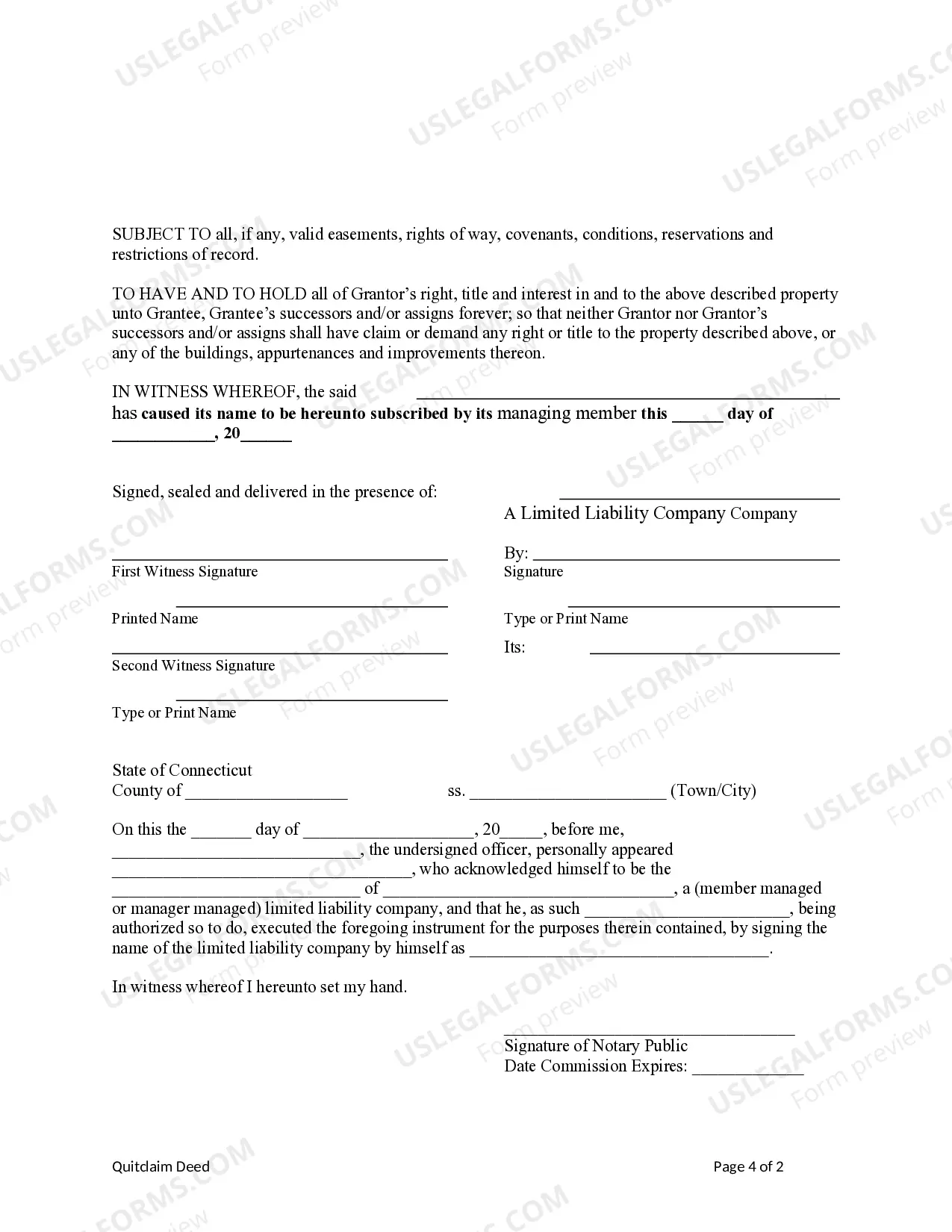
This Quitclaim Deed form allows a Limited Liability Company (LLC) to transfer property ownership to an individual. Unlike warranty deeds, a quitclaim deed does not guarantee that the title is free of claims or liens, making it a straightforward option for transferring property rights. It is essential to understand that while this form is simple, it may not provide the same level of protection as other types of deeds. Always consider consulting a legal professional for advice tailored to your situation.
Key components of this form
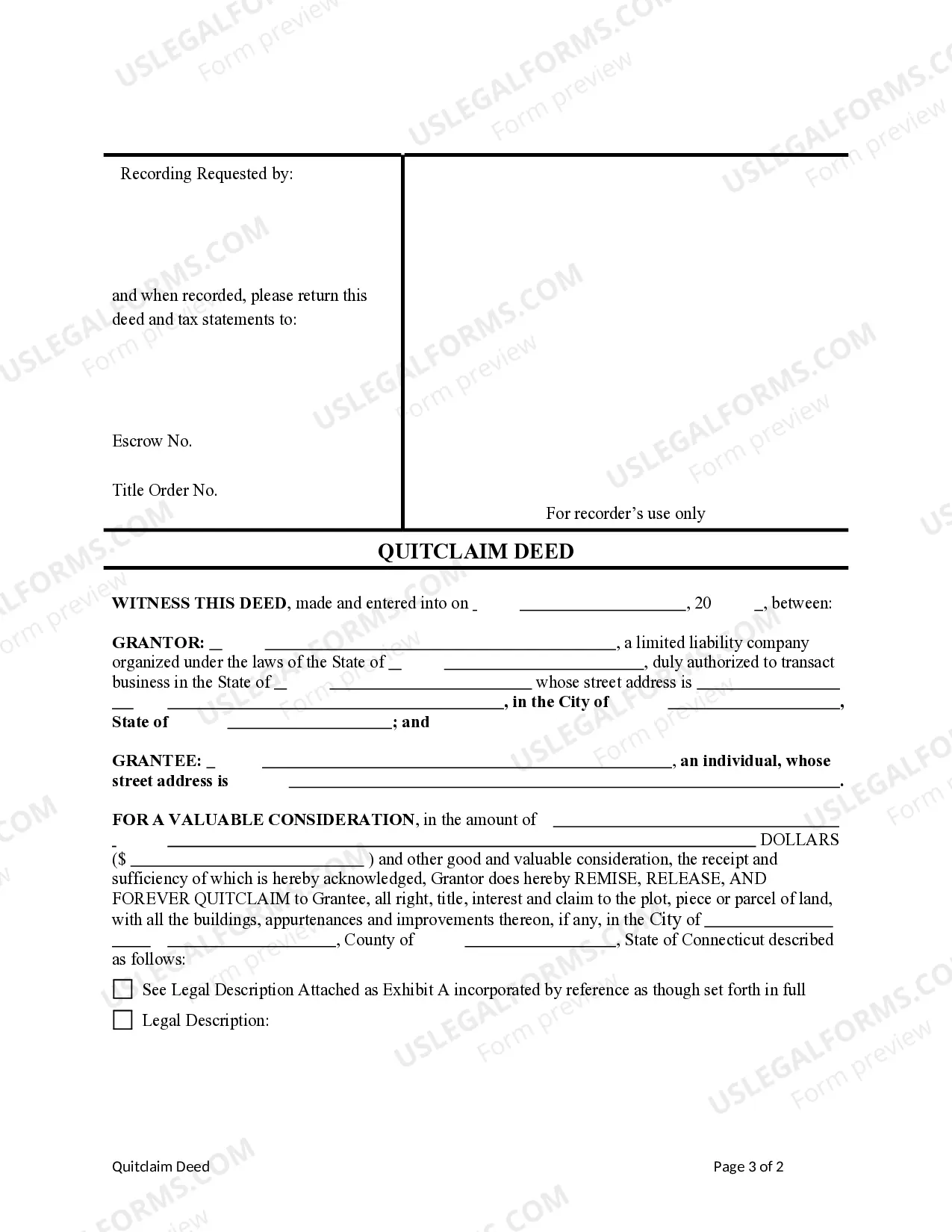
- Identification of the Grantor (LLC) and Grantee (Individual).
- Description of the property being transferred.
- Statement of the grant and quitclaim from Grantor to Grantee.
- Signatures of both parties, and a space for notarization.





When to use this form
This Quitclaim Deed is useful when an LLC wishes to convey property to an individual without the need for a warranty or guarantee regarding the title. Common scenarios include family transfers, informal agreements, or situations where the parties trust one another and do not require title insurance or assurances. This form is often used during estate planning or when simplifying property transfers.
Who should use this form
This form is intended for:
- LLCs looking to transfer real estate to an individual.
- Individuals receiving property from an LLC.
- Real estate professionals and agents involved in property transfers.
How to prepare this document
- Identify the Grantor and Grantee, including legal names and addresses.
- Describe the property being conveyed, including its legal description.
- Ensure both parties sign the form in the designated areas.
- Include the date of the transfer.
- Have the form notarized where required for legal validity.
Is notarization required?
Yes, this form must be notarized to be legally valid. It is essential to have a notary public witness the signatures to enforce the deed transfer properly. US Legal Forms offers integrated online notarization services, available 24/7, to facilitate this process securely.
Get your form ready online
Our built-in tools help you complete, sign, share, and store your documents in one place.
Make edits, fill in missing information, and update formatting in US Legal Forms—just like you would in MS Word.
Download a copy, print it, send it by email, or mail it via USPS—whatever works best for your next step.
Sign and collect signatures with our SignNow integration. Send to multiple recipients, set reminders, and more. Go Premium to unlock E-Sign.
If this form requires notarization, complete it online through a secure video call—no need to meet a notary in person or wait for an appointment.
We protect your documents and personal data by following strict security and privacy standards.

Make edits, fill in missing information, and update formatting in US Legal Forms—just like you would in MS Word.

Download a copy, print it, send it by email, or mail it via USPS—whatever works best for your next step.

Sign and collect signatures with our SignNow integration. Send to multiple recipients, set reminders, and more. Go Premium to unlock E-Sign.

If this form requires notarization, complete it online through a secure video call—no need to meet a notary in person or wait for an appointment.

We protect your documents and personal data by following strict security and privacy standards.
Common mistakes to avoid
- Failing to accurately describe the property can lead to future disputes.
- Not obtaining notarization when necessary, which could invalidate the deed.
- Leaving out the signatures of both parties.
Benefits of using this form online
- Convenience of completing the form from your home.
- Editability enables you to make changes as needed before finalizing.
- Access to trusted legal templates prepared by licensed attorneys.
Main things to remember
- A Quitclaim Deed is a simple way for an LLC to transfer property to an individual.
- This form does not guarantee against title claims.
- Ensure notarization for the deed to hold legal weight.
Looking for another form?
Form popularity
FAQ
To transfer property from an LLC to an individual, you typically need to execute a Connecticut Quitclaim Deed. This document must be signed by appropriate parties and filed with the local registrar. Additionally, it’s wise to access resources like USLegalForms to guide you through the process, ensuring all legal requirements are met for a seamless transition.
Transferring ownership of an LLC can be complex due to the operating agreement and state regulations. These documents dictate the process, and they may impose restrictions on transfers. Moreover, with a Connecticut Quitclaim Deed from an LLC to an Individual, legal considerations must be navigated carefully to ensure that all parties comply with the law and that the transfer is executed smoothly.
When you transfer ownership of an LLC, it can trigger various tax consequences. The IRS may view the transfer as a sale, which could result in capital gains taxes depending on the fair market value of the assets involved. Additionally, when utilizing a Connecticut Quitclaim Deed from an LLC to an Individual, it's essential to consult with a tax professional to ensure compliance and understand your specific situation.
Yes, you can handle the process of creating a quitclaim deed yourself, especially with a Connecticut Quitclaim Deed from an LLC to an Individual. Many resources are available online to guide you through the steps. However, you may want to consider using a platform like US Legal Forms for access to templates and legal guidance. This can help ensure that the deed is completed accurately and filed correctly, avoiding potential issues in the future.
Filing a quitclaim deed in Connecticut requires you to properly fill out the deed with the correct details of the transfer. Ensure all parties involved, particularly from the LLC to the Individual, are accurately represented. Once completed, you must have the document notarized and then file it with your local town clerk’s office. Keeping a copy for your records is also a good practice.
People frequently use a quitclaim deed for a transfer of property between family members or during divorce settlements. The Connecticut Quitclaim Deed from an LLC to an Individual is particularly useful when the parties know each other well and trust the title being conveyed. Additionally, it simplifies the transfer process since no title insurance is typically involved. This deed allows for quick transfers without an extensive title search.
To file a quitclaim deed in Connecticut, you must complete the statutory form for the Connecticut Quitclaim Deed from an LLC to an Individual. Next, you need to sign the document in the presence of a notary public. Then, submit the signed deed to the local town clerk’s office where the property is located. It's also wise to check local requirements for any additional information or fees that may apply.
The process for a Connecticut Quitclaim Deed from an LLC to an Individual involves several steps. First, prepare the deed with the necessary information and have it signed by the grantor in the presence of a notary. After that, you must file the deed with the local town clerk's office where the property is located. This ensures that the transfer is officially recorded and publicly accessible.
Yes, you can fill out a Connecticut Quitclaim Deed from an LLC to an Individual yourself if you understand the process. However, it's important to ensure that all details are correct and meet state requirements. Using a platform like US Legal Forms can simplify this task, offering templates and guidance to make sure your deed adheres to legal standards.
To create a Connecticut Quitclaim Deed from an LLC to an Individual, you must provide basic information. This includes the names of both the grantor and the grantee, a legal description of the property, and the date of execution. Additionally, the deed must be signed by the grantor and notarized to ensure its validity. It's essential to follow these requirements to prevent complications later.