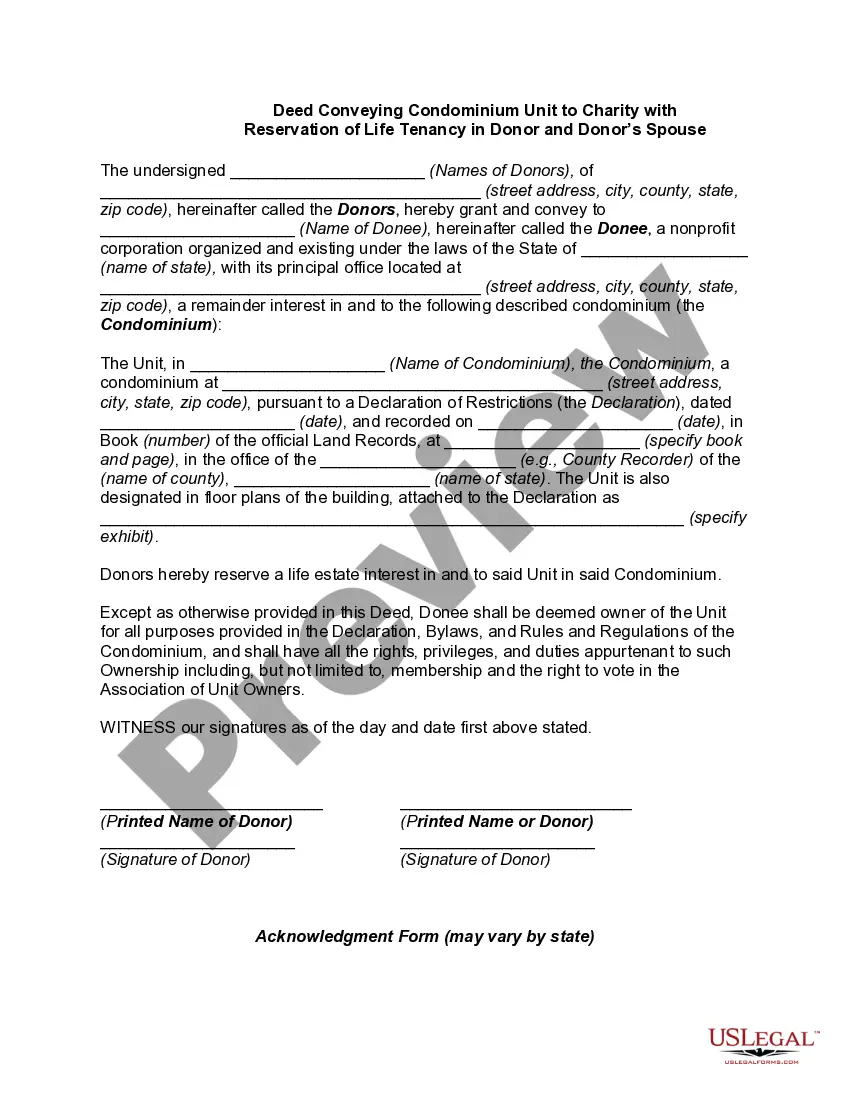
Connecticut Deed Conveying Condominium Unit to Charity with Reservation of Life Tenancy in Donor and Donor's Spouse
Description


Get your form ready online
Our built-in tools help you complete, sign, share, and store your documents in one place.
Make edits, fill in missing information, and update formatting in US Legal Forms—just like you would in MS Word.
Download a copy, print it, send it by email, or mail it via USPS—whatever works best for your next step.
Sign and collect signatures with our SignNow integration. Send to multiple recipients, set reminders, and more. Go Premium to unlock E-Sign.
If this form requires notarization, complete it online through a secure video call—no need to meet a notary in person or wait for an appointment.
We protect your documents and personal data by following strict security and privacy standards.

Make edits, fill in missing information, and update formatting in US Legal Forms—just like you would in MS Word.

Download a copy, print it, send it by email, or mail it via USPS—whatever works best for your next step.

Sign and collect signatures with our SignNow integration. Send to multiple recipients, set reminders, and more. Go Premium to unlock E-Sign.

If this form requires notarization, complete it online through a secure video call—no need to meet a notary in person or wait for an appointment.

We protect your documents and personal data by following strict security and privacy standards.
Looking for another form?
How to fill out Deed Conveying Condominium Unit To Charity With Reservation Of Life Tenancy In Donor And Donor's Spouse?
Finding the right legitimate papers format can be quite a battle. Naturally, there are a lot of templates accessible on the Internet, but how will you find the legitimate kind you want? Use the US Legal Forms web site. The services offers a large number of templates, such as the Connecticut Deed Conveying Condominium Unit to Charity with Reservation of Life Tenancy in Donor and Donor's Spouse, which you can use for business and personal requirements. Every one of the types are checked by specialists and fulfill state and federal requirements.
Should you be already signed up, log in to the account and click on the Acquire option to find the Connecticut Deed Conveying Condominium Unit to Charity with Reservation of Life Tenancy in Donor and Donor's Spouse. Make use of account to search from the legitimate types you possess ordered in the past. Check out the My Forms tab of your account and acquire another duplicate from the papers you want.
Should you be a whole new user of US Legal Forms, listed here are simple directions for you to comply with:
- Very first, make certain you have selected the right kind to your area/area. You can check out the form using the Review option and browse the form information to ensure this is basically the right one for you.
- If the kind is not going to fulfill your expectations, take advantage of the Seach discipline to obtain the correct kind.
- Once you are certain that the form is suitable, select the Purchase now option to find the kind.
- Opt for the costs plan you need and type in the needed details. Build your account and pay for your order utilizing your PayPal account or bank card.
- Select the file formatting and download the legitimate papers format to the gadget.
- Complete, edit and printing and indication the received Connecticut Deed Conveying Condominium Unit to Charity with Reservation of Life Tenancy in Donor and Donor's Spouse.
US Legal Forms may be the greatest catalogue of legitimate types where you can see a variety of papers templates. Use the service to download expertly-created paperwork that comply with state requirements.
Form popularity
FAQ
A life estate is a form of ownership of real property. The person who holds the life estate is called the life tenant, and he or she is given rights to occupy the property until death. The other owner(s) are called remaindermen.
A life estate can be established during one's life time by deeding property to someone while reserving, for oneself or another party, a life estate. This is accomplished through language in the transfer instrument that gives a designated person (or people) the right to use the property for their lifetime.
In Connecticut, the right of survivorship comes when you own property in joint tenancy. Property owned in joint tenancy automatically passes to the surviving owners when one owner dies. No probate is necessary.
A life estate helps avoid the probate process upon the life tenant's death. The property will automatically transfer to the remainderman, making the process simple and easy ? a will isn't needed for the transfer to happen.
Cons of a Life Estate Deed Lack of control for the owner. ... Property taxes, which remain for the life tenant until their death. ... It's tough to reverse. ... The owner is still vulnerable to any debt actions that may be brought against the future beneficiary or remainderman.
Within a life estate, the life estate deed is a document that grants the owner the ability to pass on ownership of a property without including it in a will as part of a person's assets.
WILL A LIVING TRUST AVOID PROBATE? Yes, but under current Connecticut law, not entirely. If assets are properly placed in trust before death, the living trust ?bypasses? probate as no proceedings are now necessary to pass title on death.
In Connecticut an owner of real property can can transfer ownership of their property by a quit claim deed of the property to another person(s) and retain a life use, allowing them to continue living in the home until their death. This avoids probate of this real property.