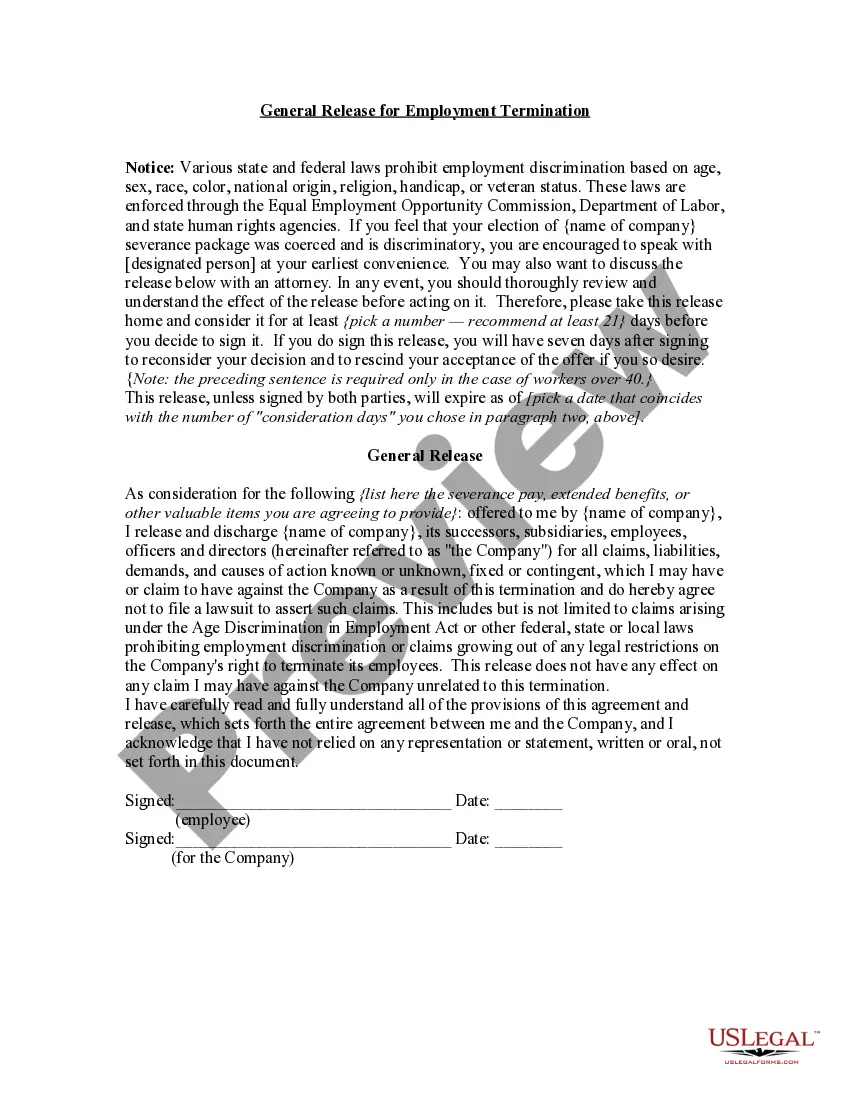
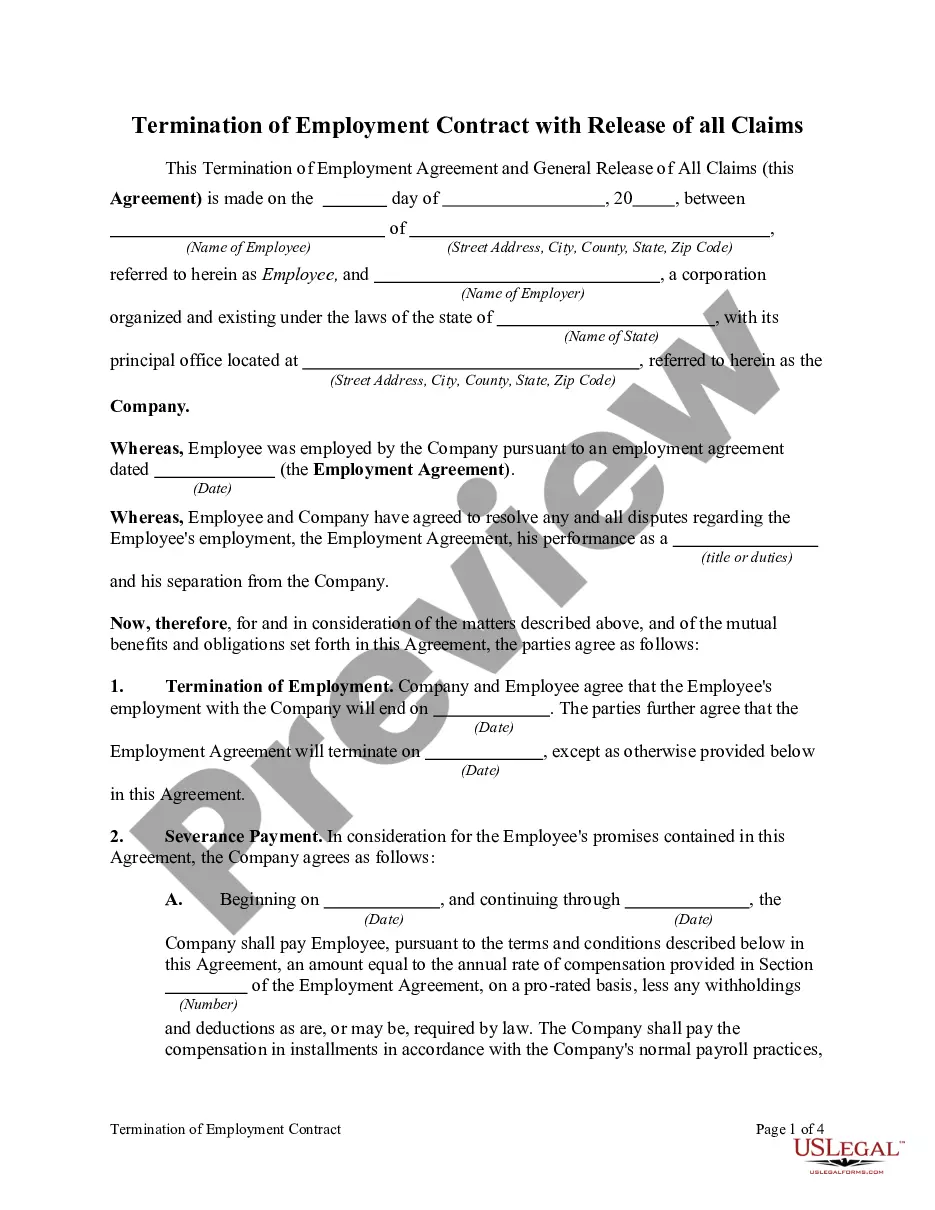
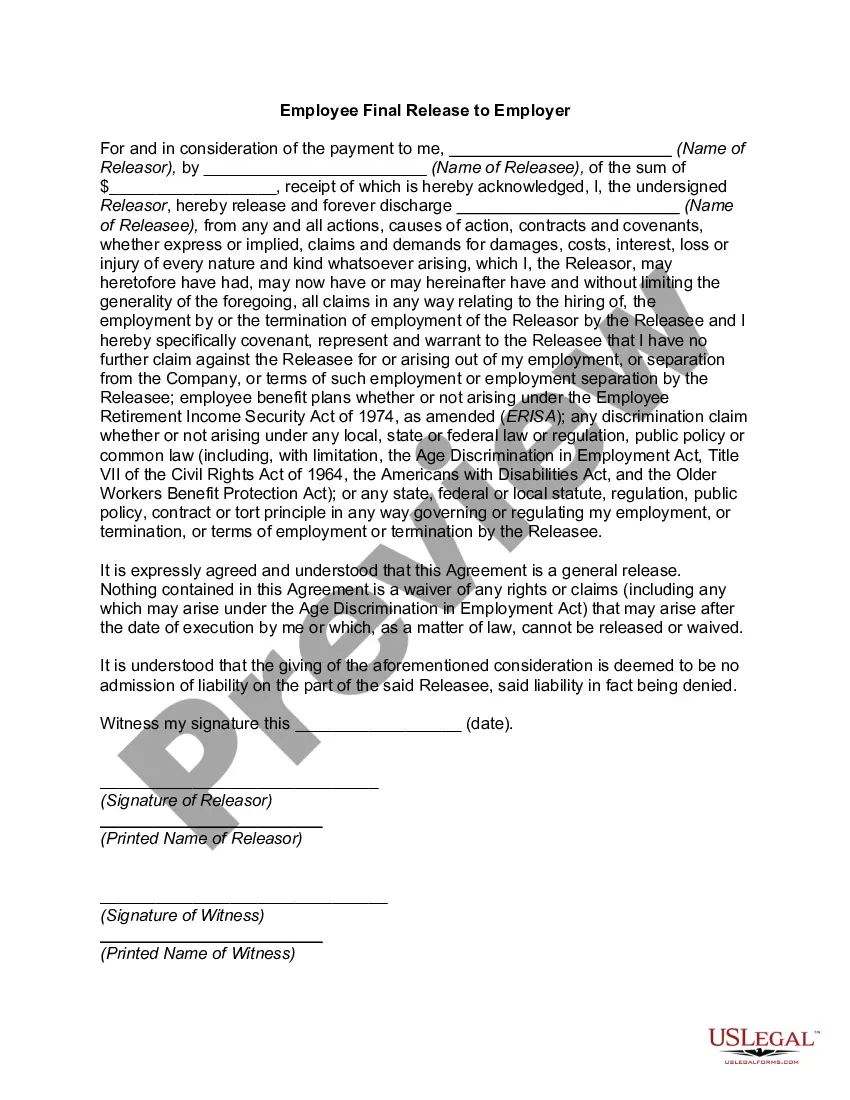
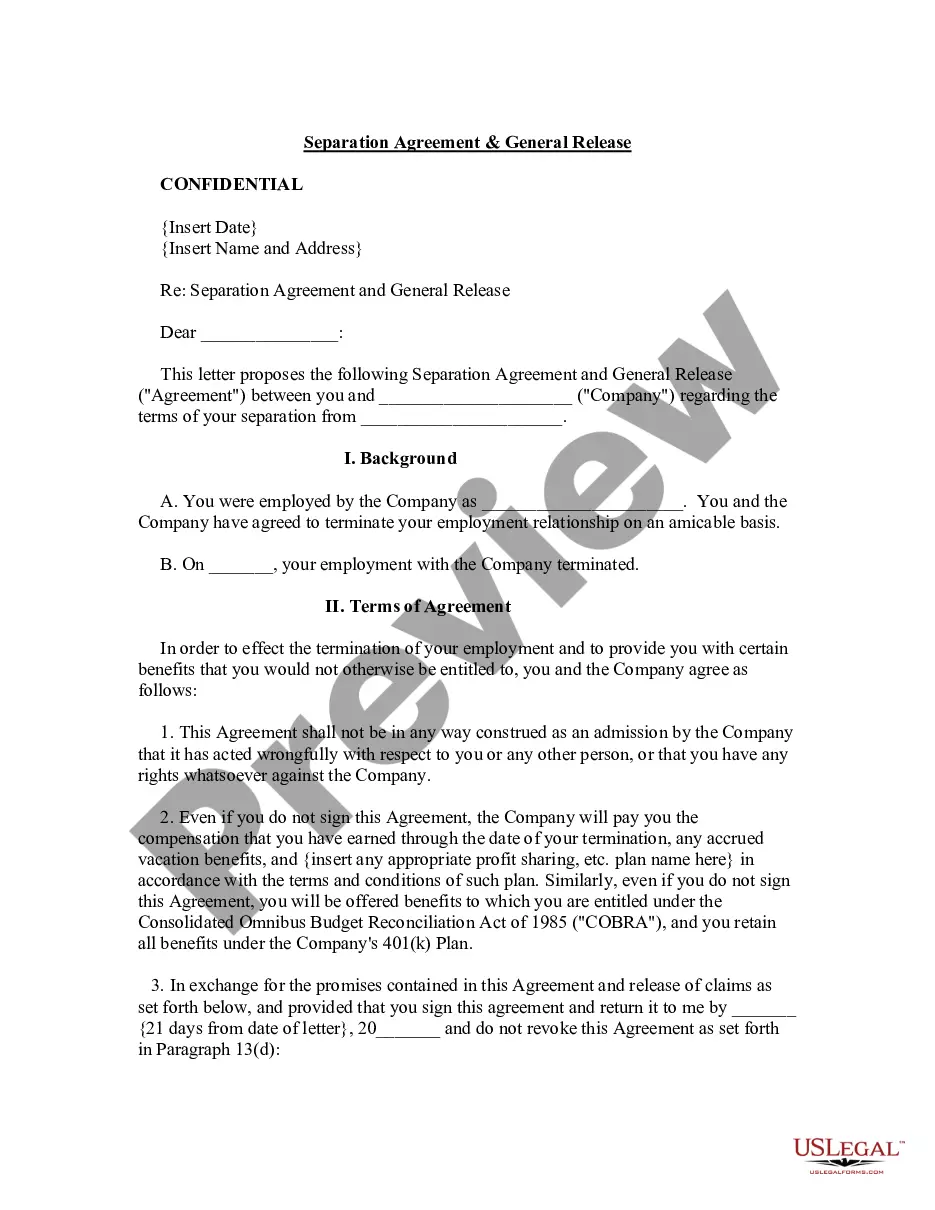
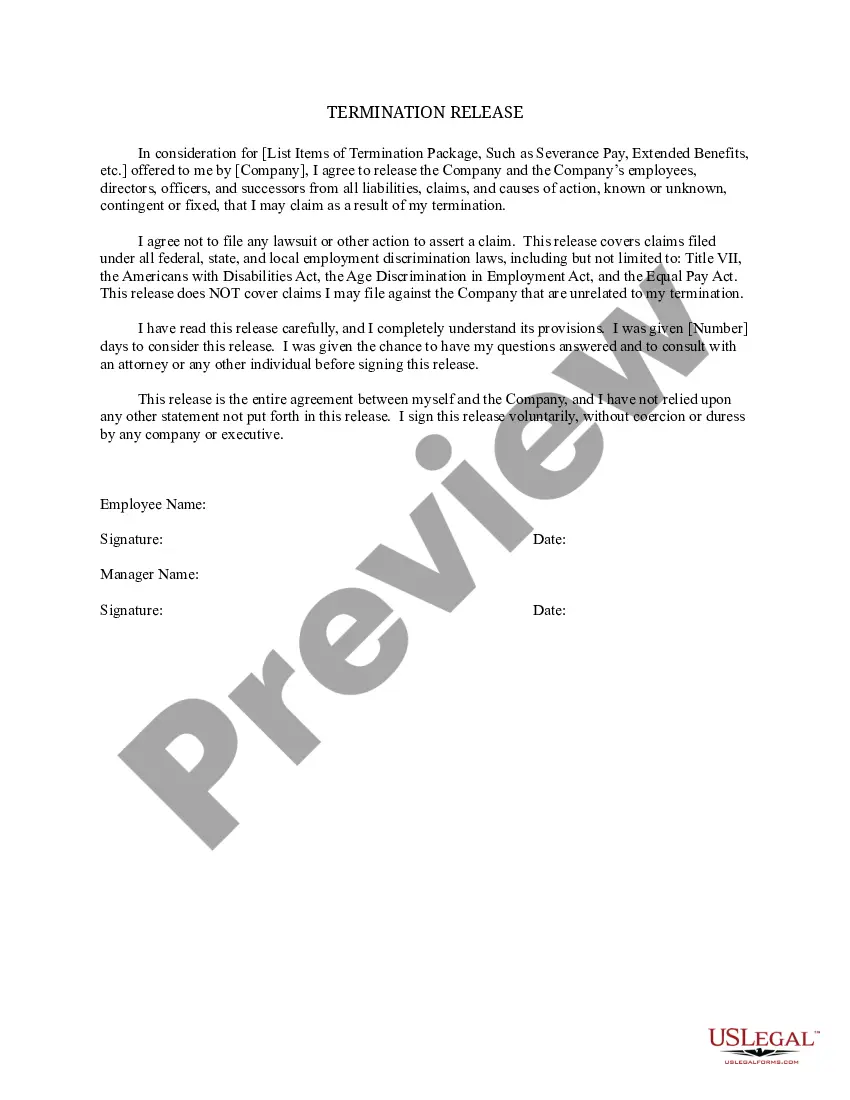
Connecticut General Release for Employment or Job Termination
Description
Get your form ready online
Our built-in tools help you complete, sign, share, and store your documents in one place.
Make edits, fill in missing information, and update formatting in US Legal Forms—just like you would in MS Word.
Download a copy, print it, send it by email, or mail it via USPS—whatever works best for your next step.
Sign and collect signatures with our SignNow integration. Send to multiple recipients, set reminders, and more. Go Premium to unlock E-Sign.
If this form requires notarization, complete it online through a secure video call—no need to meet a notary in person or wait for an appointment.
We protect your documents and personal data by following strict security and privacy standards.

Make edits, fill in missing information, and update formatting in US Legal Forms—just like you would in MS Word.

Download a copy, print it, send it by email, or mail it via USPS—whatever works best for your next step.

Sign and collect signatures with our SignNow integration. Send to multiple recipients, set reminders, and more. Go Premium to unlock E-Sign.

If this form requires notarization, complete it online through a secure video call—no need to meet a notary in person or wait for an appointment.

We protect your documents and personal data by following strict security and privacy standards.
Looking for another form?
How to fill out General Release For Employment Or Job Termination?
You have the capability to devote multiple hours online trying to locate the legal document template that aligns with the federal and state requirements you need.
US Legal Forms offers thousands of legal templates that are vetted by experts.
You can effortlessly obtain or generate the Connecticut General Release for Employment or Job Termination from the platform.
If available, utilize the Preview button to review the document format as well.
- If you already possess a US Legal Forms account, you can Log In and then press the Acquire button.
- Then, you can fill out, modify, generate, or sign the Connecticut General Release for Employment or Job Termination.
- Every legal document template you obtain is yours permanently.
- To acquire another copy of a purchased template, navigate to the My documents tab and select the corresponding button.
- If this is your first time using the US Legal Forms website, adhere to the simple instructions below.
- First, ensure you have selected the appropriate document template for the area/city of your choice.
- Review the template summary to confirm you have chosen the correct form.
Form popularity
FAQ
If termination is due to a layoff or position elimination covered under the WARN Act, notices need to be sent out 60 days prior to termination.
Federally, and in most states, a termination letter is not legally required. In some states, currently including Arizona, California, Illinois and New Jersey, written termination notices are required by law. Some of these states have specific templates employers must use for the letter.
Termination of employment refers to the end of an employee's work with a company. Termination may be voluntary, as when a worker leaves of their own accord. Involuntary termination occurs when a company downsizes, makes layoffs, or fires an employee.
What is a termination policy? The simplest definition of an employee termination policy is a written document that details how employee termination happens inside your organization. It outlines each step of the termination process and provides guidelines for management and human resources staff.
In other words, firing is "the final step in a fair and transparent process," as outlined below.Identify and Document the Issues.Coach Employees to Rectify the Issue.Create a Performance Improvement Plan.Terminate the Employee.Have HR Conduct an Exit Interview.
All Connecticut employers must provide a Separation Packet, which includes a Separation Notice (UC-61) and instructions to the worker immediately upon termination of employment or indefinite layoff. The notice should be provided regardless of whether the termination is voluntary or involuntary.
Connecticut is an "at will" state. This means that employers have the right to fire or terminate an employee at anytime without providing a reason, as long as it is not illegal.
Given the structure of Indian labor laws, there is no standard process to terminate an employee in India. An employee may be terminated according to terms laid out in the individual labor contract signed between the employee and the employer. Equally, the terms may be subject to the country's labor laws.