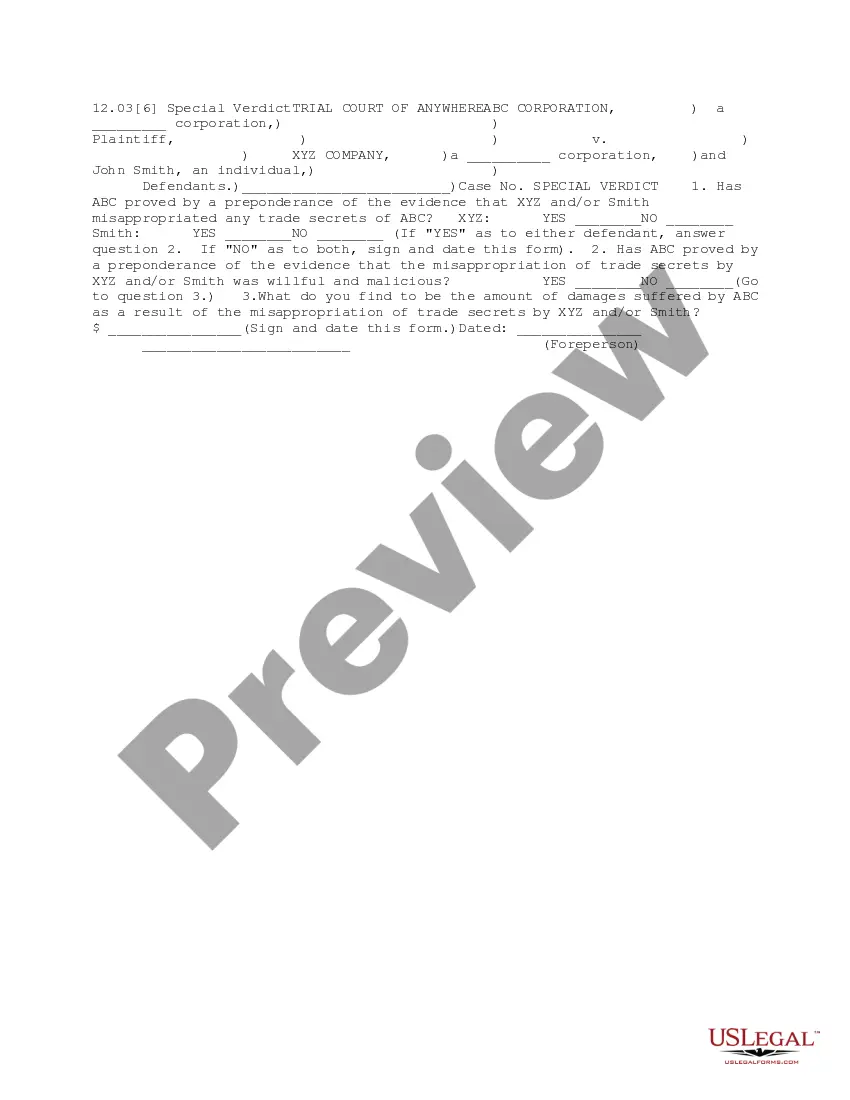
This form is a Special Verdict usable in cases involving misappropriation of commercial trade secrets.
Delaware Special Verdict
State:
Multi-State
Control #:
US-TS12036
Format:
Word;
PDF;
Rich Text
Instant download
Description
Get your form ready online
Our built-in tools help you complete, sign, share, and store your documents in one place.
Built-in online Word editor
Make edits, fill in missing information, and update formatting in US Legal Forms—just like you would in MS Word.
Export easily
Download a copy, print it, send it by email, or mail it via USPS—whatever works best for your next step.
E-sign your document
Sign and collect signatures with our SignNow integration. Send to multiple recipients, set reminders, and more. Go Premium to unlock E-Sign.
Notarize online 24/7
If this form requires notarization, complete it online through a secure video call—no need to meet a notary in person or wait for an appointment.
Store your document securely
We protect your documents and personal data by following strict security and privacy standards.

Make edits, fill in missing information, and update formatting in US Legal Forms—just like you would in MS Word.

Download a copy, print it, send it by email, or mail it via USPS—whatever works best for your next step.

Sign and collect signatures with our SignNow integration. Send to multiple recipients, set reminders, and more. Go Premium to unlock E-Sign.

If this form requires notarization, complete it online through a secure video call—no need to meet a notary in person or wait for an appointment.

We protect your documents and personal data by following strict security and privacy standards.
Looking for another form?


How to fill out Special Verdict?
Choosing the right legal file design might be a struggle. Naturally, there are a variety of templates available online, but how would you get the legal form you need? Utilize the US Legal Forms site. The support delivers thousands of templates, like the Delaware Special Verdict, that can be used for enterprise and personal demands. Every one of the types are checked by pros and satisfy federal and state demands.
If you are previously listed, log in in your account and then click the Download option to find the Delaware Special Verdict. Make use of account to look throughout the legal types you may have acquired formerly. Go to the My Forms tab of the account and get another copy of the file you need.
If you are a whole new customer of US Legal Forms, allow me to share easy recommendations for you to stick to:
- First, make sure you have chosen the appropriate form for your personal city/county. You may examine the shape while using Preview option and study the shape outline to make certain this is the right one for you.
- In the event the form will not satisfy your needs, make use of the Seach industry to find the proper form.
- When you are sure that the shape is suitable, select the Acquire now option to find the form.
- Opt for the pricing plan you desire and enter the needed details. Create your account and pay money for the transaction using your PayPal account or bank card.
- Opt for the file formatting and obtain the legal file design in your gadget.
- Comprehensive, modify and print out and indicator the acquired Delaware Special Verdict.
US Legal Forms is definitely the largest catalogue of legal types for which you can see numerous file templates. Utilize the service to obtain skillfully-created files that stick to state demands.
Form popularity
FAQ
The verdict of a jury is either general or special. A general verdict is that by which they pronounce generally upon all or any of the issues, either in favor of the plaintiff or defendant; a special verdict is that by which the jury find the facts only, leaving the judgment to the Court.
Rule 9. Upon the request of the attorney general a summons instead of a warrant shall issue. If no request is made, the court may issue either a warrant or a summons in its discretion. More than one warrant or summons may issue for the same defendant.
If a judge tries the case, the judge's decision is called a judgment. If a jury tries the case, the jury's decision is called a verdict.
The special verdict must present the conclusions of fact as established by the evidence, and not the evidence to prove them; and those conclusions of fact must be so presented as that nothing shall remain to the Court but to draw from them conclusions of law.
If it makes factual findings in addition to the ultimate legal conclusions, it returns a general verdict with interrogatories. (Ibid.) ?If it returns only factual findings, leaving the court to determine the ultimate legal result, it returns a special verdict.? (Ibid.)
A general verdict is that by which they pronounce generally upon all or any of the issues, either in favor of the plaintiff or defendant; a special verdict is that by which the jury find the facts only, leaving the judgment to the Court.
A judgment notwithstanding the verdict (JNOV) is a judgment by the trial judge after a jury has issued a verdict, setting aside the jury's verdict and entering a judgment in favor of the losing party without a new trial. A JNOV is very similar to a directed verdict except for the timing within a trial.
Clerical mistakes in judgments, orders or other parts of the record and errors therein arising from oversight or omission may be corrected by the Court any time of its own initiative, or on motion of any party and after such notice, if any, as the Court orders.