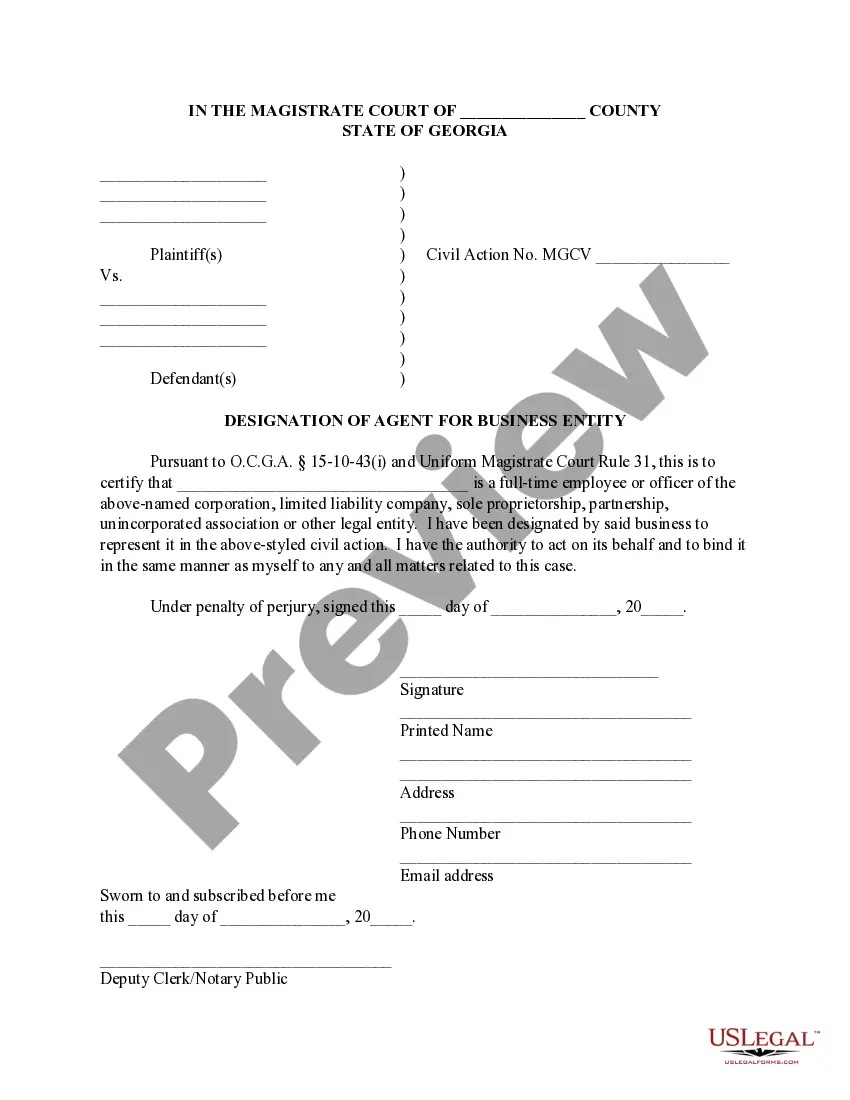
Georgia Designation of Agent for Business Entity
Overview of this form
The Designation of Agent for Business Entity is a legal document that allows a designated employee or officer to represent a business entity in a civil action. This form is crucial as it certifies that the signatory has the authority to act on behalf of the business in legal matters, distinguishing it from other legal representation forms. It is specifically designed for use in Georgia, ensuring compliance with state regulations governing civil actions.
What’s included in this form
- Name of the business entity involved in the civil action.
- Designation of the full-time employee or officer authorized to represent the business.
- Certification of the authority to bind the business in matters related to the case.
- Signature of the designated agent, along with their printed name, address, phone number, and email address.
- Certification by a Deputy Clerk or Notary Public to validate the document.

Situations where this form applies
This form should be used when a business entity, such as a corporation, limited liability company, or partnership, needs to designate an individual to act on its behalf in a civil legal case. It is essential when the business is being sued or is participating in a lawsuit, ensuring that the appointed agent has the legal authority to represent the entity in court proceedings.
Who should use this form
- Business owners and officers of corporations needing to represent their entity in legal actions.
- Full-time employees designated by the business to handle legal matters.
- Legal representatives seeking to certify their authority to act on behalf of a business entity.
How to prepare this document
- Identify the business entity involved in the civil action and fill in the relevant details.
- Designate the individual who will represent the business by providing their name and position.
- Certify that the designated agent has the authority to act on behalf of the business in court.
- Have the designated agent sign the form, adding their printed name, contact information, and the date of signing.
- Ensure the form is sworn to and subscribed by a Deputy Clerk or Notary Public for validation.
Is notarization required?
Yes, this form must be notarized to be legally valid. US Legal Forms offers integrated online notarization, available 24/7, ensuring a secure video call with a licensed notary public to complete the process without the need to travel.
Get your form ready online
Our built-in tools help you complete, sign, share, and store your documents in one place.
Make edits, fill in missing information, and update formatting in US Legal Forms—just like you would in MS Word.
Download a copy, print it, send it by email, or mail it via USPS—whatever works best for your next step.
Sign and collect signatures with our SignNow integration. Send to multiple recipients, set reminders, and more. Go Premium to unlock E-Sign.
If this form requires notarization, complete it online through a secure video call—no need to meet a notary in person or wait for an appointment.
We protect your documents and personal data by following strict security and privacy standards.

Make edits, fill in missing information, and update formatting in US Legal Forms—just like you would in MS Word.

Download a copy, print it, send it by email, or mail it via USPS—whatever works best for your next step.

Sign and collect signatures with our SignNow integration. Send to multiple recipients, set reminders, and more. Go Premium to unlock E-Sign.

If this form requires notarization, complete it online through a secure video call—no need to meet a notary in person or wait for an appointment.

We protect your documents and personal data by following strict security and privacy standards.
Common mistakes
- Failing to include the proper name of the business entity.
- Not ensuring that the designated agent is a full-time employee or officer of the business.
- Omitting required contact information for the agent.
- Not having the form notarized by a Deputy Clerk or Notary Public if required.
Why complete this form online
- Convenience of downloading and completing the form at your own pace.
- Editable fields allow for easy customization to fit your specific situation.
- Access to reliable legal templates drafted by licensed attorneys.
Quick recap
- The Designation of Agent for Business Entity allows a designated individual to represent a business in legal matters.
- It is a vital form for business entities involved in civil actions, ensuring proper legal representation.
- Accuracy and notarization are essential for the form's validity.
Looking for another form?
Form popularity
FAQ
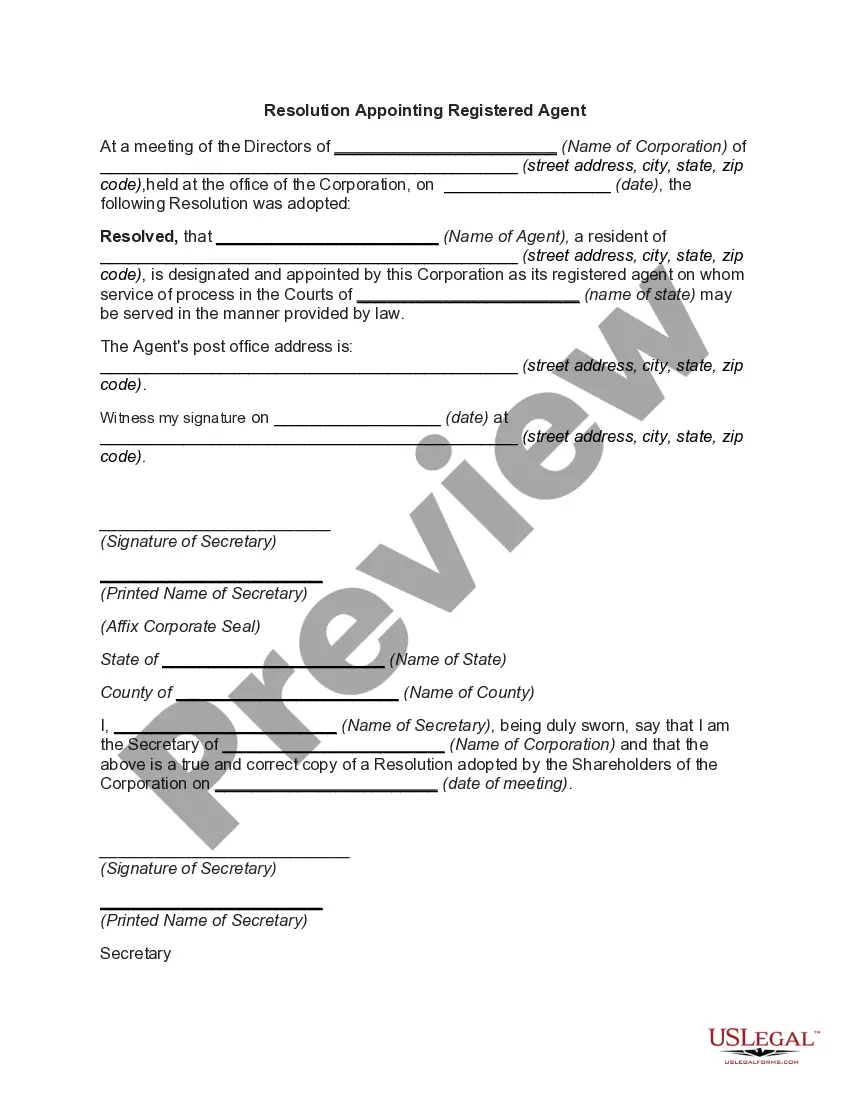
Yes, a member of an LLC can serve as the registered agent for that LLC under the Georgia Designation of Agent for Business Entity. This arrangement simplifies the process for businesses, as it allows members to manage legal documents directly. However, it is important to ensure that the member meets the state’s requirements for registered agents, including being a resident of Georgia or a business entity authorized to do business in Georgia. If you need guidance on how to designate a registered agent effectively, uslegalforms can provide valuable resources.
Yes, having a registered agent is very important for any business entity. This role ensures that you receive important legal documents in a timely manner, which helps avoid penalties or legal complications. By using services like uslegalforms for the Georgia Designation of Agent for Business Entity, you can focus on running your business while we handle your legal notifications.
Yes, appointing a registered agent is a legal requirement for businesses operating in Georgia. This designation is critical for ensuring that your business complies with state laws. By designating a qualified agent, you enhance your business's credibility and ensure important documents are handled properly.
The registered agent is an individual or a business entity designated to receive legal notifications and documents for your business in Georgia. It's essential to choose someone who is reliable and accessible during business hours. For a seamless experience with the Georgia Designation of Agent for Business Entity, you may find our services at uslegalforms helpful.
Yes, you can serve as your own registered agent in Georgia if you meet certain criteria. However, it's important to consider the implications of being available during business hours to receive legal documents. Alternatively, many choose to use a service like uslegalforms for the Georgia Designation of Agent for Business Entity to ensure reliability and peace of mind.
Yes, every business entity in Georgia must have a registered agent. This requirement ensures that there is a designated individual or business available to receive legal documents on behalf of the business. By fulfilling the Georgia Designation of Agent for Business Entity, you can ensure proper communication and compliance with state regulations.
In Georgia, the registered agent for a business is an individual or a business entity designated to receive official documents on behalf of the organization. This agent must have a physical address in Georgia and be available during standard business hours. Choosing the right agent is crucial, as they ensure compliance with legal requirements tied to the Georgia Designation of Agent for Business Entity. For assistance in designating an agent, consider using the uslegalforms platform, which simplifies the process and provides necessary legal documentation.
Yes, you can serve as your own registered agent for an LLC in Georgia. However, you must maintain a physical address in the state and be available during regular business hours to receive legal documents. This role is crucial in conjunction with the Georgia Designation of Agent for Business Entity to ensure all correspondence related to your business is managed correctly.
Rule 22 in Georgia pertains to the procedures regarding a motion for a judgment by default in civil cases. It outlines the requirements for obtaining a default judgment when a party fails to respond to the lawsuit. For businesses navigating legal issues, understanding such rules in conjunction with selecting a Georgia Designation of Agent for Business Entity is essential for effective legal representation.
Rule 31 in Georgia primarily addresses the process of mediation in civil proceedings. This rule encourages parties to consider mediation before proceeding to trial, potentially saving time and resources. Understanding the implications of this rule can also be relevant for entities utilizing the Georgia Designation of Agent for Business Entity, as mediation often involves authorized representatives.