Georgia Last Will and Testament for other Persons
About this form
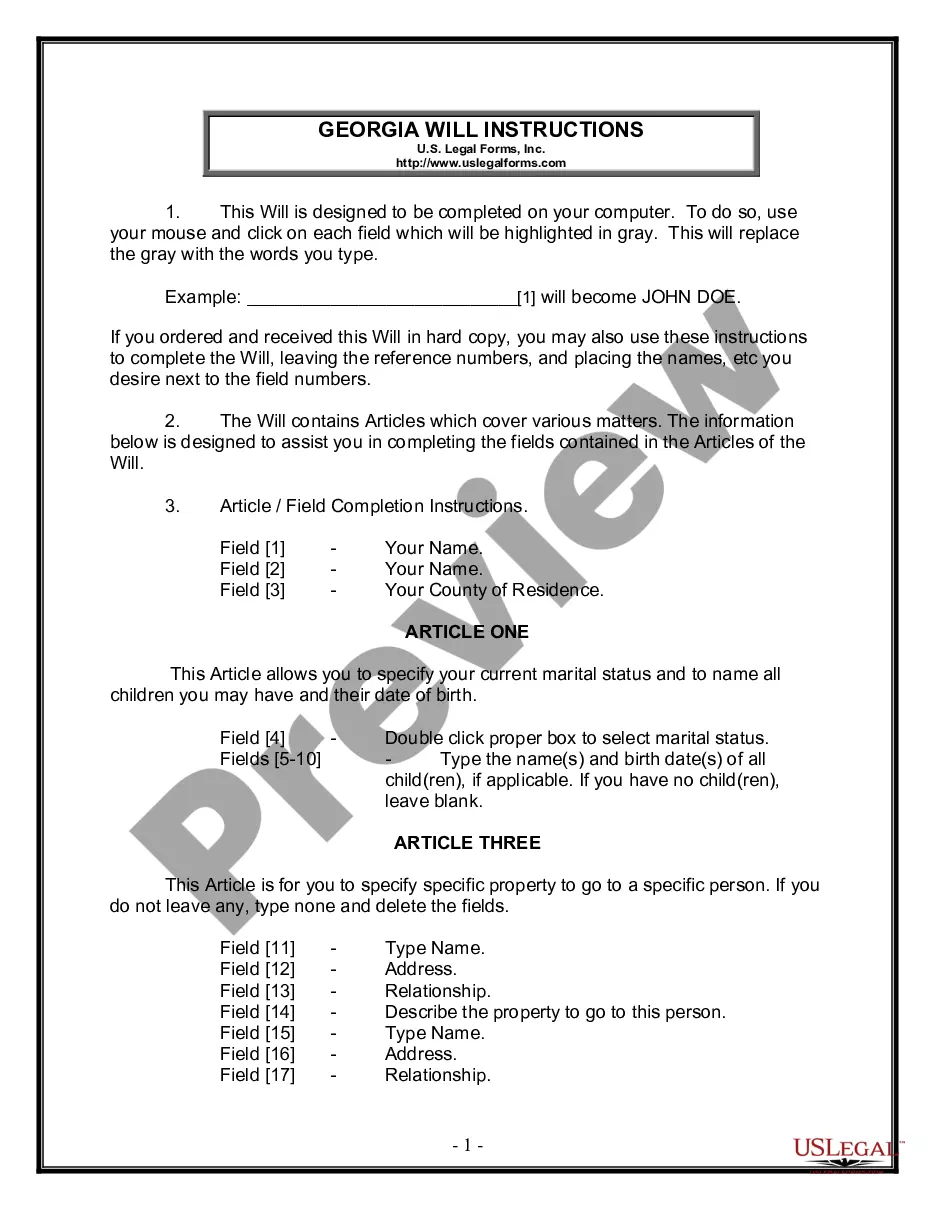
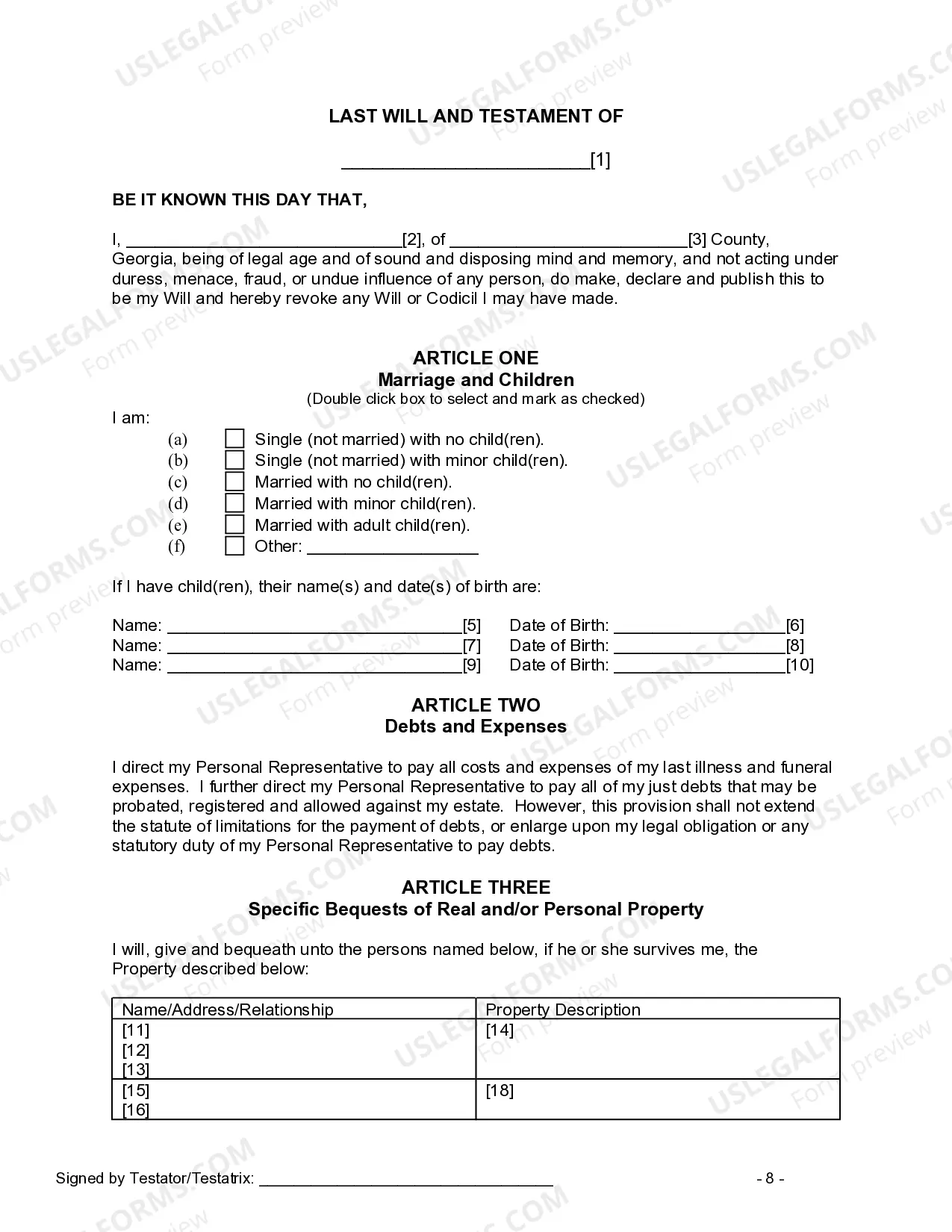
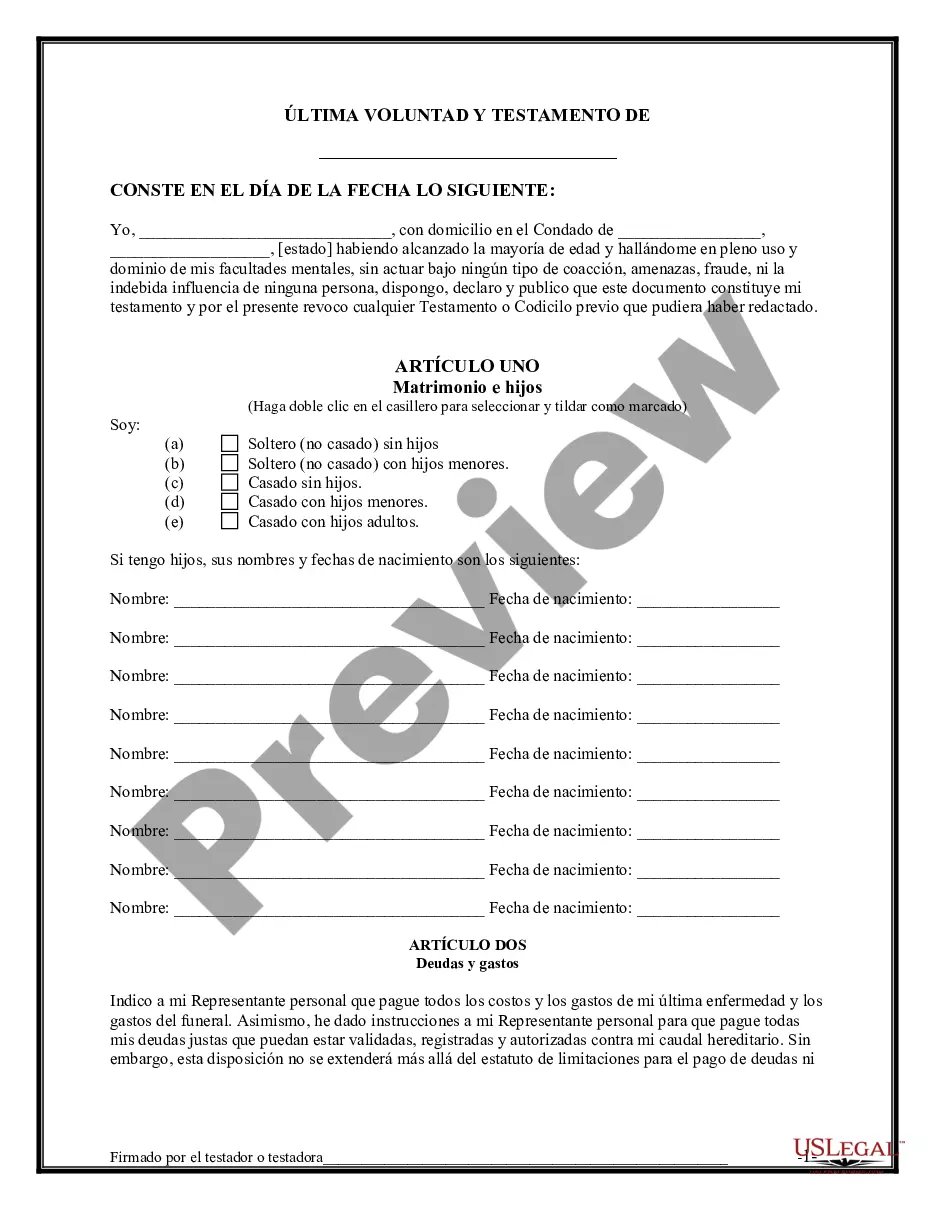
The Last Will and Testament for Other Persons is a legal document that outlines how your property will be distributed upon your death. It designates beneficiaries, appoints guardians for minor children, and specifies an executor to manage your estate. This form is specifically tailored for use in Georgia and is created to be completed on a computer, making it easier for you to fill out and save a record.
What’s included in this form
- Personal information, including your name and county of residence.
- Details regarding your marital status and information about your children.
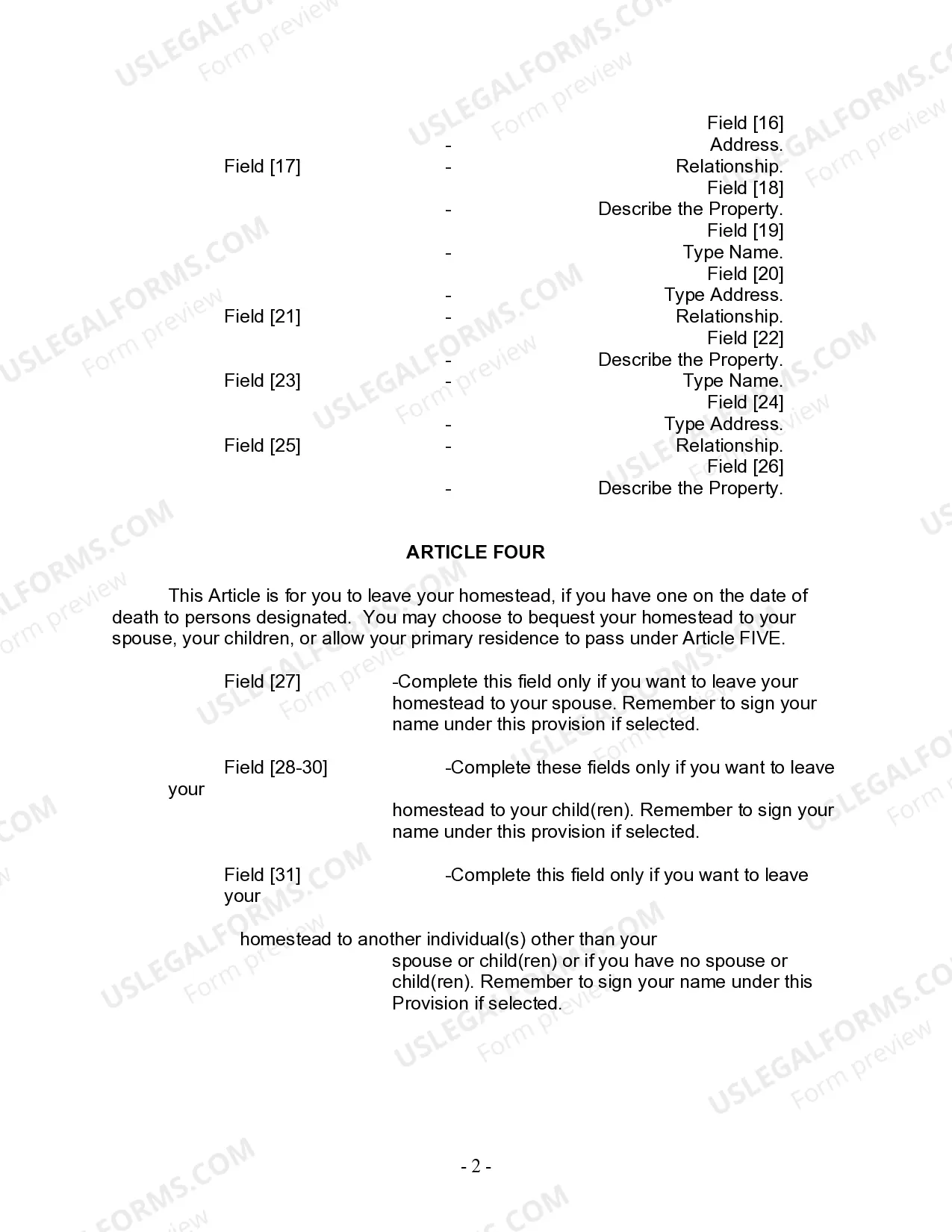
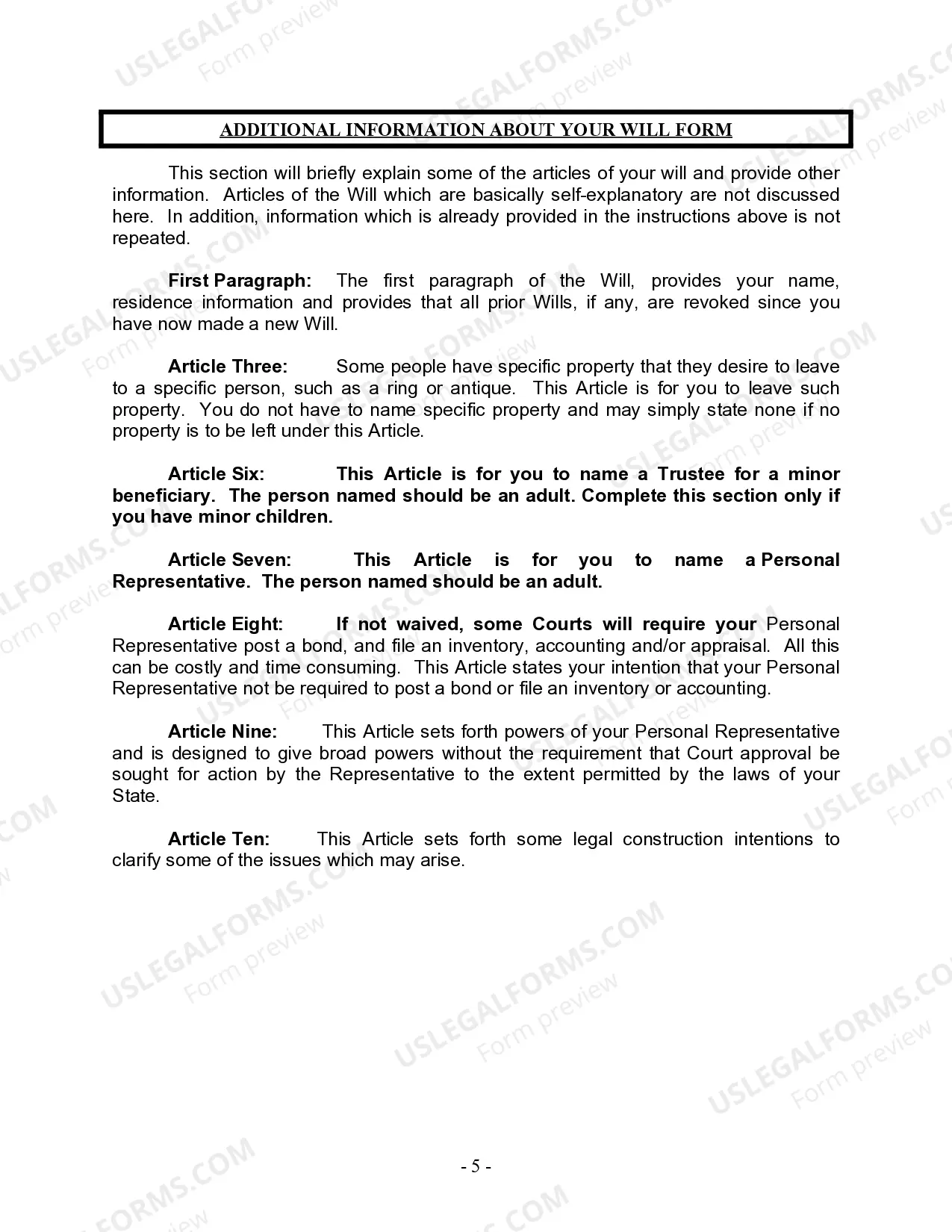
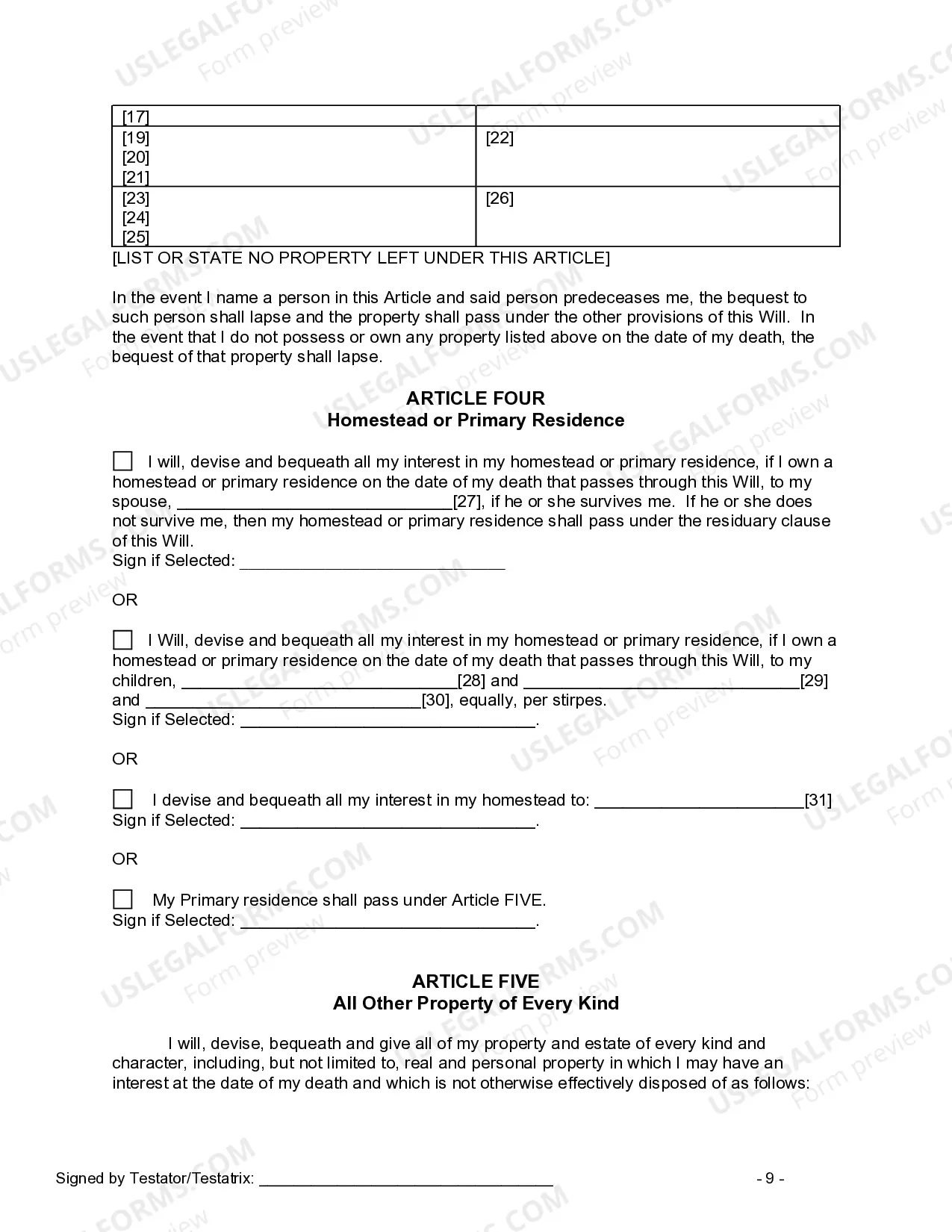
- Specific bequests for property to particular individuals.
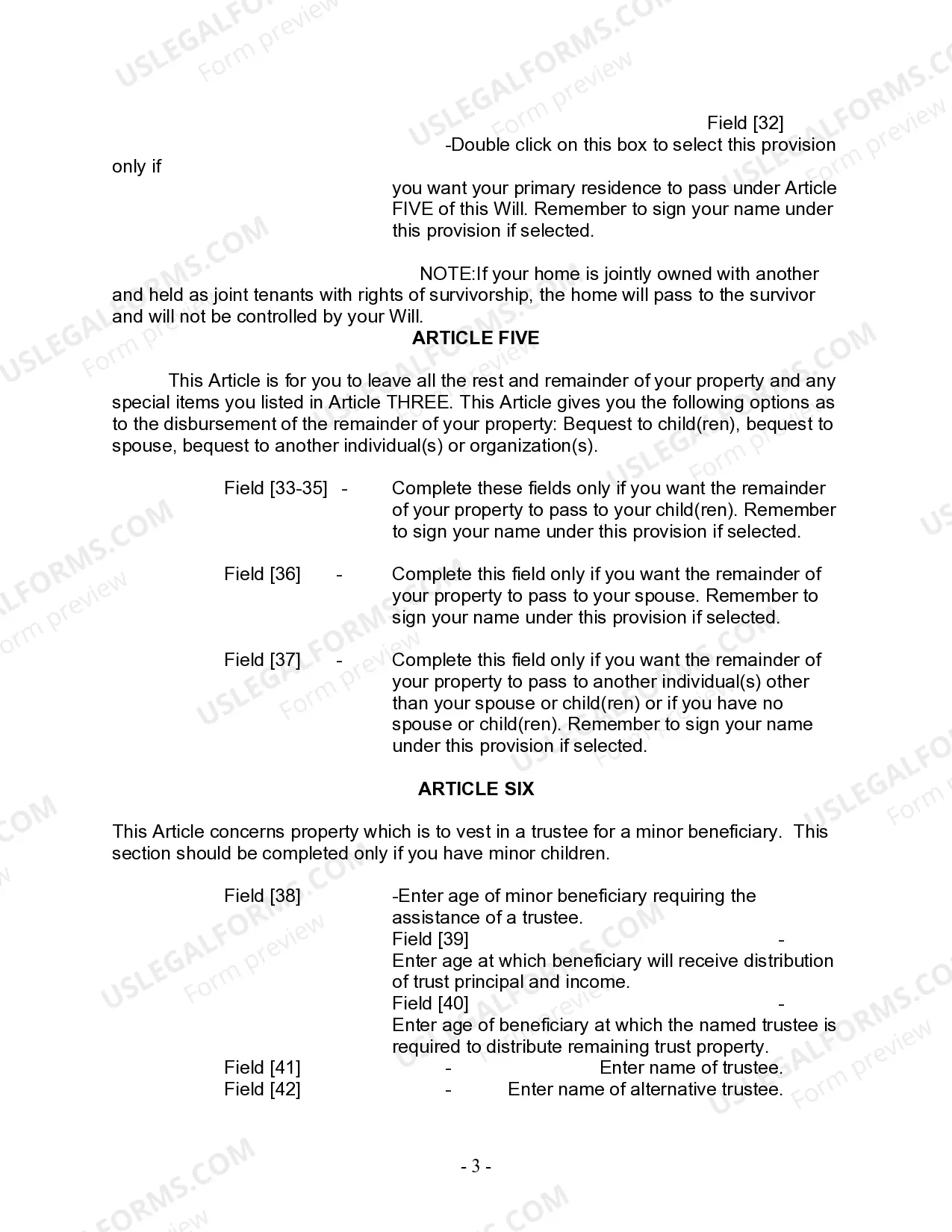
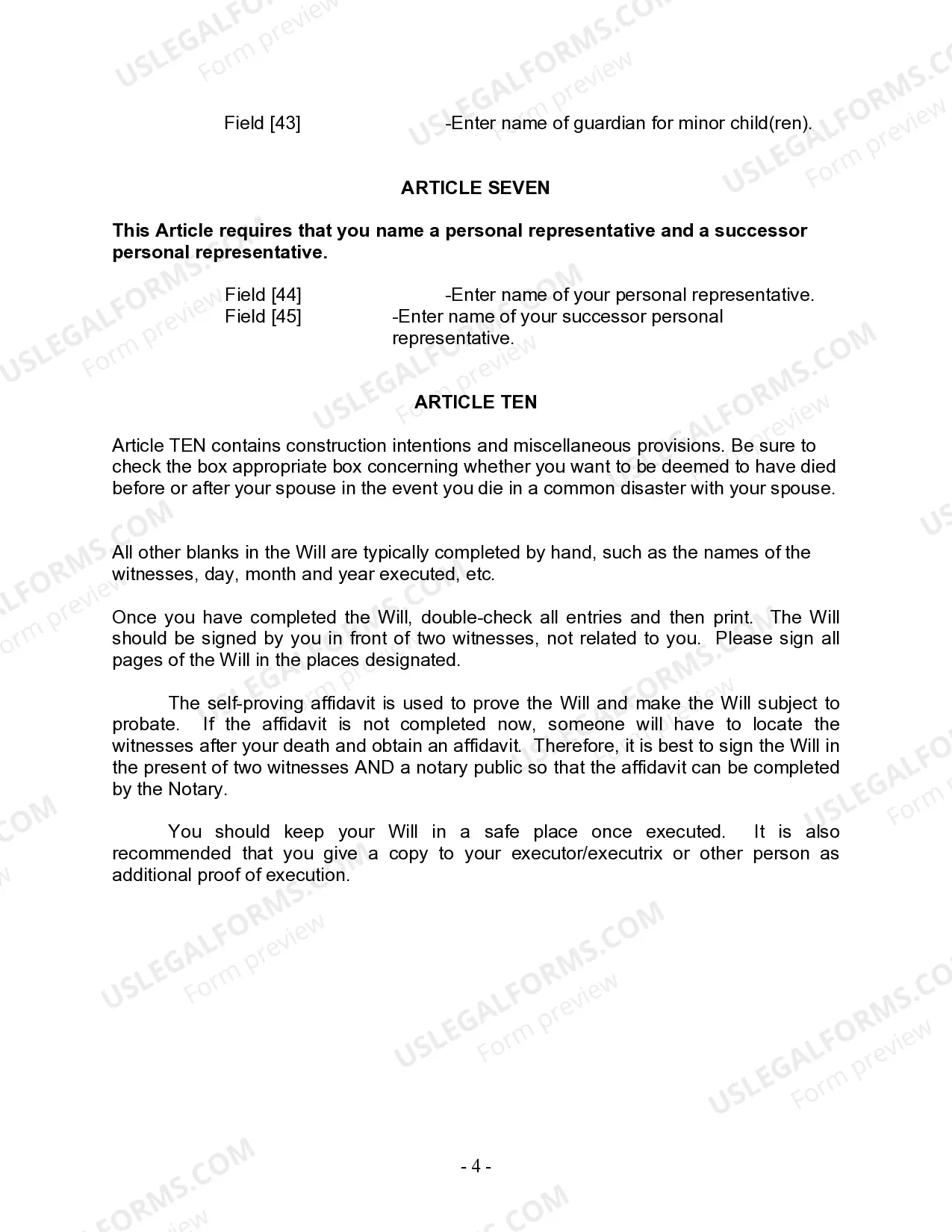
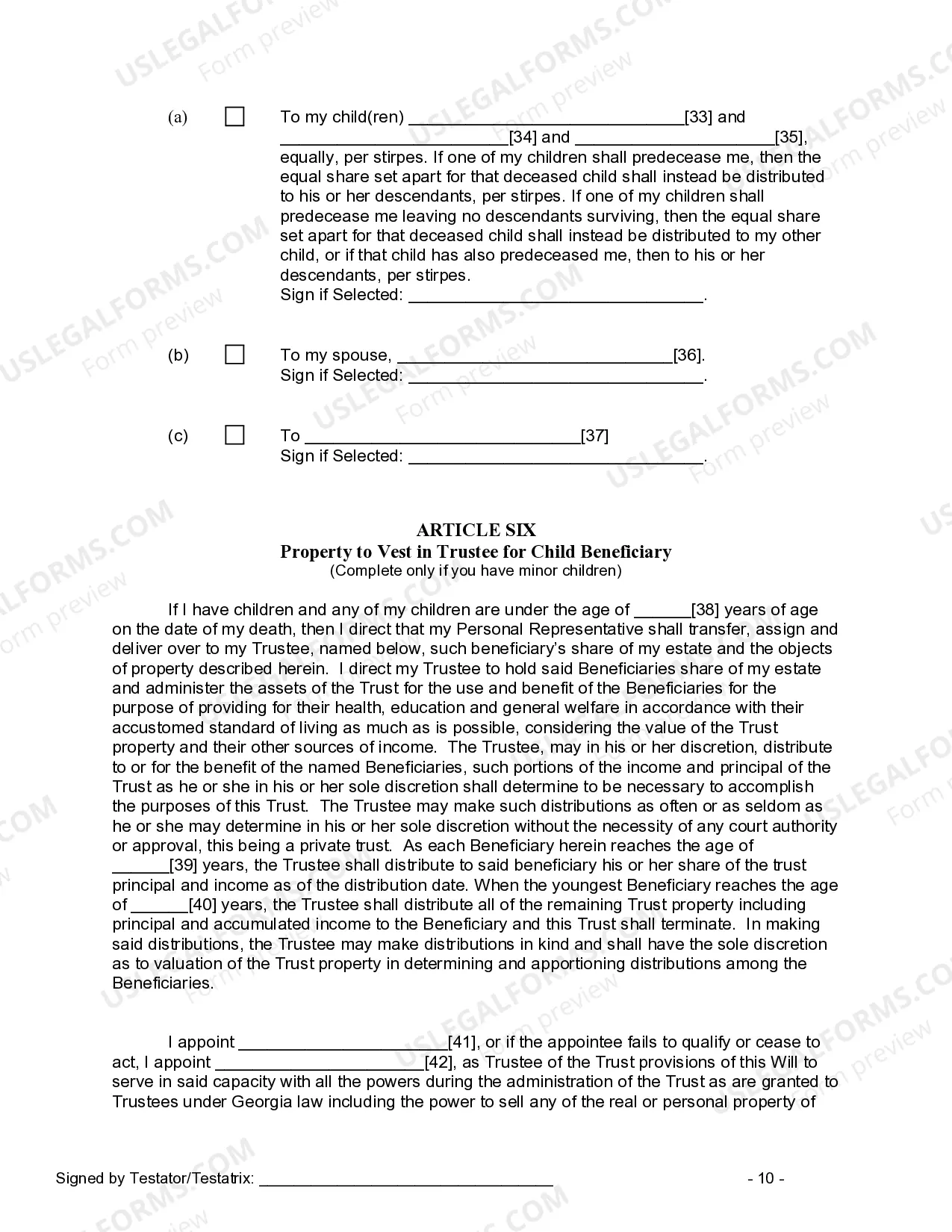
- Designation of a guardian for your minor children and a trustee for managing any trusts.
- Appointment of a personal representative to execute your will.
- Provisions regarding debts, expenses, and how the remainder of your estate will be distributed.




When to use this document
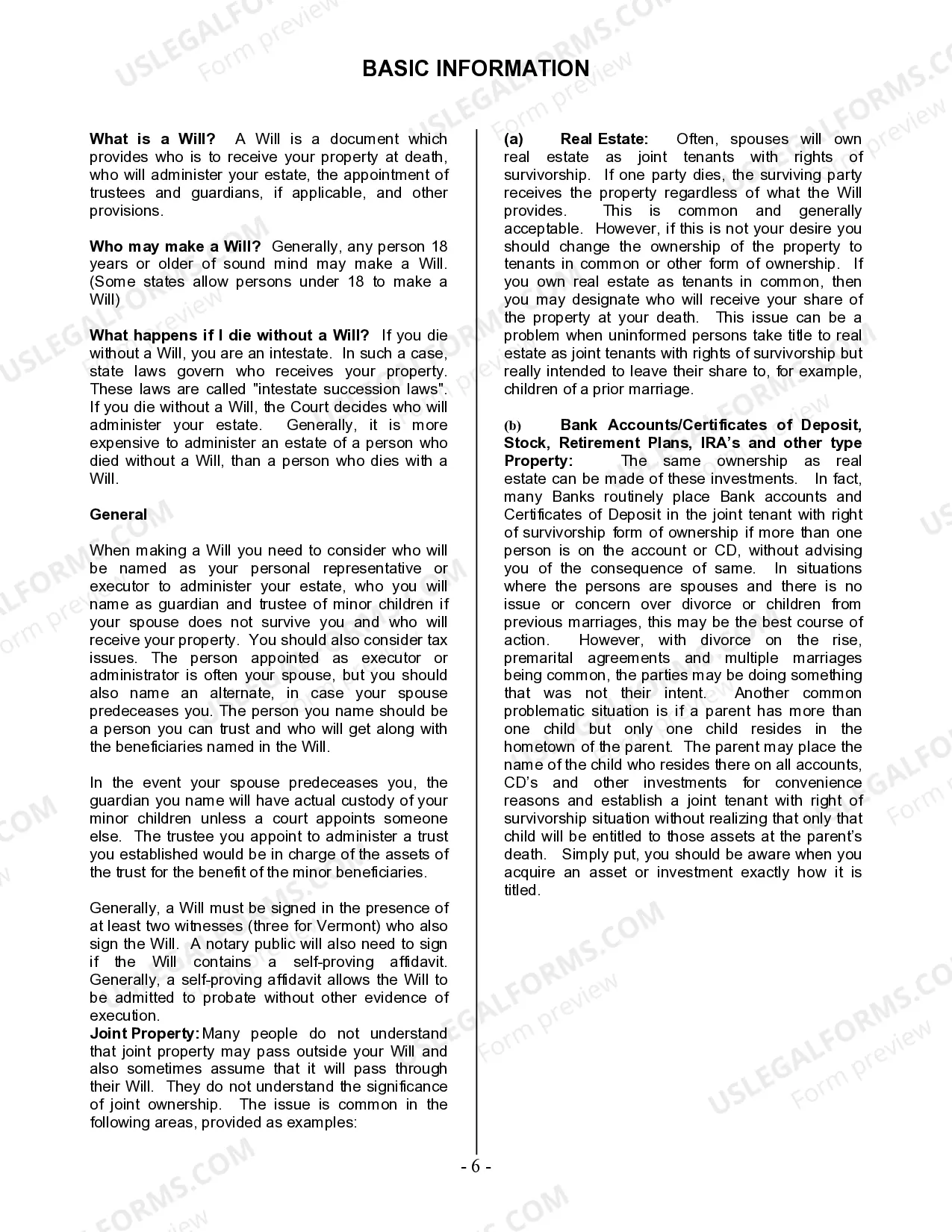
You should use this Last Will and Testament if you want to legally define how your assets will be distributed after your death, especially if you have specific wishes regarding family members, minor children, or particular properties. It is also useful if you wish to avoid the laws of intestate succession, which dictate how your assets would be distributed if you pass away without a will.
Who needs this form
- Individuals aged eighteen or older who are residents of Georgia.
- Parents of minor children, to designate guardians and trustees.
- Anyone looking to clearly outline their wishes regarding property distribution to avoid potential disputes among family members.
Completing this form step by step
- Provide your personal details such as name and residence county.
- Specify your marital status and list names and birth dates of your children if applicable.
- Detail specific property bequests by mentioning the beneficiaries and describing the assets.
- Appoint a personal representative and, if necessary, a guardian for minor children.
- Make sure to sign the form in front of two witnesses and, if possible, a notary to ensure validity.
Notarization guidance
This form does not typically require notarization unless specified by local law. However, it is recommended to have it signed in the presence of witnesses to ensure its validity.
Get your form ready online
Our built-in tools help you complete, sign, share, and store your documents in one place.
Make edits, fill in missing information, and update formatting in US Legal Forms—just like you would in MS Word.
Download a copy, print it, send it by email, or mail it via USPS—whatever works best for your next step.
Sign and collect signatures with our SignNow integration. Send to multiple recipients, set reminders, and more. Go Premium to unlock E-Sign.
If this form requires notarization, complete it online through a secure video call—no need to meet a notary in person or wait for an appointment.
We protect your documents and personal data by following strict security and privacy standards.

Make edits, fill in missing information, and update formatting in US Legal Forms—just like you would in MS Word.

Download a copy, print it, send it by email, or mail it via USPS—whatever works best for your next step.

Sign and collect signatures with our SignNow integration. Send to multiple recipients, set reminders, and more. Go Premium to unlock E-Sign.

If this form requires notarization, complete it online through a secure video call—no need to meet a notary in person or wait for an appointment.

We protect your documents and personal data by following strict security and privacy standards.
Common mistakes to avoid
- Failing to update the will after major life changes, such as marriage or the birth of a child.
- Not signing the will in front of the required witnesses.
- Leaving out important details, such as specific bequests or naming an executor.
Benefits of completing this form online
- Convenience of filling out and editing the form directly on your computer.
- Immediate access to legal templates created by licensed attorneys.
- Ability to save and modify your will as your circumstances change.
- A Last Will and Testament clearly states how your assets will be distributed after you pass away.
- This form allows for the appointment of guardians for minor children and a trusted executor for your estate.
- It is essential to follow legal signing requirements to ensure the document is valid and enforceable.
Looking for another form?
Form popularity
FAQ
Documents that may supersede a will in Georgia include a legally executed trust or certain beneficiary designations. For example, life insurance policies and retirement accounts typically pass directly to designated beneficiaries, regardless of what a Georgia Last Will and Testament for other Persons states. It's essential to review all estate documents regularly to ensure they align with your wishes and current relationships.
A valid will in Georgia requires that the testator be at least 14 years old and of sound mind. It must be signed by the testator and witnessed by at least two individuals who are present at the same time. To create an effective Georgia Last Will and Testament for other Persons, it’s important to follow these guidelines to ensure your wishes are honored after your passing.
While one person cannot create a legal will for someone else, they can assist in the process. You can help gather necessary information and ensure the will meets the legal requirements for a Georgia Last Will and Testament for other Persons. However, it's vital that the testator personally signs the will to validate it, as this ensures their intention and consent are clearly reflected.
To avoid probate in Georgia, consider options such as setting up a living trust or designating beneficiaries on accounts and policies. If you create a Georgia Last Will and Testament for other Persons, you may still need to go through probate; however, using a trust can help streamline asset distribution. Additionally, gifting assets before death can reduce the assets in your estate, thus bypassing probate entirely.
In Georgia, several factors can void a will. If the testator lacked the mental capacity to create a Georgia Last Will and Testament for other Persons, the will may be considered invalid. Additionally, if the will was not signed by the testator or by at least two witnesses, Georgia law may render it void. Circumstances like undue influence or fraud can also contribute to a will's invalidity.
The next of kin in Georgia typically refers to the closest surviving relatives of the deceased. This may include a spouse, children, parents, or siblings, depending on the family structure. Clarifying next of kin matters is vital, as it influences inheritance rights, making a Georgia Last Will and Testament for other Persons essential for communicating your final wishes.
In Georgia, if someone dies without a will, the inheritance process follows specific state laws. Generally, the estate goes to the spouse and children first, but if none exist, further relatives, like parents or siblings, may inherit. It is clear that having a Georgia Last Will and Testament for other Persons can help bypass the often ambiguous rules of intestacy, securing your intended heirs.
Yes, wills become public records once they are filed with the probate court in Georgia. This means that anyone can access the document and see its contents, including the distribution of assets. This transparency is important for ensuring the proper execution of a Georgia Last Will and Testament for other Persons, while also allowing interested parties to understand the decedent’s intentions.
Without a will, an executor does not have the authority to decide how assets are distributed in Georgia. The law dictates the inheritance process, leaving the executor with a duty to follow the established intestacy rules. This scenario makes it crucial to have a Georgia Last Will and Testament for other Persons, empowering you to specify your wishes.
If there is no will in place, Georgia's intestacy laws govern the distribution of the deceased's estate. The assets are divided among surviving relatives according to a specific hierarchy, starting with the spouse and children. This can lead to outcomes that may not align with the deceased's wishes. It underscores the importance of creating a Georgia Last Will and Testament for other Persons to ensure your preferences are honored.