Guam Independent Contractor Agreement Between Licensed Counselor and Therapist and Licensed Counselor and Therapist Practicing as a Solo Practitioner

State:
Multi-State
Control #:
US-02565BG
Format:
Word; 
Rich Text
Instant download

Description

An independent contractor is a person or business who performs services for another person pursuant to an agreement and who is not subject to the other's control, or right to control, the manner and means of performing the services. The exact nature of the independent contractor's relationship with the hiring party is important since an independent contractor pays his/her own Social Security, income taxes without payroll deduction, has no retirement or health plan rights, and often is not entitled to worker's compensation coverage. The traditional tests to determine whether a worker is an employee or independent contractor involve the concept of control. The Internal Revenue Service (IRS) developed 20 factors used to determine whether a worker is an independent contractor under the common law. A "yes" answer to any of these questions would be evidence of an employer-employee relationship.

" Does the principal provide instructions to the worker about when, where, and how he or she is to perform the work?


" Does the principal provide training to the worker?

" Are the services provided by the worker integrated into the principal's business operations?

" Must the services be rendered personally by the worker?

" Does the principal hire, supervise and pay assistants to the worker?

" Is there a continuing relationship between the principal and the worker?

" Does the principal set the work hours and schedule?

" Does the worker devote substantially full time to the business of the principal?

" Is the work performed on the principal's premises?

" Is the worker required to perform the services in an order or sequence set by the principal?

" Is the worker required to submit oral or written reports to the principal?

" Is the worker paid by the hour, week, or month?

" Does the principal have the right to discharge the worker at will?

" Can the worker terminate his or her relationship with the principal any time he or she wishes without incurring liability to the principal?

" Does the principal pay the business or traveling expenses of the worker?

A "yes" answer to any of these questions would be evidence of an independent contractor relationship.


" Does the worker furnish significant tools, materials and equipment?

" Does the worker have a significant investment in facilities?

" Can the worker realize a profit or loss as a result of his or her services?

" Does the worker provide services for more than one firm at a time?

" Does the worker make his or her services available to the general public?
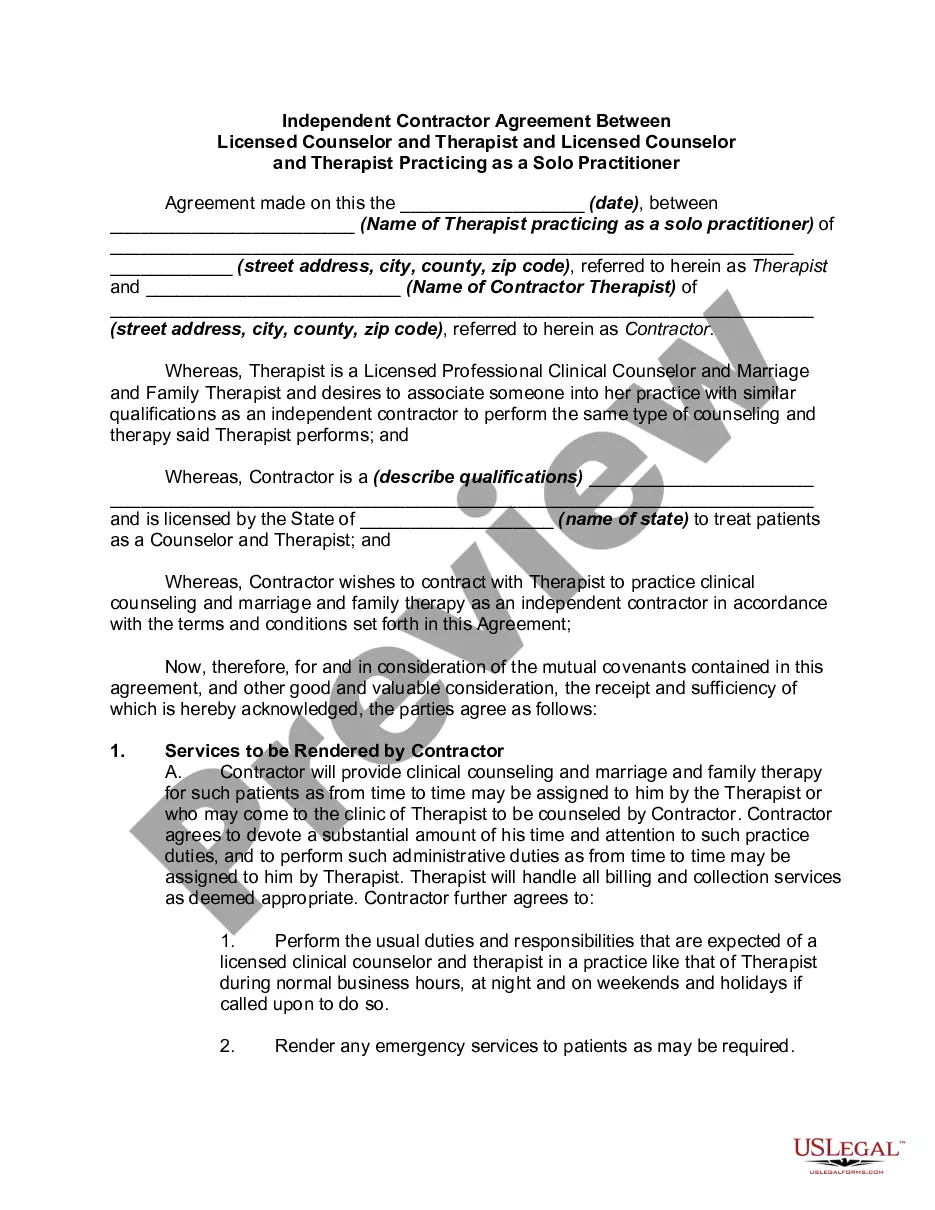
Free preview
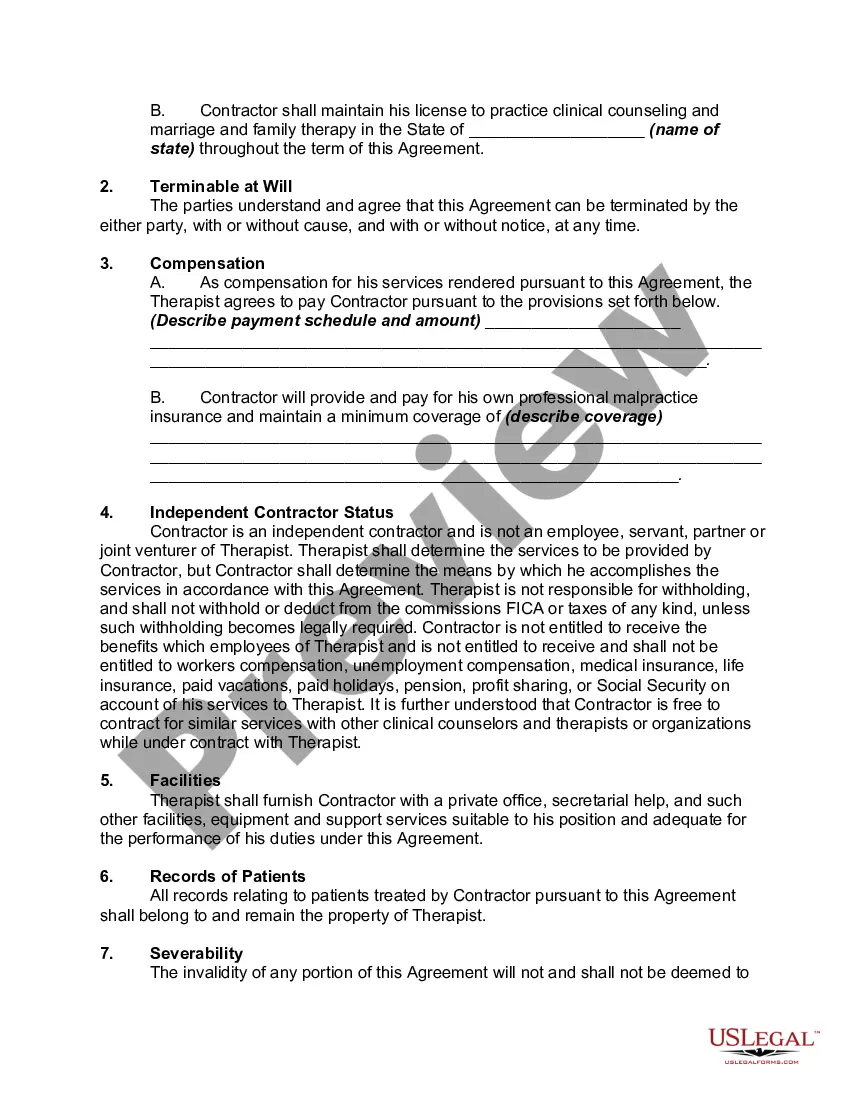
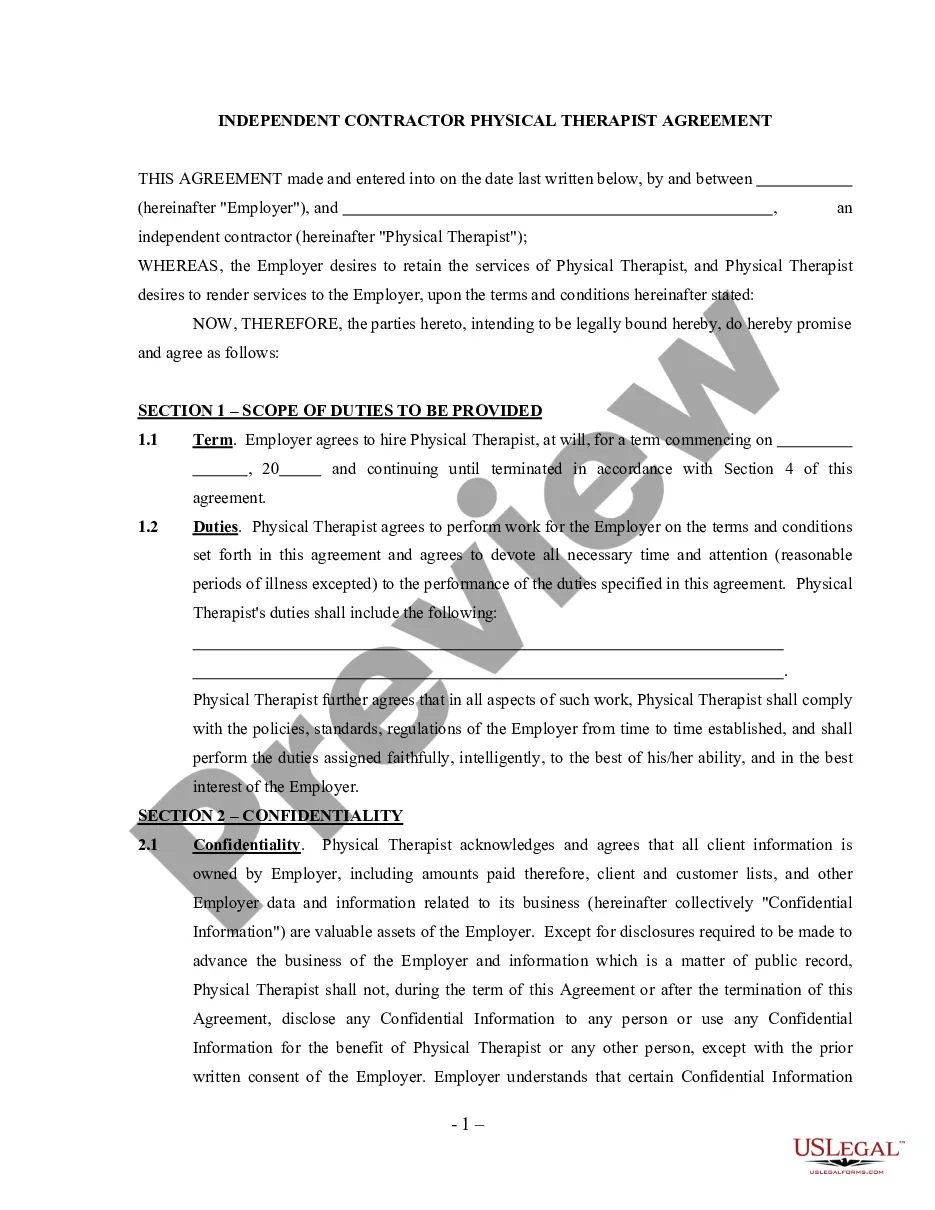
  • Preview Independent Contractor Agreement Between Licensed Counselor and Therapist and Licensed Counselor and Therapist Practicing as a Solo Practitioner
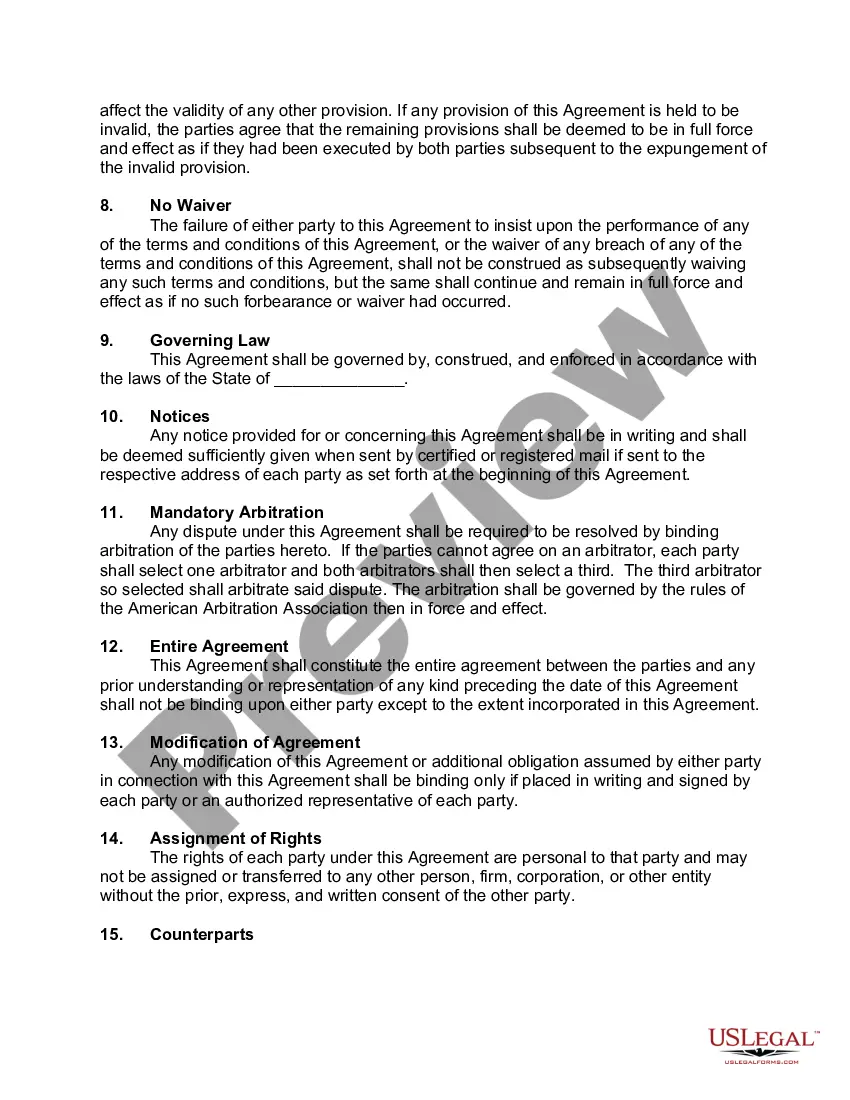
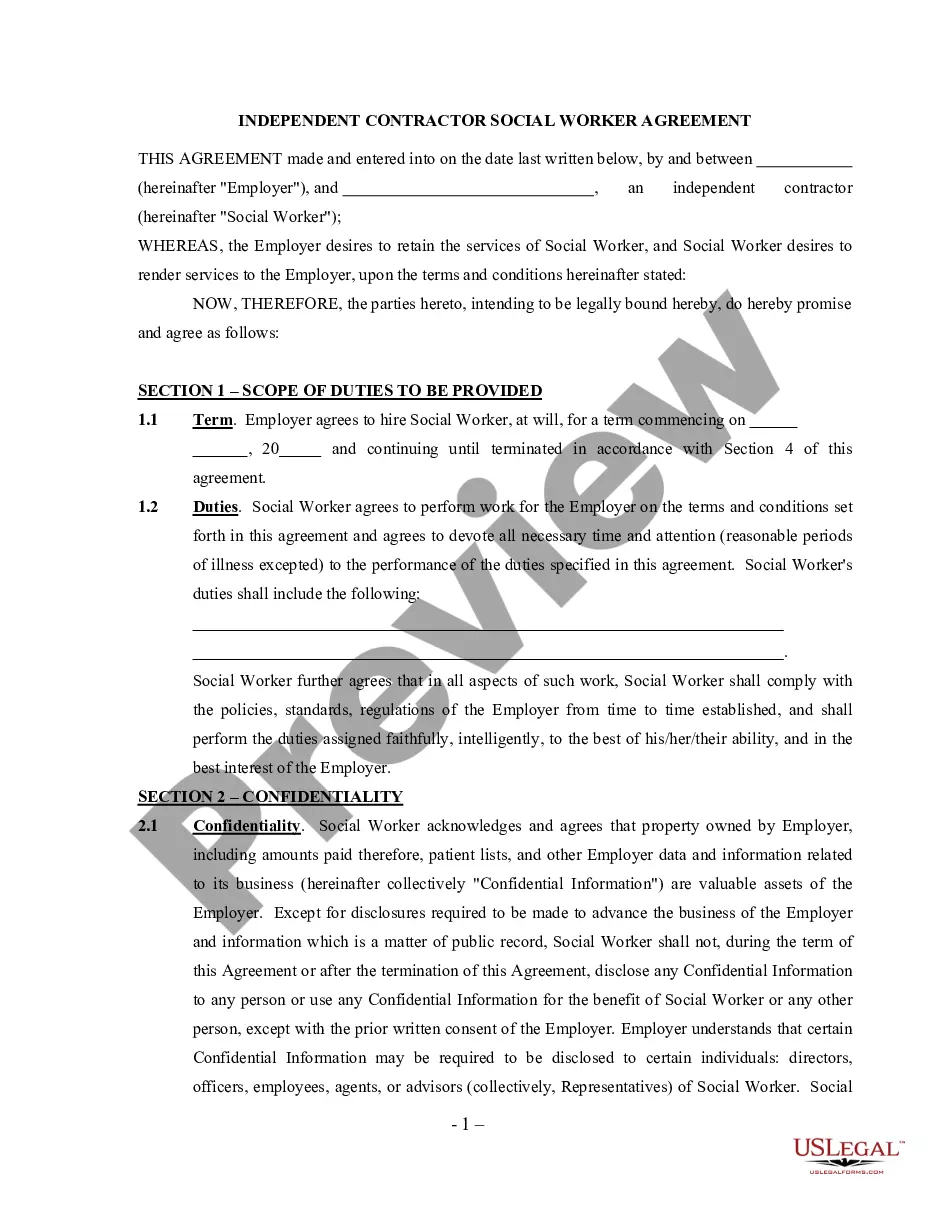
  • Preview Independent Contractor Agreement Between Licensed Counselor and Therapist and Licensed Counselor and Therapist Practicing as a Solo Practitioner
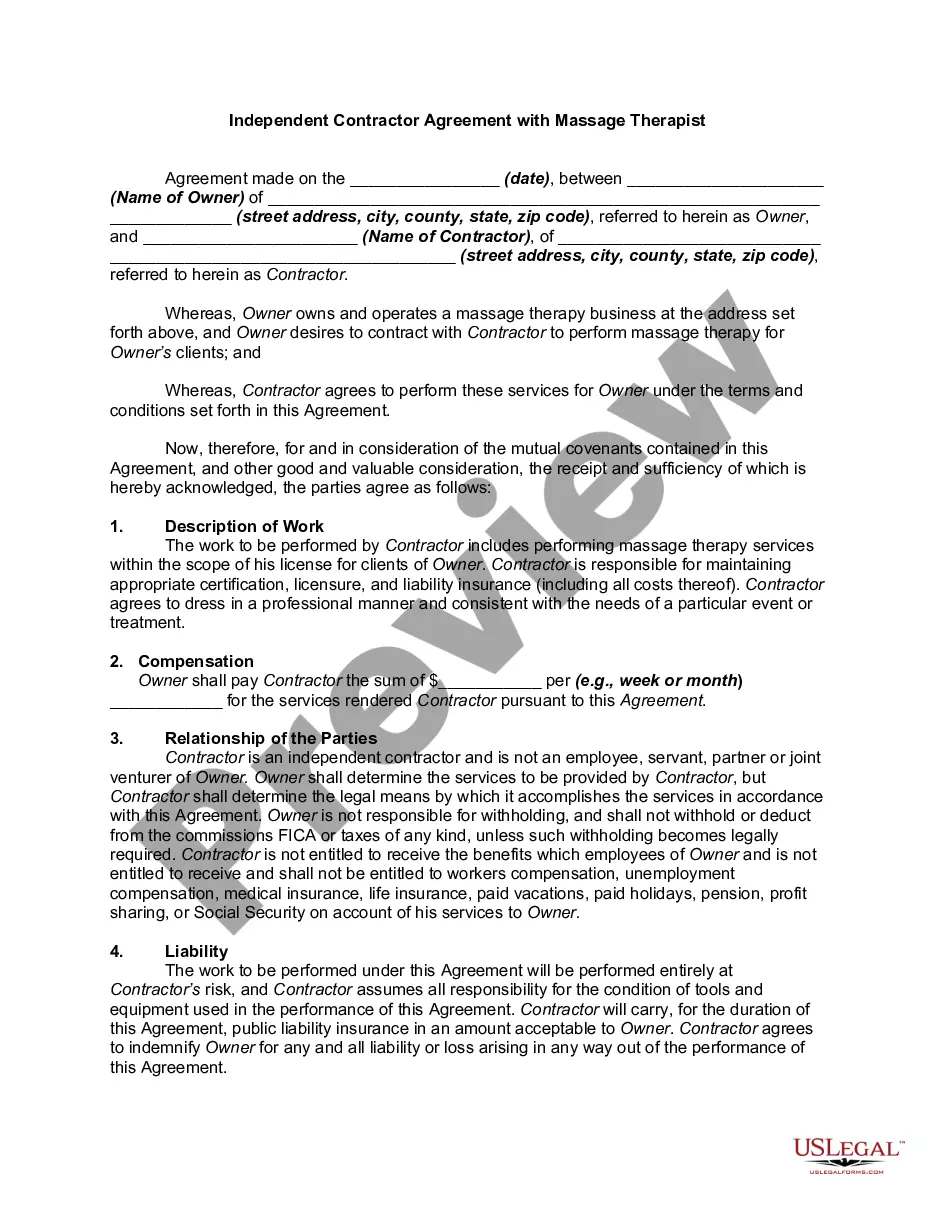
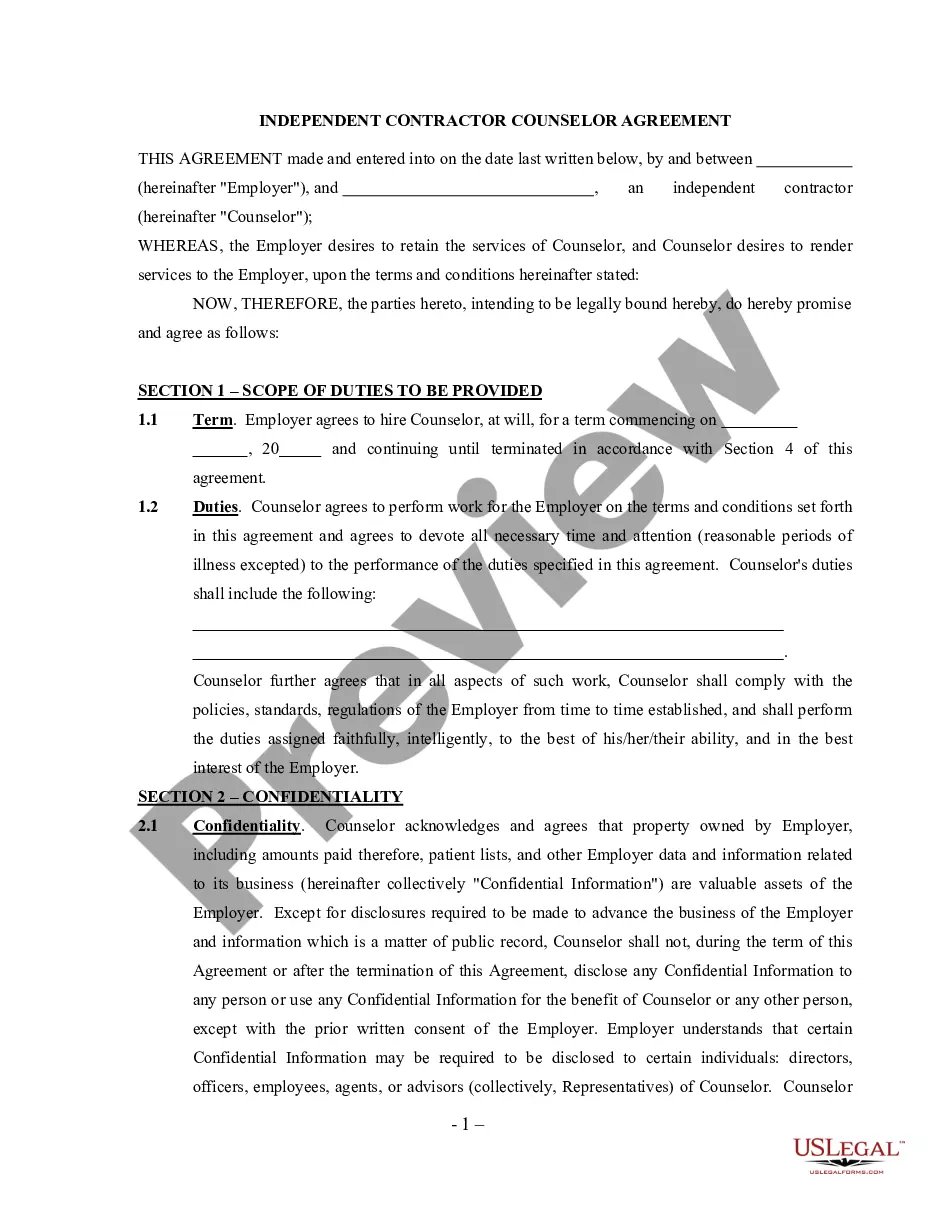
  • Preview Independent Contractor Agreement Between Licensed Counselor and Therapist and Licensed Counselor and Therapist Practicing as a Solo Practitioner
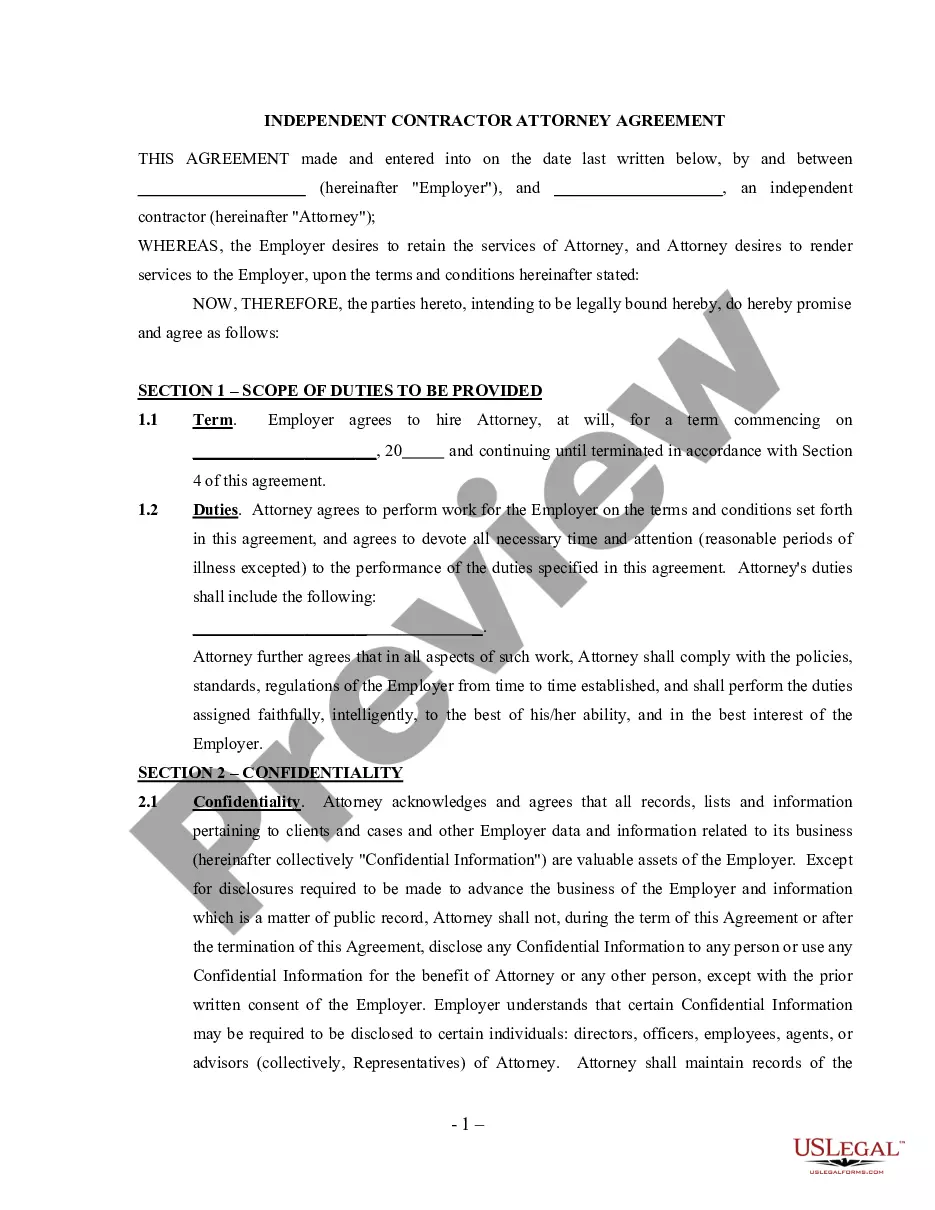
  • Preview Independent Contractor Agreement Between Licensed Counselor and Therapist and Licensed Counselor and Therapist Practicing as a Solo Practitioner

How to fill out Independent Contractor Agreement Between Licensed Counselor And Therapist And Licensed Counselor And Therapist Practicing As A Solo Practitioner?

US Legal Forms - one of the largest collections of legal documents in the United States - provides a variety of legal templates that you can download or print.

On the website, you can find thousands of forms for business and personal purposes, organized by categories, states, or keywords. You can access the latest forms like the Guam Independent Contractor Agreement Between Licensed Counselor and Therapist and Licensed Counselor and Therapist Practicing as a Solo Practitioner in moments.

If you have an account, Log In to download the Guam Independent Contractor Agreement Between Licensed Counselor and Therapist and Licensed Counselor and Therapist Practicing as a Solo Practitioner from the US Legal Forms library. The Download button will appear on each form you view.

When you are satisfied with the form, confirm your selection by clicking the Buy now button. Then, choose the payment plan you prefer and submit your information to create an account.

Complete the purchase. Use a credit card or PayPal account to finalize your transaction. Select the format and download the form to your device. Make edits. Fill out, modify, print, and sign the downloaded Guam Independent Contractor Agreement Between Licensed Counselor and Therapist and Licensed Counselor and Therapist Practicing as a Solo Practitioner.

  1. You can access all previously downloaded forms in the My documents tab of your account.
  2. If you are using US Legal Forms for the first time, here are simple steps to get you started.
  3. Verify you have chosen the correct form for your city/state.
  4. Click the Preview button to examine the form's content.
  5. Review the form description to confirm you have selected the right form.
  6. If the form does not fulfill your requirements, use the Search field at the top of the screen to find the one that does.

Form popularity

FAQ

Being an independently licensed therapist means you can practice without supervision, having fulfilled all state-imposed qualifications. This status empowers therapists to manage their practices, set their schedules, and work with clients directly. Establishing a Guam Independent Contractor Agreement Between Licensed Counselor and Therapist and Licensed Counselor and Therapist Practicing as a Solo Practitioner provides a formal structure for these independent practices, ensuring clarity in services offered.

The key difference between a licensed and non-licensed therapist lies in the formal credentials and authority to practice. Licensed therapists have completed their educational requirements, passed state exams, and received authorization to provide therapy. Non-licensed therapists may have training but lack the necessary credentials to practice independently, thus highlighting the importance of a Guam Independent Contractor Agreement Between Licensed Counselor and Therapist and Licensed Counselor and Therapist Practicing as a Solo Practitioner for clarity.

An independently licensed therapist is a mental health professional who has obtained the necessary credentials to practice solo. These therapists have completed specific educational and training requirements, enabling them to provide therapy without supervision. The Guam Independent Contractor Agreement Between Licensed Counselor and Therapist and Licensed Counselor and Therapist Practicing as a Solo Practitioner helps clarify the professional relationship and responsibilities of independently licensed therapists.

'Licensed independently' refers to a professional's ability to practice on their own without supervision. This status indicates that the individual has met all state requirements for independent practice, often including advanced education and clinical experience. When forming business arrangements, especially through a Guam Independent Contractor Agreement Between Licensed Counselor and Therapist and Licensed Counselor and Therapist Practicing as a Solo Practitioner, it's crucial to define independent roles clearly.

Yes, it is possible to hold licenses in two different states as a therapist. However, each state has its licensing requirements and processes, which may include additional examinations or documentation. If you plan to practice in multiple states, defining your relationships in a Guam Independent Contractor Agreement Between Licensed Counselor and Therapist and Licensed Counselor and Therapist Practicing as a Solo Practitioner can streamline your professional obligations.

Contract work for a therapist involves providing services under a specified agreement without formal employment ties. Therapists can work as independent contractors, allowing them to set their hours and choose their clients. This arrangement can be defined clearly in a Guam Independent Contractor Agreement Between Licensed Counselor and Therapist and Licensed Counselor and Therapist Practicing as a Solo Practitioner, ensuring both parties understand their responsibilities.

The terms 'licensed counselor' and 'licensed therapist' often refer to similar roles but can vary by state regulations. Generally, licensed counselors focus on specific issues like marriage, family, or substance use, while licensed therapists may handle broader emotional and psychological concerns. Understanding these distinctions is vital when drafting a Guam Independent Contractor Agreement Between Licensed Counselor and Therapist and Licensed Counselor and Therapist Practicing as a Solo Practitioner.

An independent contractor is defined as a person or business that provides services to another under terms specified in a contract. They operate autonomously, maintaining control over how and when work is completed. It is important for independent contractors to have clear agreements in place to define their scope of work. A Guam Independent Contractor Agreement Between Licensed Counselor and Therapist and Licensed Counselor and Therapist Practicing as a Solo Practitioner outlines these responsibilities effectively.

An independent contractor therapist is a licensed therapist who provides services under their own business arrangement rather than as a company employee. This arrangement gives them the freedom to manage their practice, including setting hours and client lists. For those pursuing this path, establishing a formal agreement is essential. A Guam Independent Contractor Agreement Between Licensed Counselor and Therapist and Licensed Counselor and Therapist Practicing as a Solo Practitioner can help formalize these terms.

Yes, a Licensed Professional Counselor (LPC) can own their own practice, allowing for greater control over their work environment and business operations. This ownership empowers LPCs to set their own fees, schedule, and client policies. To establish this business effectively, an LPC should consider using a Guam Independent Contractor Agreement Between Licensed Counselor and Therapist and Licensed Counselor and Therapist Practicing as a Solo Practitioner to outline the terms of their practice.

Trusted and secure by over 3 million people of the world’s leading companies

Guam Independent Contractor Agreement Between Licensed Counselor and Therapist and Licensed Counselor and Therapist Practicing as a Solo Practitioner