Iowa Qualified Income Miller Trust

Category:
State:
Multi-State
Control #:
US-02035BG
Format:
Word; 
Rich Text
Instant download

Description

A trustor is the person who creates a trust. A trustor is also called a grantor, donor or settlor. A trust is a separate legal entity that holds property or assets of some kind for the benefit of a specific person, group of people or organization known as the beneficiary/beneficiaries. When a trust is established, an individual or corporate entity is named to oversee or manage the assets in the trust. This individual or entity is called a trustee. A trustee can be a professional with financial knowledge, a relative or loyal friend or a corporation. More than one trustee can be named by the trustor.


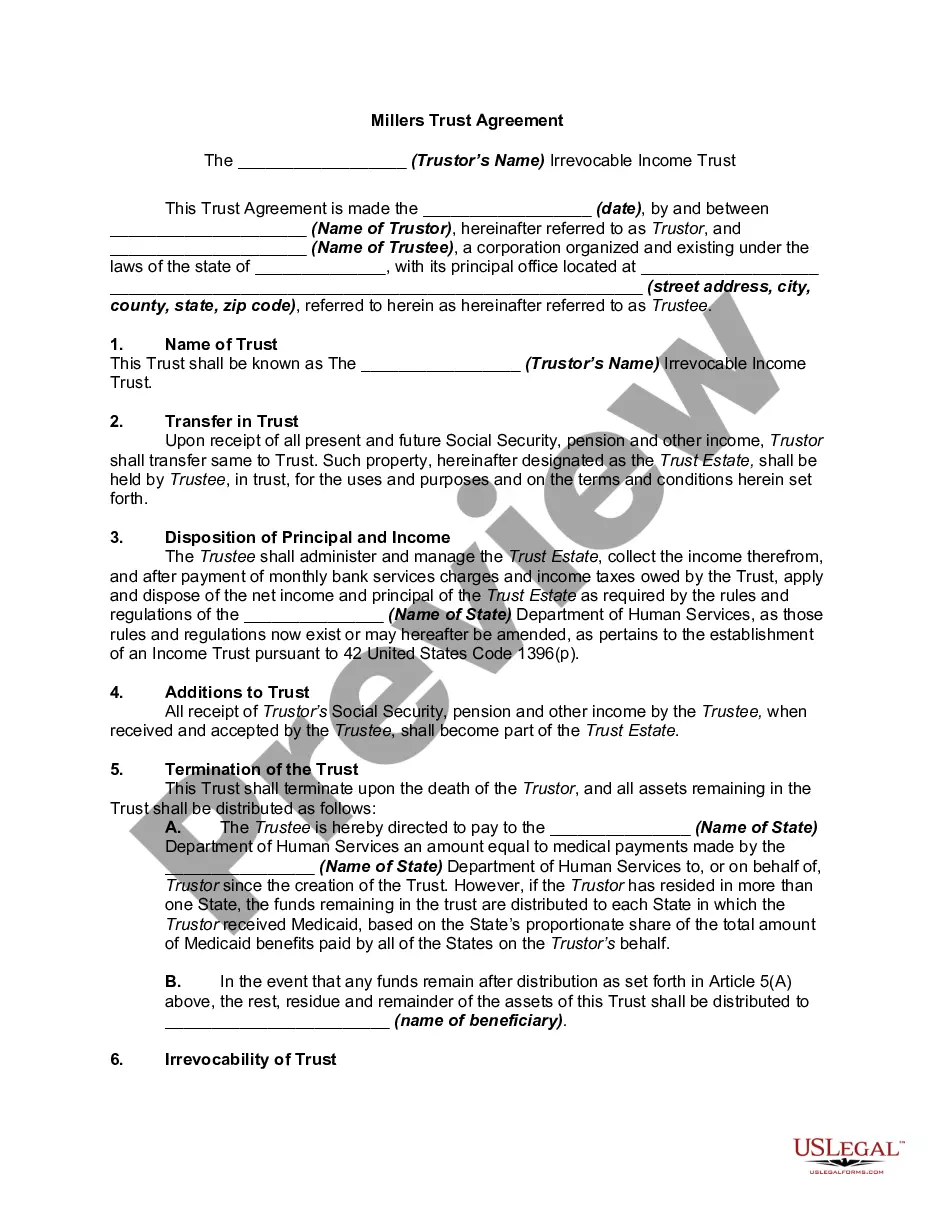
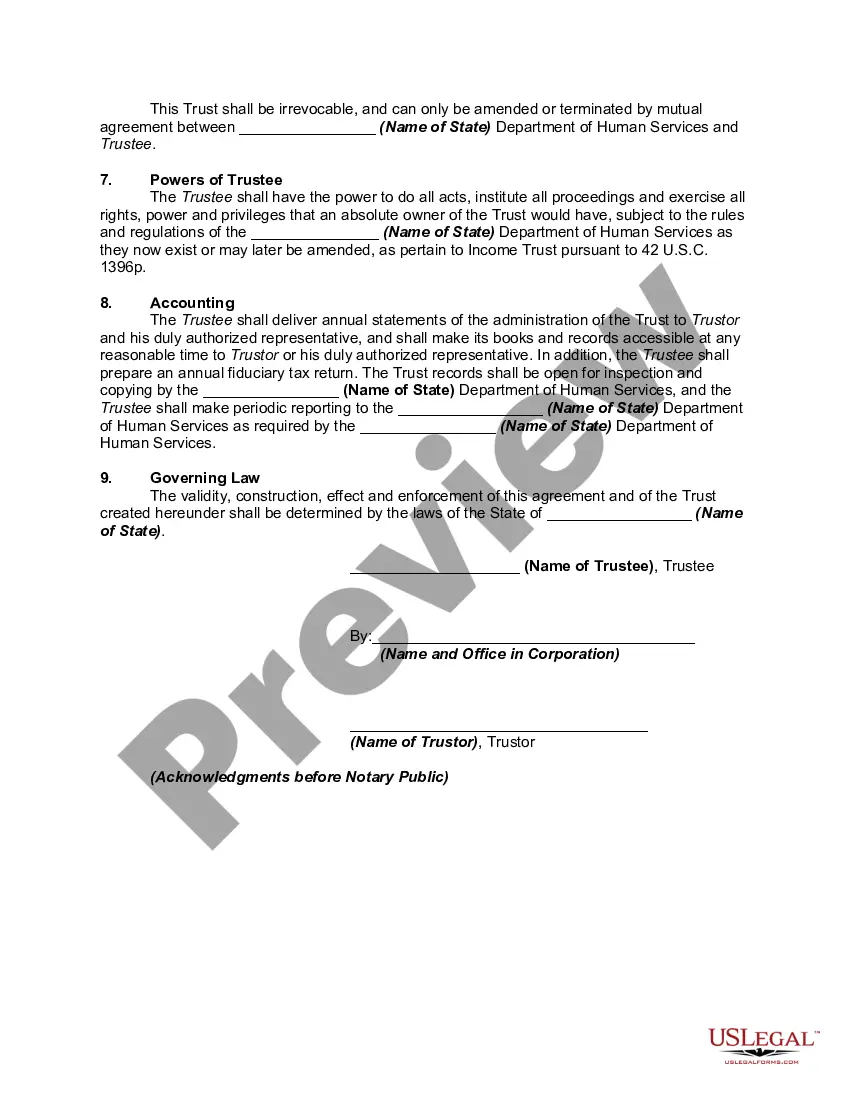
The qualified Medicaid income trust is a legal instrument which meets criteria in 42 United States Code 1396(p) and which allows individuals with income over the institutional care program limits to qualify for institutional care services or for home and community based services assistance.


A Medicaid trust may take various forms and laws vary by state. There are differing requirements under state laws regarding what assets may be counted or reached for recovery upon death. To comply with applicable requirements, professional financial advice should be sought. The term "Miller Trust" is an informal name. A more accurate name for this trust is an "Income Cap Trust". It has also been called an Income Assignment Trust. This is because, after the trust is created, the patient assigns his or her right to receive social security and pension to the trust.
Free preview
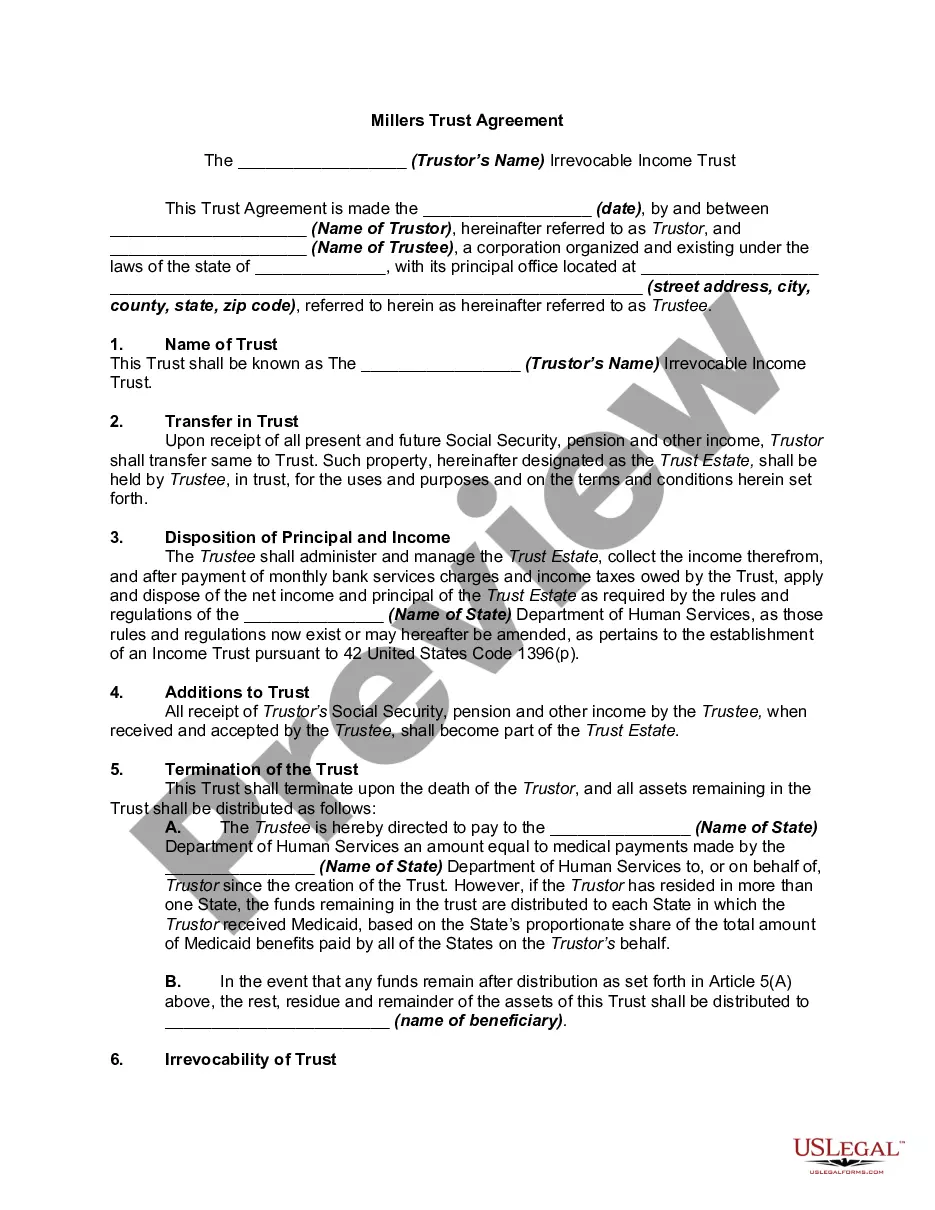
  • Preview Qualified Income Miller Trust
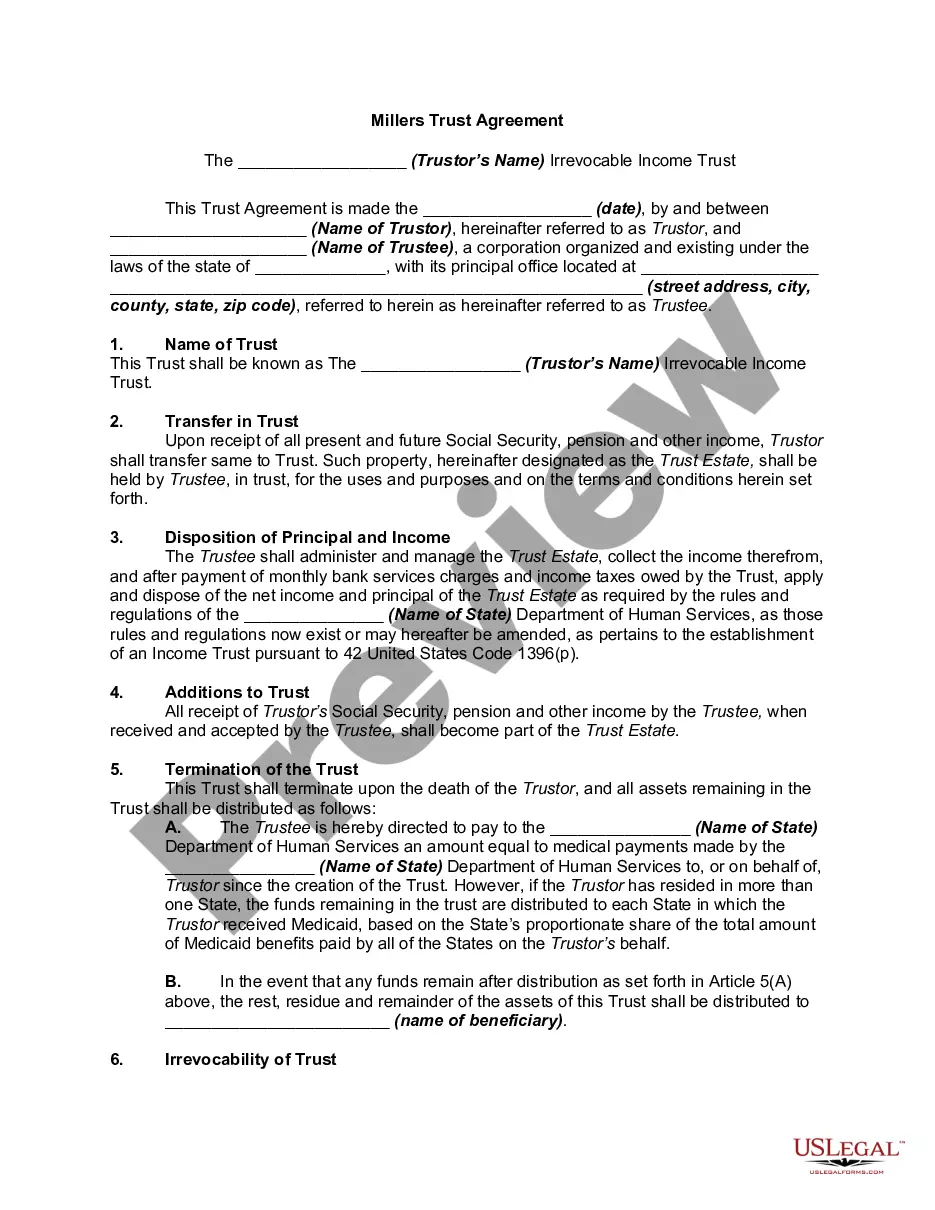
  • Preview Qualified Income Miller Trust

How to fill out Qualified Income Miller Trust?

You can spend numerous hours online trying to locate the legal document template that meets the federal and state requirements you need.

US Legal Forms offers countless legal templates that have been evaluated by experts.

You can easily obtain or print the Iowa Qualified Income Miller Trust from the service.

Review the form description to confirm you have chosen the correct form. If applicable, utilize the Preview button to browse through the document template as well.

  1. If you already possess a US Legal Forms account, you can Log In and then click the Download button.
  2. After that, you can complete, modify, print, or sign the Iowa Qualified Income Miller Trust.
  3. Every legal document template you obtain is yours forever.
  4. To receive an additional copy of any purchased form, navigate to the My documents tab and click the appropriate button.
  5. If you are using the US Legal Forms website for the first time, follow the simple instructions below.
  6. First, ensure that you have selected the correct document template for your region/area of choice.

Form popularity

FAQ

Setting up a Qualified Income Trust (QIT) account in Iowa involves several steps to ensure compliance with state regulations. Begin by gathering necessary documentation, such as your income records and identification. Then, consult the guidelines for creating an Iowa Qualified Income Miller Trust to help you formulate the trust agreement. Once established, you can easily manage your contributions to the trust with the help of platforms like uslegalforms, which provide resources to assist with the setup process.

To document trust income for an Iowa Qualified Income Miller Trust, you will need to keep accurate records of all income received. Start by collecting statements from all income sources, including bank statements and tax documents. Use these records to create a comprehensive summary that outlines each income type and its total amount annually. Having organized documentation simplifies the process of verifying income when managing your trust.

To establish a qualified income trust in Iowa, also known as an Iowa Qualified Income Miller Trust, you first need to create a legal document that meets state requirements. This document must clearly state how income is distributed and designate a trustee to manage the trust. You can streamline this process by using a platform like US Legal Forms, which provides templates and guidance to help you navigate the creation of your trust effectively. Always consider seeking advice from a financial advisor to ensure compliance with Medicaid eligibility requirements.

When the last beneficiary of a trust dies, the trust generally terminates, and the remaining assets are distributed according to the terms set in the trust document. If you have an Iowa Qualified Income Miller Trust, it is important to specify how the remaining funds should be handled after all beneficiaries pass away. If no instructions exist, state laws will dictate the distribution of the assets. This process can be complex, so consulting with a legal expert can ensure your wishes are honored.

A Miller trust works by setting aside income that exceeds the Medicaid eligibility limit, allowing the beneficiary to qualify for Medicaid benefits. When you place your excess income into the trust, it is then managed according to specific guidelines, ensuring that funds are used for necessary medical expenses. Understanding these mechanics can be complex, but resources like US Legal Forms can help you set up and manage your Iowa Qualified Income Miller Trust efficiently.

The primary benefit of an Iowa Qualified Income Miller Trust is that it allows individuals to qualify for Medicaid while keeping some of their income. This trust helps safeguard your financial well-being by setting aside excess income for medical needs without affecting your eligibility. Additionally, it promotes better management of medical expenses and assets.

Yes, a Miller trust may need to file a tax return if it generates any income. The return is filed using Form 1041, which reports the income and expenses of the trust. If your Iowa Qualified Income Miller Trust has no income, filing is not necessary. It's best to check with a tax professional to understand your specific requirements.

Yes, a Qualified Income Trust in Iowa requires an Employer Identification Number (EIN) for tax purposes. The EIN identifies the trust to the IRS and is necessary when filing any required tax returns, such as Form 1041. Obtaining an EIN is a straightforward process, and you can easily do it online through the IRS website.

You do not need to file Form 1041 for your Iowa Qualified Income Miller Trust if it has no income. This form is specifically for reporting income generated by the trust. If your trust does not produce income, it simplifies your tax responsibilities and reduces filing requirements.

A Miller's trust, also known as a Qualified Income Trust in Iowa, helps individuals qualify for Medicaid while preserving some of their income. It allows you to allocate excess income into the trust to meet eligibility requirements. By using this trust, you can ensure that you maintain access to necessary medical care without losing your financial assets.

Trusted and secure by over 3 million people of the world’s leading companies

Iowa Qualified Income Miller Trust