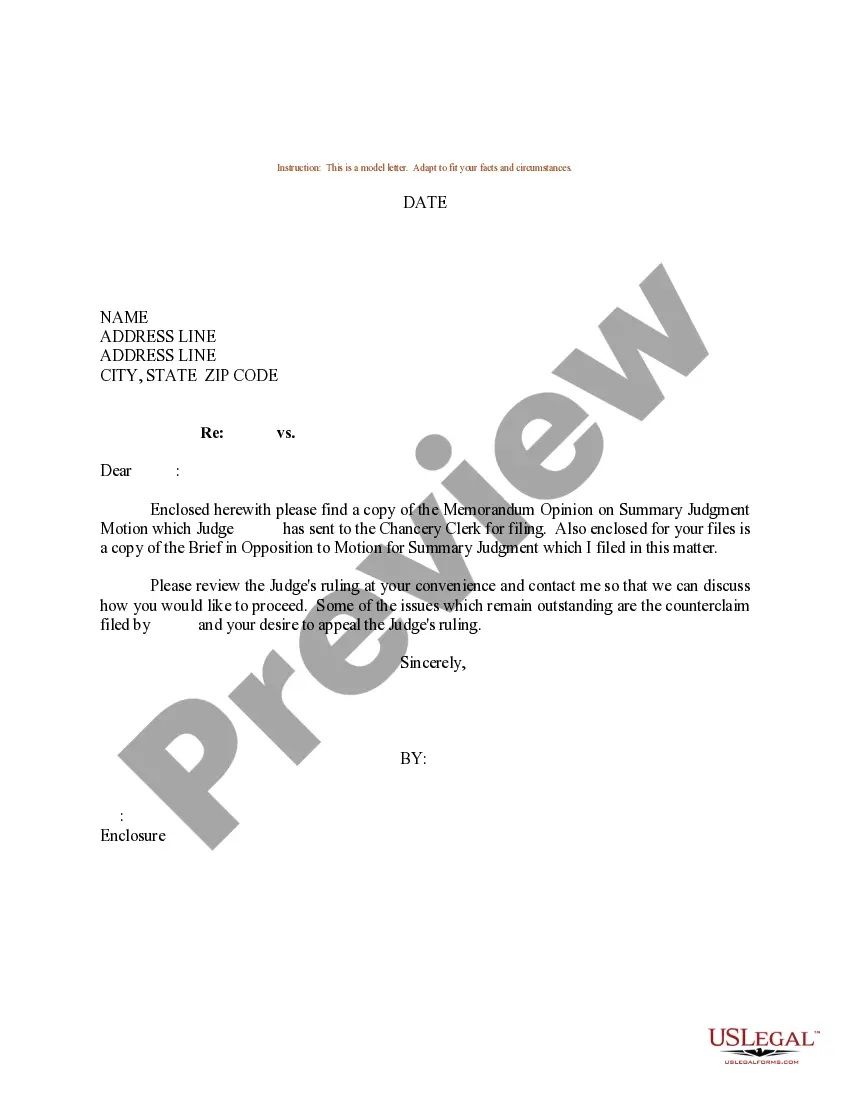
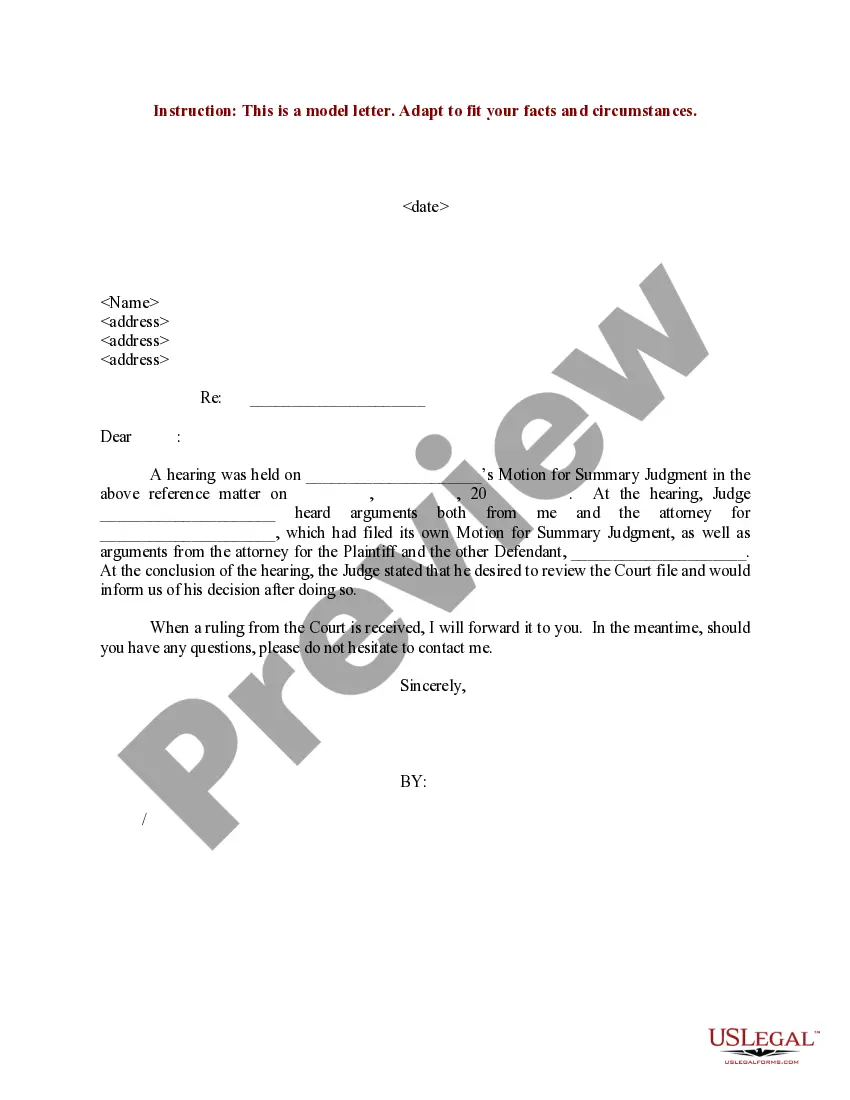
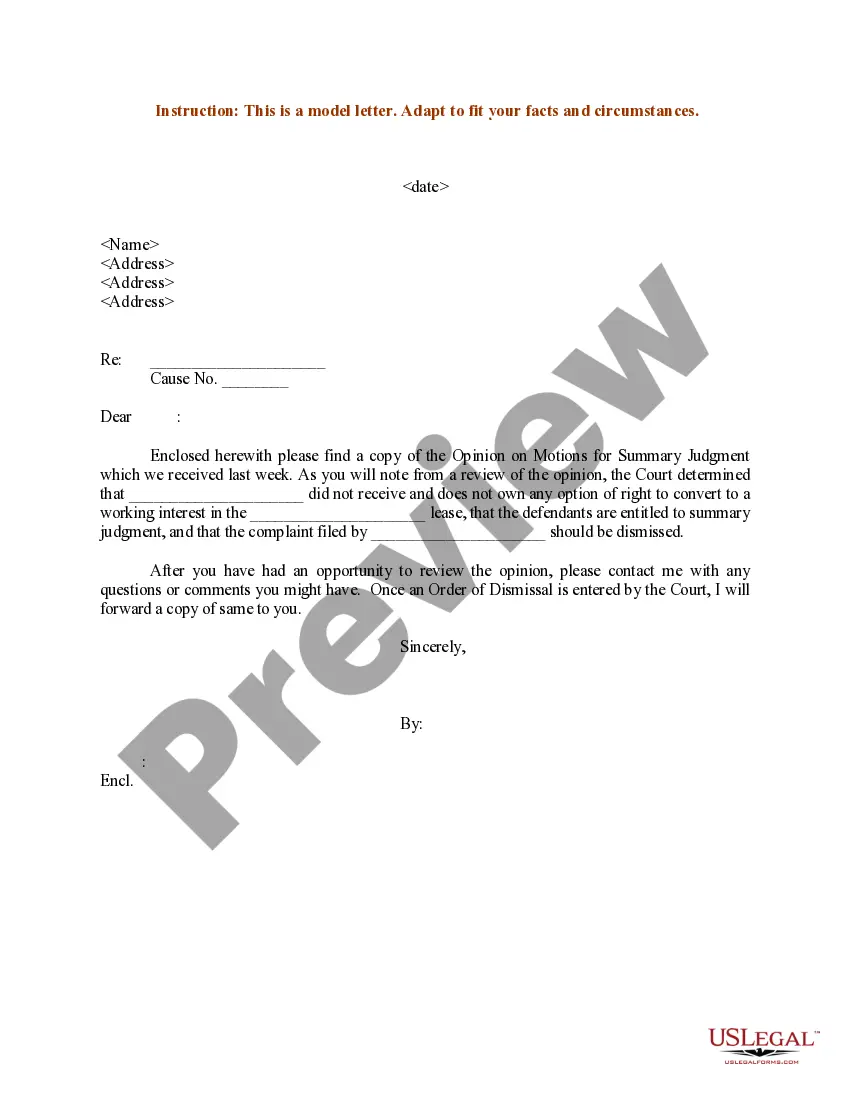
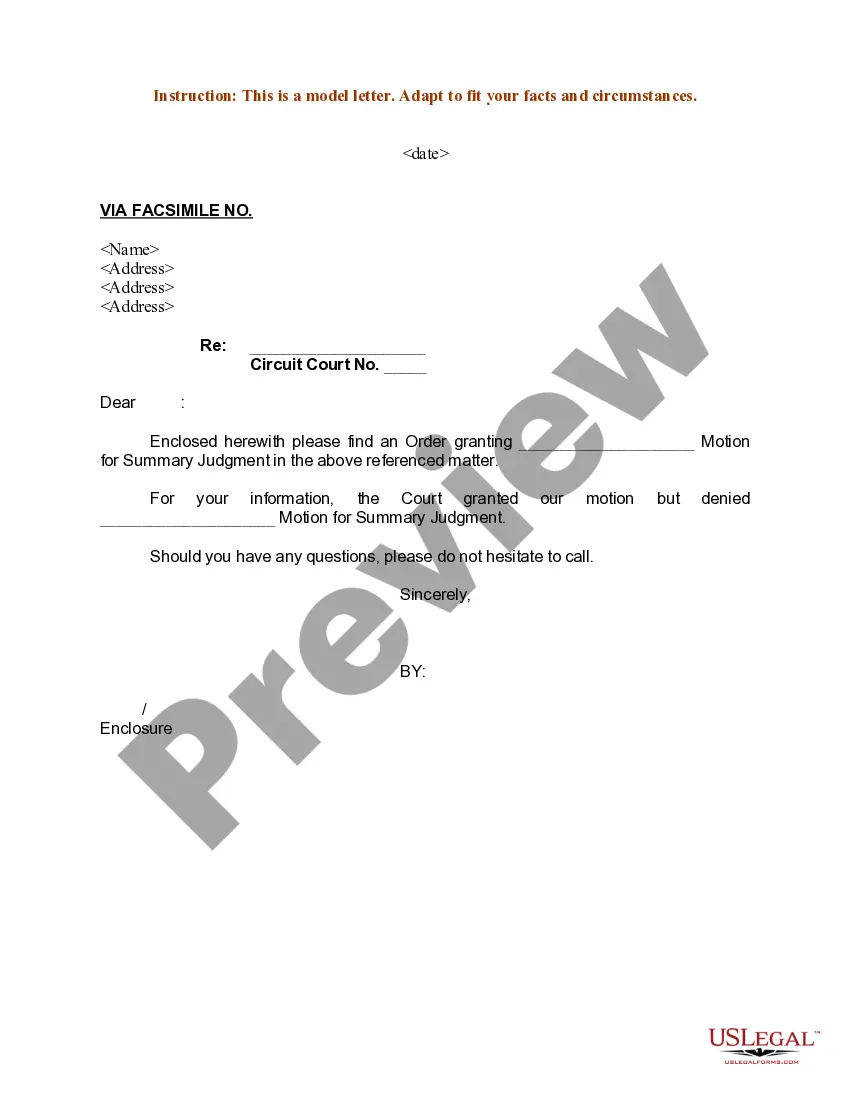
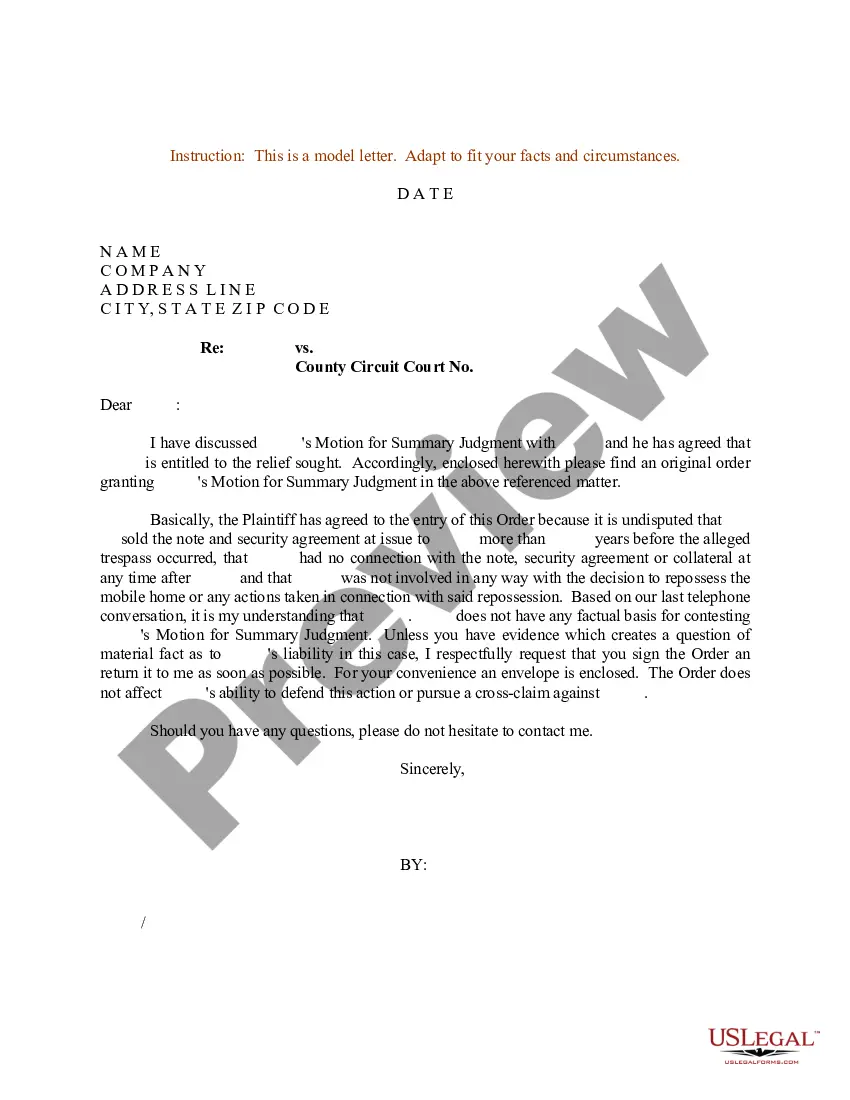
Idaho Sample Letter regarding Memorandum Opinion on Summary Judgment Motion
Description
Get your form ready online
Our built-in tools help you complete, sign, share, and store your documents in one place.
Make edits, fill in missing information, and update formatting in US Legal Forms—just like you would in MS Word.
Download a copy, print it, send it by email, or mail it via USPS—whatever works best for your next step.
Sign and collect signatures with our SignNow integration. Send to multiple recipients, set reminders, and more. Go Premium to unlock E-Sign.
If this form requires notarization, complete it online through a secure video call—no need to meet a notary in person or wait for an appointment.
We protect your documents and personal data by following strict security and privacy standards.

Make edits, fill in missing information, and update formatting in US Legal Forms—just like you would in MS Word.

Download a copy, print it, send it by email, or mail it via USPS—whatever works best for your next step.

Sign and collect signatures with our SignNow integration. Send to multiple recipients, set reminders, and more. Go Premium to unlock E-Sign.

If this form requires notarization, complete it online through a secure video call—no need to meet a notary in person or wait for an appointment.

We protect your documents and personal data by following strict security and privacy standards.
Looking for another form?

How to fill out Sample Letter Regarding Memorandum Opinion On Summary Judgment Motion?
US Legal Forms - one of the most extensive collections of sanctioned templates in the USA - offers a broad selection of legal document formats that you can obtain or print. By utilizing the website, you can discover numerous templates for business and personal use, organized by categories, states, or keywords. You can access the latest versions of templates such as the Idaho Sample Letter regarding Memorandum Opinion on Summary Judgment Motion in just a few minutes.
If you possess a subscription, Log In and retrieve the Idaho Sample Letter regarding Memorandum Opinion on Summary Judgment Motion from your US Legal Forms repository. The Download button will appear on every template you view. You can access all previously saved templates in the My documents section of your account.
If you are using US Legal Forms for the first time, here are straightforward instructions to help you get started: Ensure you have selected the correct template for your city/state. Click the Review button to examine the template's content. Check the template summary to confirm that you have chosen the right one. If the template doesn't meet your needs, utilize the Search area at the top of the screen to find one that does. When you are satisfied with the template, confirm your choice by clicking the Buy now button. Then, select your preferred pricing plan and provide your details to register for an account.
- Process the transaction. Use your credit card or PayPal account to finalize the transaction.
- Select the format and acquire the template onto your device.
- Make modifications. Complete, edit, print, and sign the saved Idaho Sample Letter regarding Memorandum Opinion on Summary Judgment Motion.
- Every template you added to your account has no expiration date and belongs to you indefinitely. Therefore, if you wish to obtain or print another copy, simply navigate to the My documents section and click on the template you need.
- Access the Idaho Sample Letter regarding Memorandum Opinion on Summary Judgment Motion with US Legal Forms, the most extensive collection of legal document templates.
- Utilize a multitude of professional and state-specific templates that fulfill your business or personal requirements and specifications.
Form popularity
FAQ
What Must an Opposition to a Motion for Summary Judgment Include? The Memorandum of Points and Authorities includes any legal authorities and arguments that support your Opposition. An effective Memorandum of Points and Authorities will directly address the arguments made in the Motion for Summary Judgment.
Motion for summary judgment: The court can consider all evidence in the record, even if the evidence was not cited in the pleadings. However, the court can only consider evidence that would be admissible at trial.
To succeed in obtaining a summary judgment, a party must present compelling evidence and legal arguments that establish there are no genuine issues of material fact to be tried.
Therefore, to win on summary judgment you have to convince a judge that it is a good use of his or her very limited time and resources to write the decision. This means that your written material has to demonstrate that the law and facts support summary judgment, and contain no misstatements of law or fact.
A summary judgment is considered very difficult to win, and lawyers mostly use it as a scare tactic. However, it can be extremely beneficial. If the party moving the summary judgment wins, the case is thrown out. The most important thing in winning summary judgments is hiring competent lawyers.
Summary judgment is granted when the facts can be decided upon without needing to go to trial, where the opposing party would lose due to a lack of evidence. If it's not clear that there is no more evidence, then summary judgment must be denied.
Rule 56 of the Federal Rules of Civil Procedure governs summary judgment for federal courts. Under Rule 56, in order to succeed in a motion for summary judgment, a movant must show 1) that there is no genuine dispute as to any material fact, and 2) that the movant is entitled to judgment as a matter of law.
If you are opposing a motion for summary judgment, your affidavit or affirmation should attach and refer to any relevant exhibits. You may also attach affidavits or affirmations from other people who have personal knowledge of relevant information regarding the motion.