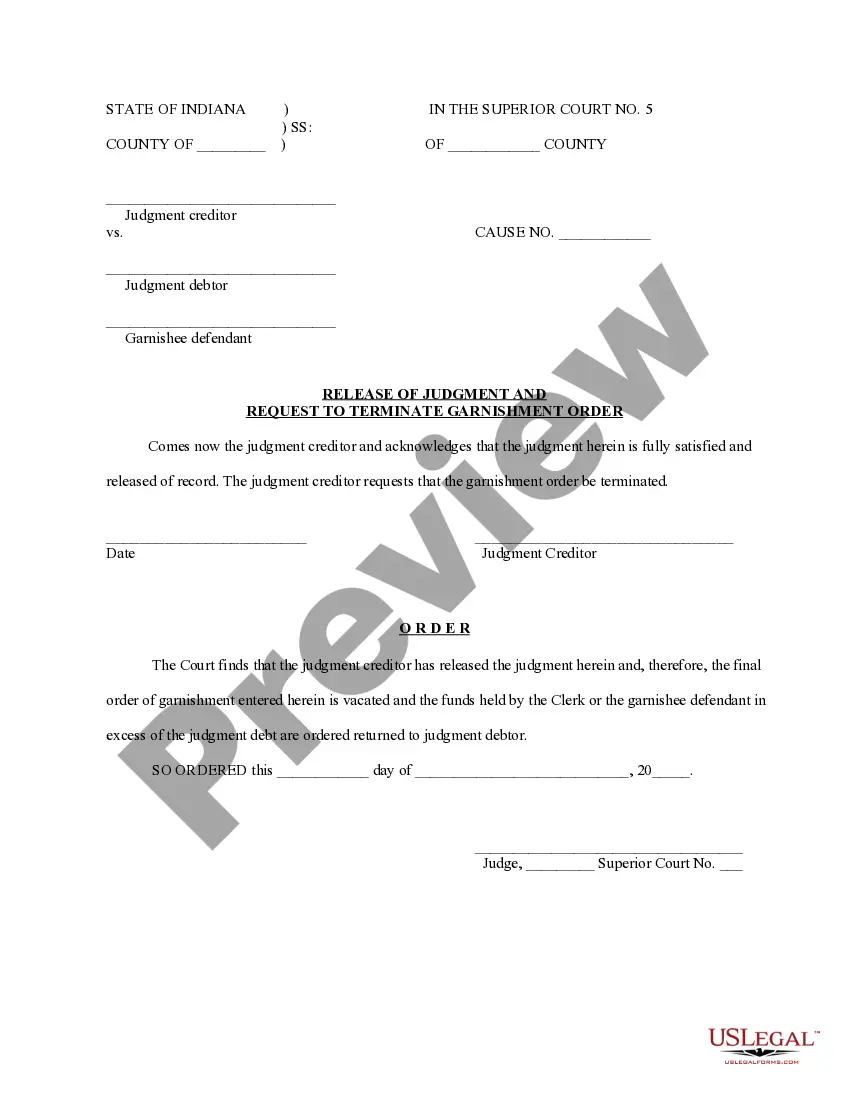
Indiana Release of Judgment and Request to Terminate Garnishment Order
Understanding this form
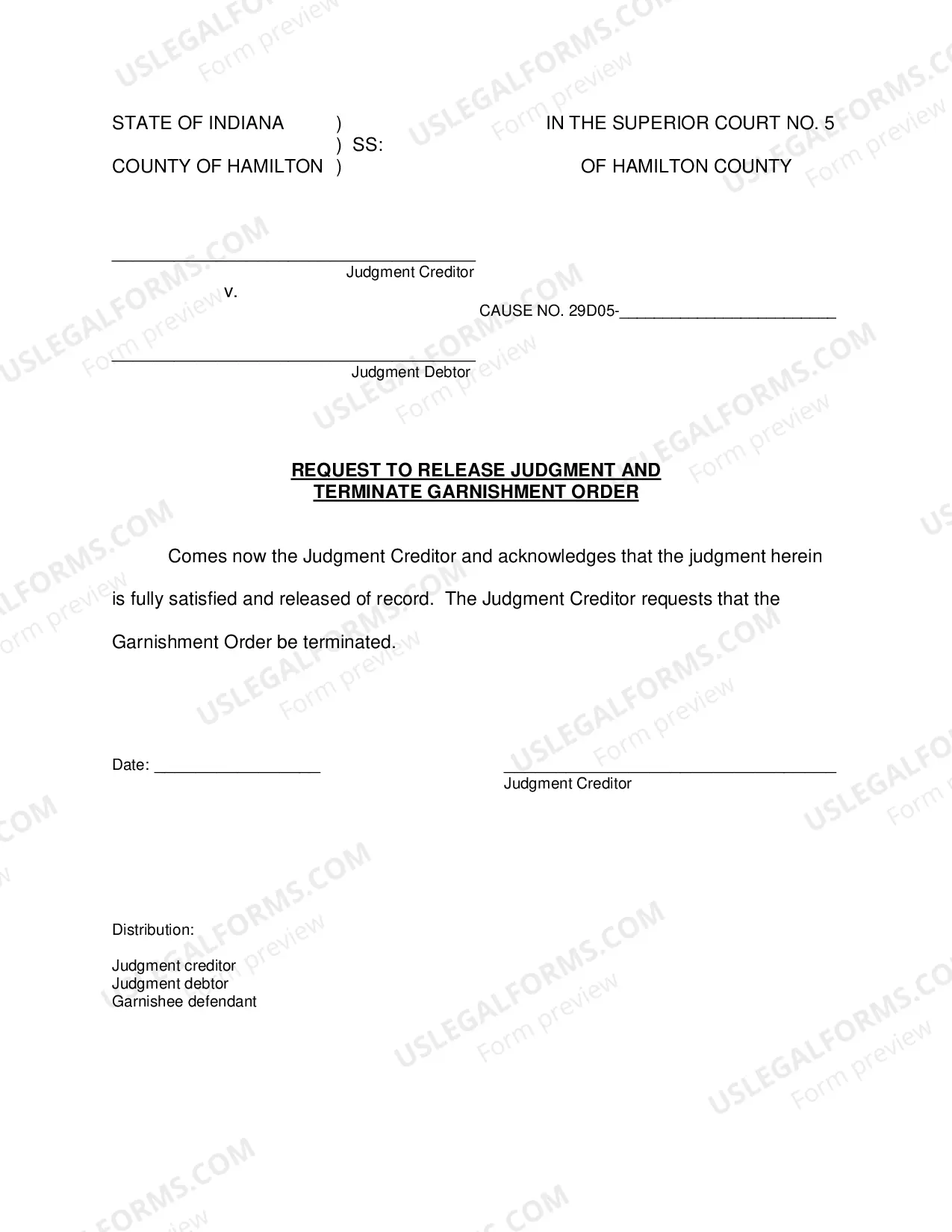
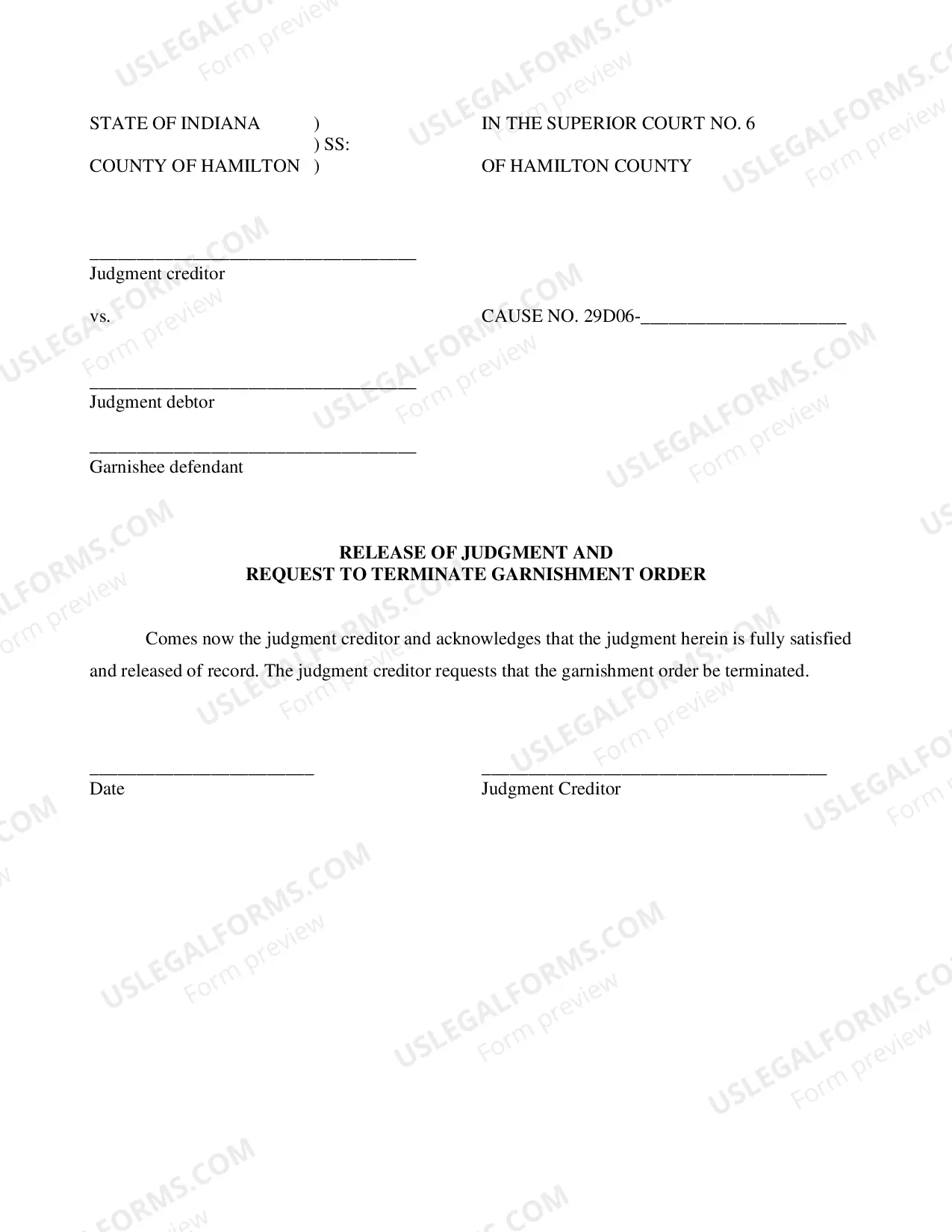
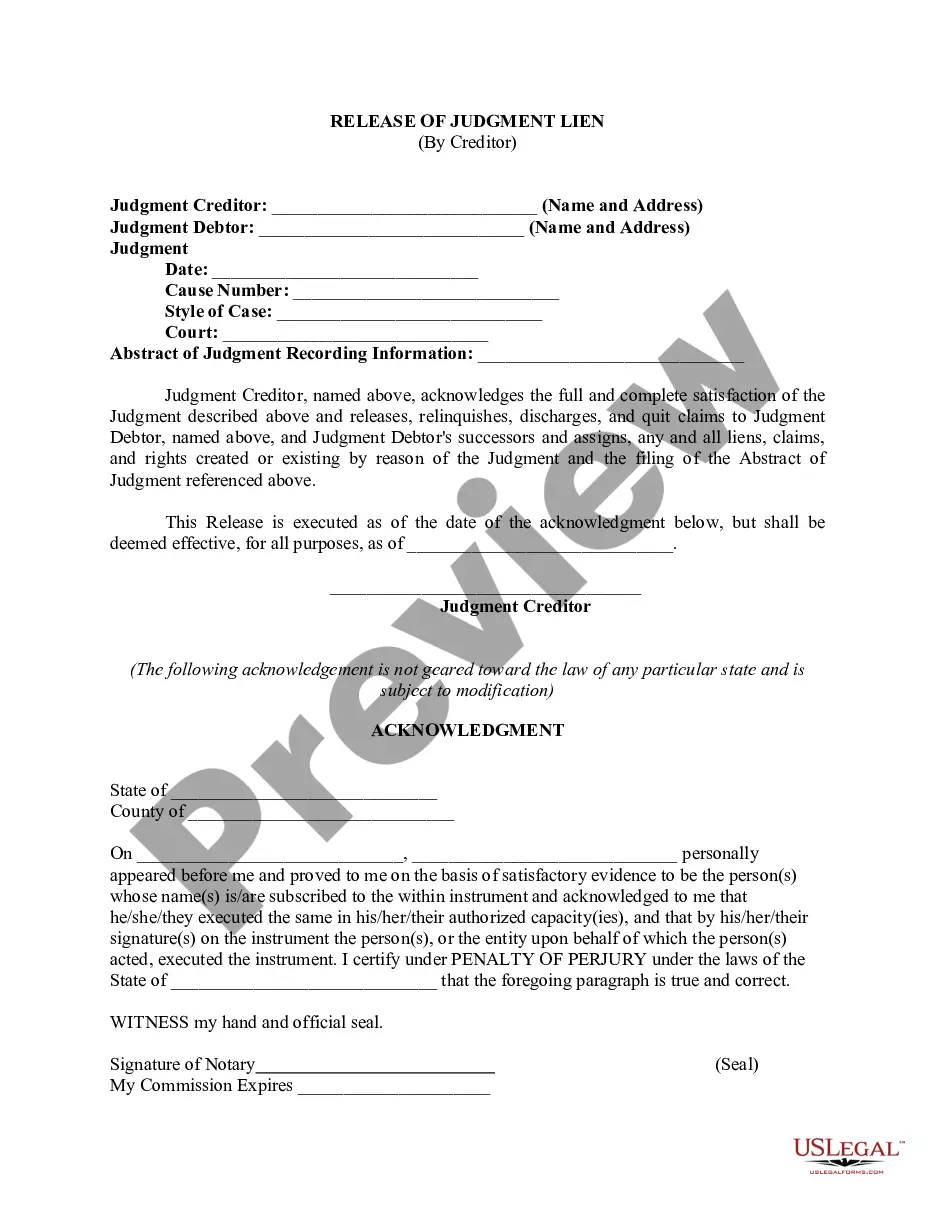
The Release of Judgment and Request to Terminate Garnishment Order is a legal document used in the Small Claims Court for the State of Indiana. This form is specifically designed for situations where the judgment creditor acknowledges that the judgment has been satisfied and requests the termination of the garnishment order, allowing the release of any funds held in excess of the judgment debt. It is distinct as it directly addresses the ending of the garnishment process following the satisfaction of a judgment.
Key parts of this document
- Parties involved: Identification of the judgment creditor, judgment debtor, and garnishee defendant.
- Complaint Case Number: Includes the cause number for reference.
- Release acknowledgment: States that the judgment is fully satisfied.
- Request section: Official request for the termination of the garnishment order.
- Order section: Court's agreement to vacate the garnishment order.
- Signatures: Requires the judgment creditor's signature and date.

Common use cases
This form should be used when a judgment creditor has received payment in full for a judgment and no longer wishes to continue the garnishment against the judgment debtorâs wages or assets. It is applicable in situations where the creditor wants to formally notify the court and the garnishee to halt the garnishment proceedings and return any excess funds held.
Intended users of this form
- Judgment creditors who have received full payment for a judgment and wish to end garnishment.
- Attorneys representing clients in small claims court regarding garnishment matters.
- Individuals involved in a small claims case in Indiana related to wage or bank account garnishment.
Instructions for completing this form
- Identify the parties: Fill in the names of the judgment creditor, judgment debtor, and garnishee.
- Enter the case number: Provide the cause number related to the original judgment.
- Complete the release acknowledgment: State that the judgment has been fully satisfied.
- Request termination: Clearly express the request to terminate the garnishment order.
- Date and sign: The judgment creditor must date and sign the form at the designated space.
Notarization requirements for this form
This form does not typically require notarization unless specified by local law. Ensure compliance with any specific court requirements in Indiana regarding notarization or additional documentation when submitting your form.
Get your form ready online
Our built-in tools help you complete, sign, share, and store your documents in one place.
Make edits, fill in missing information, and update formatting in US Legal Forms—just like you would in MS Word.
Download a copy, print it, send it by email, or mail it via USPS—whatever works best for your next step.
Sign and collect signatures with our SignNow integration. Send to multiple recipients, set reminders, and more. Go Premium to unlock E-Sign.
If this form requires notarization, complete it online through a secure video call—no need to meet a notary in person or wait for an appointment.
We protect your documents and personal data by following strict security and privacy standards.

Make edits, fill in missing information, and update formatting in US Legal Forms—just like you would in MS Word.

Download a copy, print it, send it by email, or mail it via USPS—whatever works best for your next step.

Sign and collect signatures with our SignNow integration. Send to multiple recipients, set reminders, and more. Go Premium to unlock E-Sign.

If this form requires notarization, complete it online through a secure video call—no need to meet a notary in person or wait for an appointment.

We protect your documents and personal data by following strict security and privacy standards.
Typical mistakes to avoid
- Failing to properly identify all parties involved, which can lead to delays.
- Not entering the correct cause number associated with the original judgment.
- Omitting a signature or date, which renders the form invalid.
- Neglecting to check for any local court requirements before submission.
Why use this form online
- Convenience: Download the form anytime from anywhere without needing to visit an attorney's office.
- Editability: Easily fill out the form digitally or print it for handwritten submission.
- Reliability: Access legally vetted templates created by licensed attorneys to ensure compliance.
Looking for another form?
Form popularity
FAQ
To file a judgment lien in Indiana, you need to complete specific paperwork and submit it to the county recorder's office where the debtor resides. This process formalizes the lien and protects your interests in property owned by the debtor. Utilizing the Indiana Release of Judgment and Request to Terminate Garnishment Order can help you navigate the complexities of this procedure effectively. It is essential to ensure proper filing to maintain your legal rights.
To collect on a judgment in Indiana, you can pursue various options, including garnishment of wages, bank accounts, or seizing property. First, obtain a certified copy of your judgment, then proceed with filing the necessary forms to implement the collection method of your choice. Utilizing the Indiana Release of Judgment and Request to Terminate Garnishment Order can also facilitate your efforts, helping you manage any existing garnishments effectively.
Change of Employment. The easiest thing to do is change your employer. Installment Plan. The IRS will let you pay your balance over time if you work out an installment plan with them. Offer in Compromise. Financial Hardship Exemption. Appeal. Bankruptcy.
If it's already started, you can try to challenge the judgment or negotiate with the creditor. But, they're in the driver's seat, and if they don't allow you to stop a garnishment by agreeing to make voluntary payments, you can't really force them to. You can, however, stop the garnishment by filing a bankruptcy case.
Wage garnishment is a legal procedure in which a person's earnings are required by court order to be withheld by an employer for the payment of a debt such as child support.
Further, if you think that quitting your job and simply finding another one will resolve the situation, you may be surprised to find that the garnishment order will follow you to your new job as well. As such, while quitting your job is certainly a legal option, you may do well to consider other recourse alternatives.