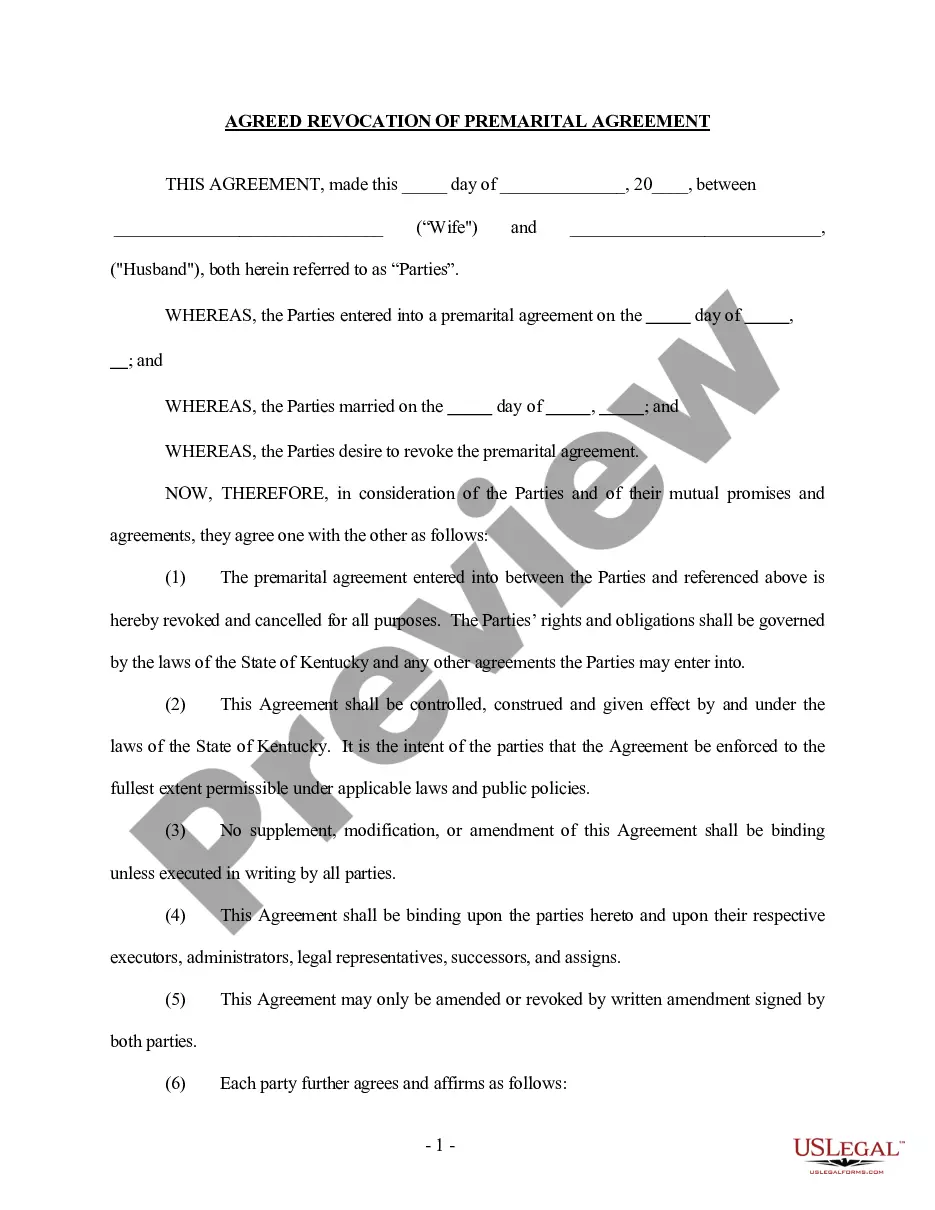
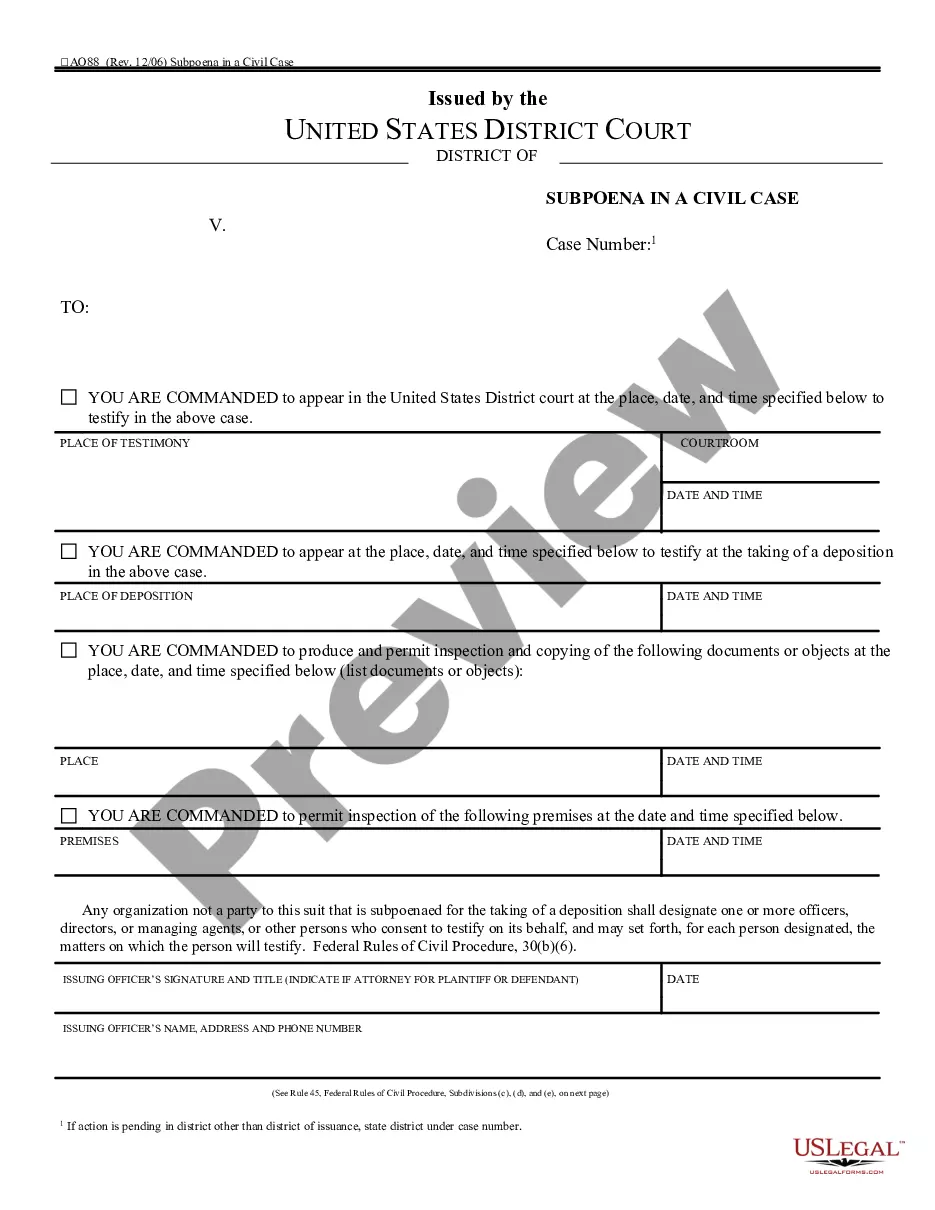
An Indiana Subpoena — Hearing (Criminal Case) is an official court proceeding used by the court to obtain evidence in a criminal case. The subpoena is issued by a judge and requires a witness to appear in court to provide testimony or to produce documents or records. There are two types of hearings that can be conducted through a subpoena: an evidentiary hearing, which is used to determine whether the evidence presented is admissible, and a sentencing hearing, which is used to determine the punishment for a criminal conviction. Both types of hearings are generally conducted in open court and are presided over by a judge.
Indiana Subpoena - Hearing (Criminal Case)
State:
Indiana
Control #:
IN-AO-89CR
Format:
PDF
Instant download
This website is not affiliated with any governmental entity
Public form
Description
Subpoena - Hearing (Criminal Case)





How to fill out Indiana Subpoena - Hearing (Criminal Case)?
How much duration and assets do you generally invest in creating formal documents.
There’s a superior chance to obtain such forms than employing legal professionals or squandering hours searching the internet for a suitable template. US Legal Forms is the leading online repository that offers expertly drafted and authenticated state-specific legal paperwork for any purpose, such as the Indiana Subpoena - Hearing (Criminal Case).
Another benefit of our library is that you can retrieve previously acquired documents that you securely store in your profile in the My documents tab. Access them at any time and re-complete your paperwork as often as necessary.
Conserve time and energy preparing legal documents with US Legal Forms, one of the most reliable online services. Join us today!
- Review the document content to confirm it fulfills your state's conditions. To accomplish this, examine the form details or utilize the Preview option.
- If your legal template fails to satisfy your needs, discover an alternative using the search bar located at the top of the page.
- If you already possess an account with us, Log In and download the Indiana Subpoena - Hearing (Criminal Case). If you do not have one, proceed to the subsequent steps.
- Click Buy now once you identify the correct document. Choose the subscription plan that accommodates you best to access our library’s complete service.
- Register for an account and remit payment for your subscription. You can complete the payment with your credit card or via PayPal - our service is completely secure for that.
- Download your Indiana Subpoena - Hearing (Criminal Case) onto your device and finalize it on a printed hard copy or digitally.
Form popularity
FAQ
An answering party may not give lack of information or knowledge as a reason for failure to admit or deny unless he states that he has made reasonable inquiry and that the information known or readily obtainable by him is insufficient to enable him to admit or deny or that the inquiry would be unreasonably burdensome.
(A) If an arrestee does not present a substantial risk of flight or danger to themselves or others, the court should release the arrestee without money bail or surety subject to such restrictions and conditions as determined by the court except when: (1) The arrestee is charged with murder or treason.
If a witness fails to appear after being subpoenaed, then they could be fined, jailed until they comply, the proceedings end, or are charged with a violation of a court order (contempt of court). Contempt may either be civil or criminal.
Rule 37-Failure to Make or Cooperate in Discovery: Sanctions. (a) Motion for Order Compelling Disclosure or Discovery. A party, upon reasonable notice to other parties and all persons affected thereby, may apply for an order compelling disclosure or discovery as follows: (1) Appropriate Court.
When actions involving a common question of law or fact are pending before the court, it may order a joint hearing or trial of any or all the matters in issue in the actions; it may order all the actions consolidated; and it may make such orders concerning proceedings therein as may tend to avoid unnecessary costs or
In fact, under Indiana Code § 35-41-4-2, murder and Level 1 and Level 2 felonies have no limitations period, meaning the prosecutor can bring the charges at any point after the commission of the offense.
Rule 37 authorizes the court to direct that parties or attorneys who fail to participate in good faith in the discovery process pay the expenses, including attorney's fees, incurred by other parties as a result of that failure. Since attorneys' fees cannot ordinarily be awarded against the United States (28 U.S.C.
Failure by any person without adequate excuse to obey a subpoena served upon him may be deemed a contempt of the court from which the subpoena issued, or court of the county where the witness was required thereunder to appear or act.