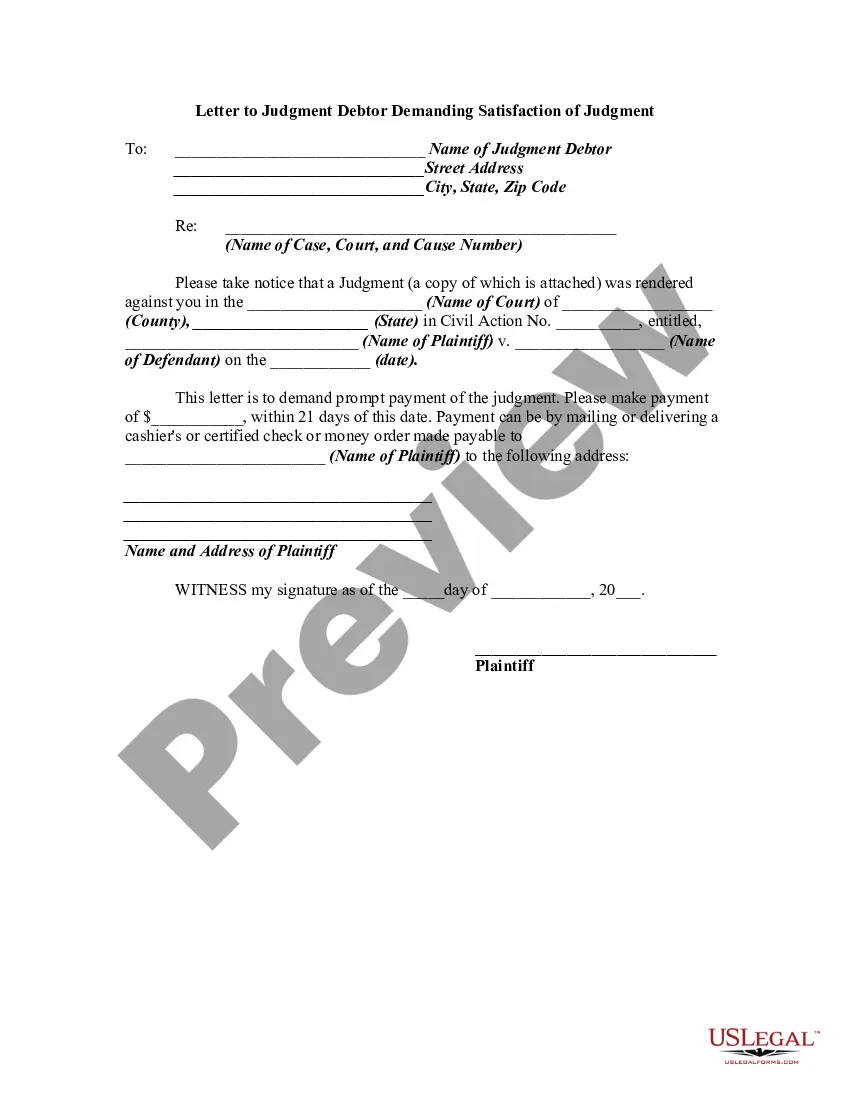
Pursuant to this form, a plaintiff who obtained a judgment against a defendant is demanding satisfaction of the judgment by payment of a sum of money sent to a specified address. If the parties are represented by an attorney, it would be preferable for the attorney representing the plaintiff to send such a letter to the attorney representing the defendant.
Indiana Letter to Judgment Debtor Demanding Satisfaction of Judgment
Category:
State:
Multi-State
Control #:
US-00760BG
Format:
Word;
Rich Text
Instant download
Description






How to fill out Letter To Judgment Debtor Demanding Satisfaction Of Judgment?
If you need to finalize, download, or create official document templates, utilize US Legal Forms, the largest selection of official forms available online.
Employ the site’s simple and user-friendly search to find the documents you need. Various templates for business and personal purposes are organized by categories and suggestions, or keywords.
Use US Legal Forms to locate the Indiana Letter to Judgment Debtor Demanding Satisfaction of Judgment with just a few clicks.
Every official document template you acquire is yours forever. You have access to each form you downloaded within your account. Go to the My documents section and select a form to print or download again.
Be proactive and download, and print the Indiana Letter to Judgment Debtor Demanding Satisfaction of Judgment with US Legal Forms. There are numerous professional and state-specific forms available for your business or personal needs.
- If you are already a US Legal Forms client, Log In to your account and then click the Download button to obtain the Indiana Letter to Judgment Debtor Demanding Satisfaction of Judgment.
- You can also access forms you previously downloaded within the My documents tab of your account.
- If this is your first time using US Legal Forms, follow the instructions below.
- Step 1. Ensure you have selected the form for the correct city/state.
- Step 2. Utilize the Review option to examine the form’s content. Be sure to view the summary.
- Step 3. If you are not satisfied with the form, use the Search field at the top of the screen to find other variations of the official form template.
- Step 4. Once you have found the form you need, click the Purchase now button. Choose the payment plan you prefer and enter your details to register for an account.
- Step 5. Complete the payment. You can use your credit card or PayPal account to finalize the transaction.
- Step 6. Select the format of the official form and download it to your device.
- Step 7. Complete, modify, and print or sign the Indiana Letter to Judgment Debtor Demanding Satisfaction of Judgment.
Form popularity
FAQ
The judgment lien definition is that if you owe a creditor money and don't pay, they can sue you for the balance. If the court rules in their favor, the creditor can file a judgment lien against you, which means that the court has permitted them to forcefully collect that debt from you.
The Court entered a judgment against you. When a judgment does not get paid, the Plaintiff is allowed to ask the Court to require the Defendant to come to a hearing so the Plaintiff can find out if the Defendant has any income or property which the Court can require the Defendant to use to pay towards the judgment.
A satisfaction of judgment is a document signed by a judgment creditor and generally filed with the court, indicating that a judgment has been paid in full.
After the judgment is obtained, the creditor can enforce the lien right for the first ten years by attempting to foreclose on any real property or personal property the judgment debtor owns.
A satisfaction of judgment may be filed to inform the court a judgment or order has been satisfied. This event should not be used in place of a Satisfaction of Claim.
Ind. Code § 34-55-9-2. Judgments are valid for a period of twenty years.
(D) Satisfaction/Release of Judgment. Upon payment in full of a judgment, including accrued interest and court costs, the judgment creditor shall file a satisfaction/release of judgment and the Clerk shall note the satisfaction/release of the judgment on the Chronological Case Summary and on the Judgment Docket.
If the court rules in their favor, the creditor can file a judgment lien against you, which means that the court has permitted them to forcefully collect that debt from you. This allows them to take possession of your real estate holdings, personal property, or business.