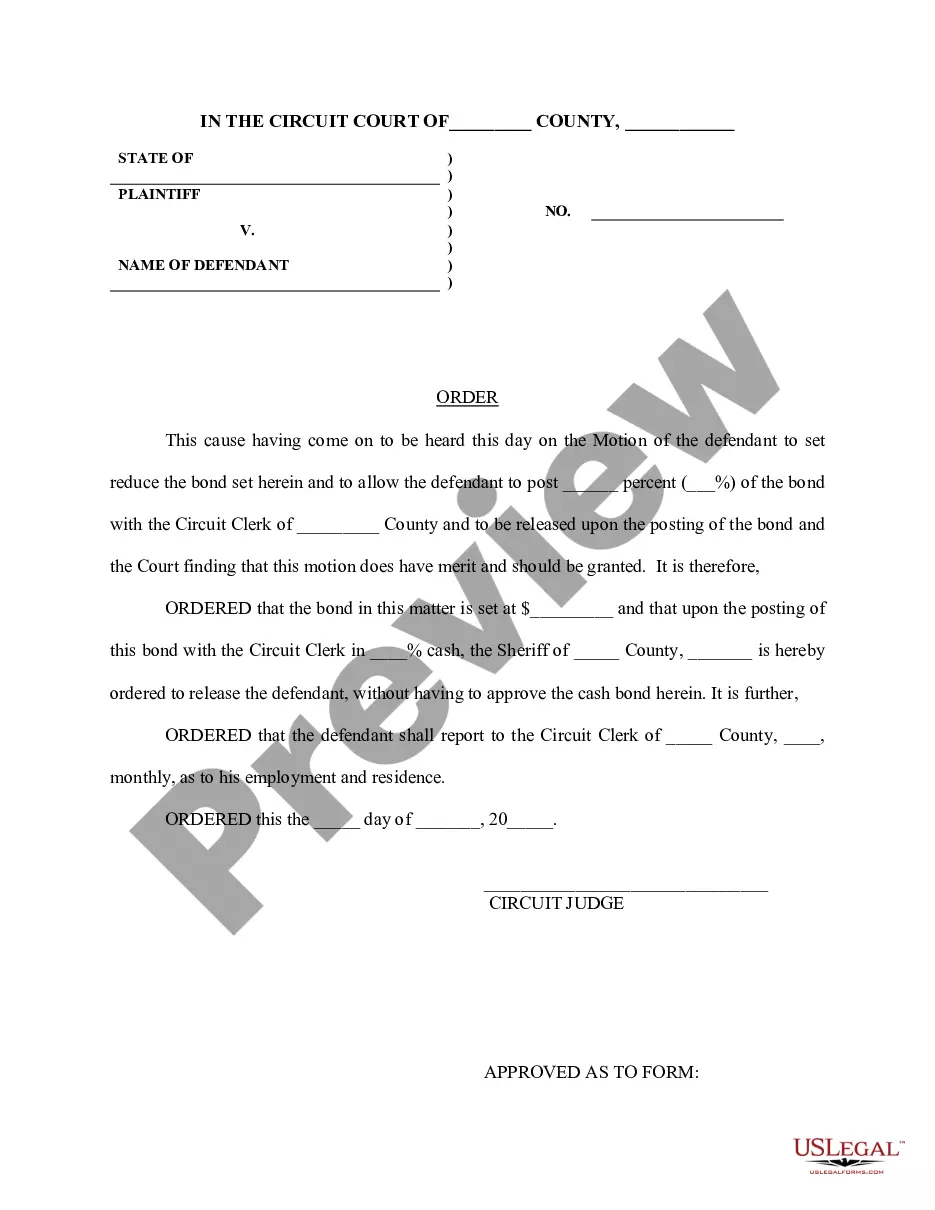
Indiana Order to reduce bond
Description

Get your form ready online
Our built-in tools help you complete, sign, share, and store your documents in one place.
Make edits, fill in missing information, and update formatting in US Legal Forms—just like you would in MS Word.
Download a copy, print it, send it by email, or mail it via USPS—whatever works best for your next step.
Sign and collect signatures with our SignNow integration. Send to multiple recipients, set reminders, and more. Go Premium to unlock E-Sign.
If this form requires notarization, complete it online through a secure video call—no need to meet a notary in person or wait for an appointment.
We protect your documents and personal data by following strict security and privacy standards.

Make edits, fill in missing information, and update formatting in US Legal Forms—just like you would in MS Word.

Download a copy, print it, send it by email, or mail it via USPS—whatever works best for your next step.

Sign and collect signatures with our SignNow integration. Send to multiple recipients, set reminders, and more. Go Premium to unlock E-Sign.

If this form requires notarization, complete it online through a secure video call—no need to meet a notary in person or wait for an appointment.

We protect your documents and personal data by following strict security and privacy standards.
Looking for another form?
How to fill out Order To Reduce Bond?
US Legal Forms - one of the largest collections of legal templates in the USA - provides a vast selection of legal document templates that you can download or print. By using the site, you will discover thousands of templates for business and personal use, categorized by types, states, or keywords. You can find the most recent versions of documents like the Indiana Order to reduce bond in seconds.
If you have a monthly subscription, Log In and download the Indiana Order to reduce bond from your US Legal Forms library. The Download button will appear on each form you view. You can access all previously downloaded templates from the My documents tab of your account.
If you are using US Legal Forms for the first time, here are simple instructions to get started: Ensure you have selected the correct form for your city/county. Click the Preview button to review the content of the form. Check the form summary to confirm that you have chosen the right template. If the form does not meet your needs, use the Search field at the top of the screen to find one that does. If you are satisfied with the form, confirm your selection by clicking the Purchase now button. Then, choose the pricing plan you prefer and provide your details to register for an account. Process the transaction. Use your Visa or Mastercard or PayPal account to complete the transaction. Select the format and download the form to your device. Make modifications. Fill out, edit, and print and sign the downloaded Indiana Order to reduce bond. Each template you added to your account has no expiration date and is yours permanently. So, if you want to download or print another copy, just go to the My documents section and click on the form you need.
- Access the Indiana Order to reduce bond with US Legal Forms, the most extensive collection of legal document templates.
- Utilize a multitude of professional and state-specific templates that meet your business or personal needs and requirements.
- Explore the variety of options available for legal documentation.
- Ensure compliance with your local jurisdiction through accurate templates.
- Enjoy the convenience of a digital library at your fingertips.
- Simplify your legal documentation process with user-friendly templates.
Form popularity
FAQ
Once they process the person into jail, it's possible to post bail through a sheriff or clerk's office before attending an initial hearing. If the person doesn't have enough cash to pay for bail, he or she can call a bond agent or family or friend from jail for help. Also, an attorney can request a bond hearing.
Any person can do it. A percent bond, also called a PR bond, is refundable if there are no fees, fines, and/or restitution ordered once the case is resolved. If the defendant fails to appear, the bond depositor may be required to pay the remaining 80 percent of the bond.
If you don't have money, you can still bail yourself or someone else out of jail in Indiana. Besides posting bail with your own cash, the law also offers other options, including bail bond agents, collateral, or release on own recognizance.
We say leverage because when a defendant is put back in custody, they often are forced to resolve their cases more quickly in order to get out of custody.By revoking a bond through a hearing, the defendant is put back in custody (often without a bond), and they remain there until the case is over.
Your Bond Must Be A Reasonable Value The Indiana Supreme Court has held that bonds must be reasonable. If a bond amount is unreasonably high, it may be seen as overstepping the intended purpose of ensuring your attendance at court. Sometimes, a seemingly outrageously high bond can be justified in the name of safety.
Bond refunds will be made payable to and given only to the the person who made the deposit. The defendant will need to apply for the bond refund when the case is decided and if the case has not been dismissed. The court may or may not apply the bond refund toward other court fees.
?No Bond? Definition A no bond status signifies that an individual is not eligible for release from county jail through the payment of bail, as a judge has not set a bail amount. The arrested person will remain in custody until a judge potentially sets bail at a later hearing or the case concludes.