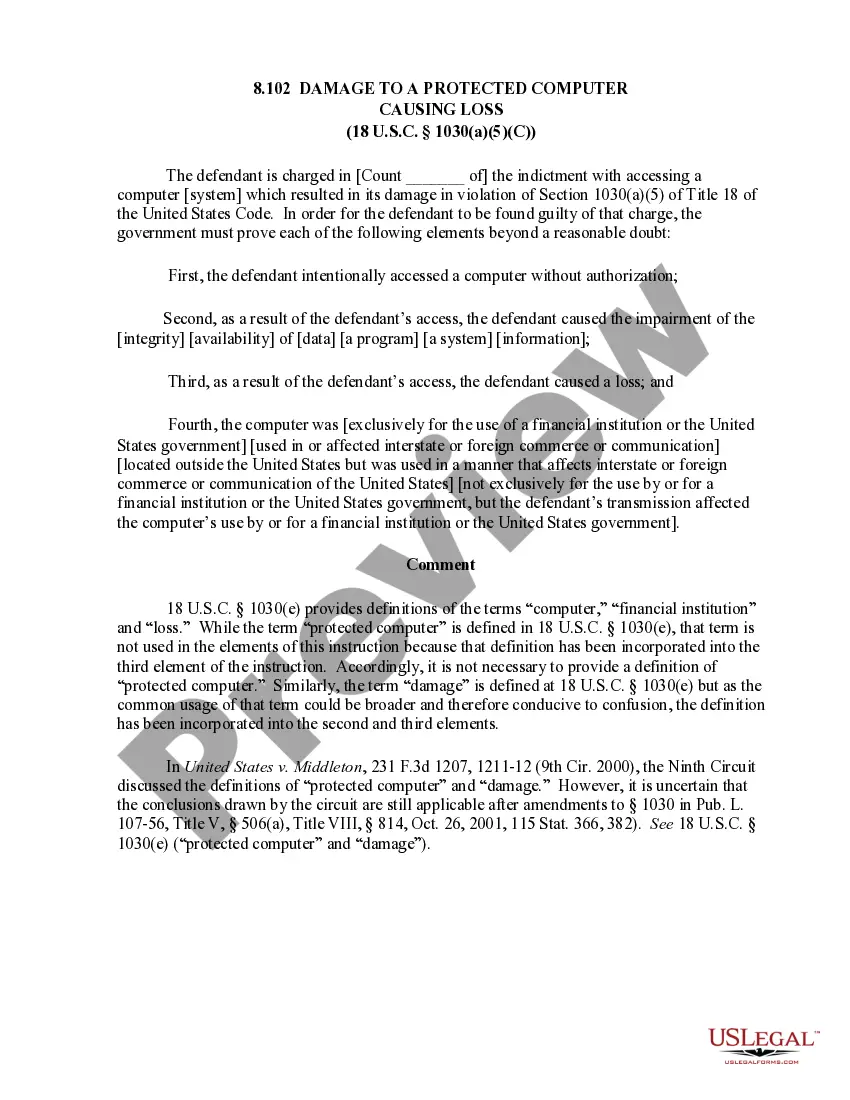
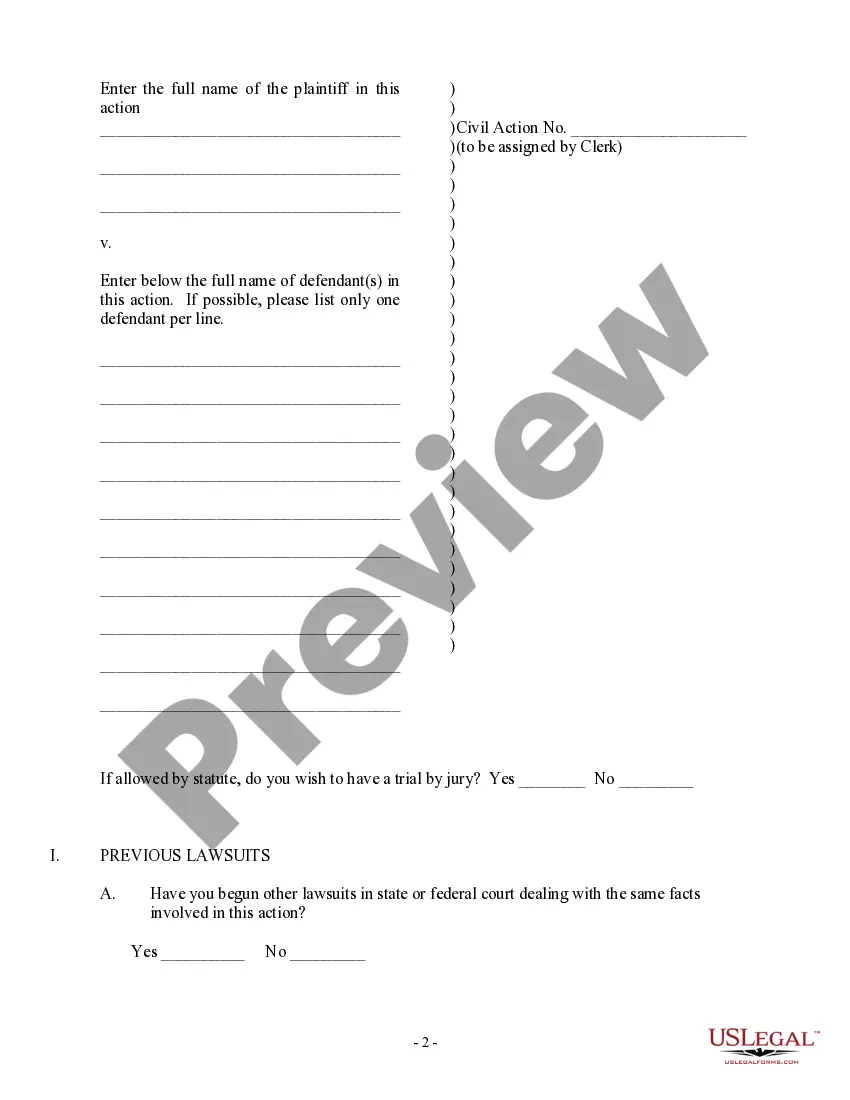
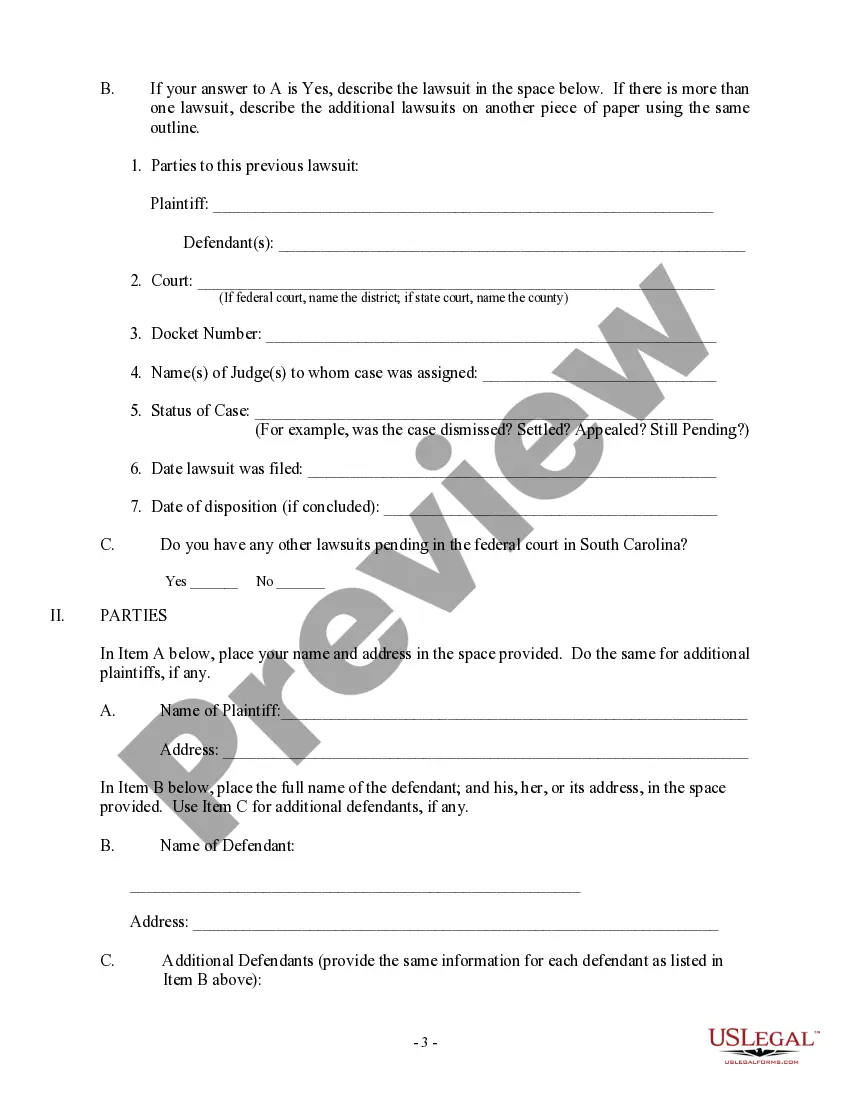
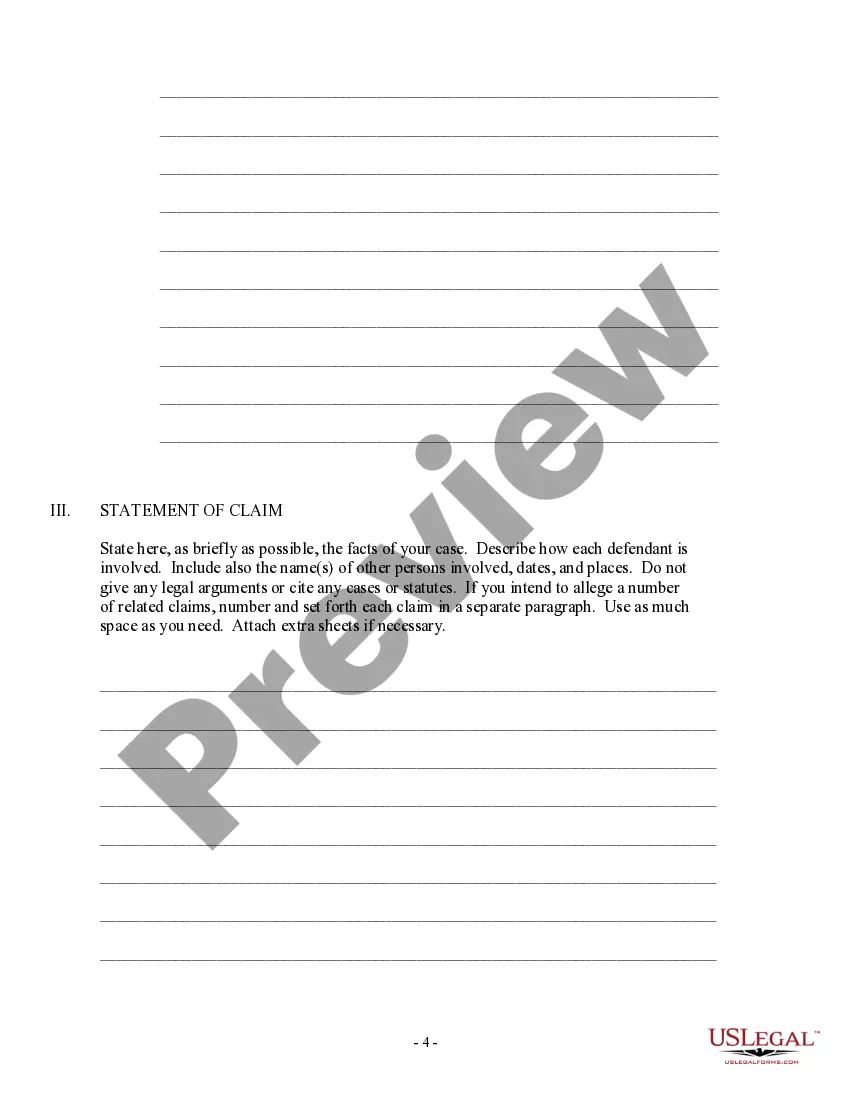
Federal Pro Se [Non-prisoner] Complaint Form:
** THIS IS NOT A FEDERAL PRO SE COMPLAINT FORM *****
Indiana Federal Pro Se - Non-Prisoner - Complaint Form
Category:
State:
Multi-State
Control #:
US-01991
Format:
Word;
Rich Text
Instant download
Description
Free preview

Get your form ready online
Our built-in tools help you complete, sign, share, and store your documents in one place.
Built-in online Word editor
Make edits, fill in missing information, and update formatting in US Legal Forms—just like you would in MS Word.
Export easily
Download a copy, print it, send it by email, or mail it via USPS—whatever works best for your next step.
E-sign your document
Sign and collect signatures with our SignNow integration. Send to multiple recipients, set reminders, and more. Go Premium to unlock E-Sign.
Notarize online 24/7
If this form requires notarization, complete it online through a secure video call—no need to meet a notary in person or wait for an appointment.
Store your document securely
We protect your documents and personal data by following strict security and privacy standards.

Make edits, fill in missing information, and update formatting in US Legal Forms—just like you would in MS Word.

Download a copy, print it, send it by email, or mail it via USPS—whatever works best for your next step.

Sign and collect signatures with our SignNow integration. Send to multiple recipients, set reminders, and more. Go Premium to unlock E-Sign.

If this form requires notarization, complete it online through a secure video call—no need to meet a notary in person or wait for an appointment.

We protect your documents and personal data by following strict security and privacy standards.
Looking for another form?
How to fill out Federal Pro Se - Non-Prisoner - Complaint Form?
Locating the appropriate authentic document template can be quite a challenge. Of course, there are numerous designs available online, but how can you find the genuine form you require? Utilize the US Legal Forms website. The service offers a vast array of templates, including the Indiana Federal Pro Se - Non-Prisoner - Complaint Form, which you may use for business and personal needs. All the forms are vetted by experts and comply with state and federal regulations.
If you are already registered, Log In to your account and click on the Download button to access the Indiana Federal Pro Se - Non-Prisoner - Complaint Form. Use your account to browse through the legal forms you have previously purchased. Visit the My documents section of your account and obtain another copy of the document you need.
If you are a new user of US Legal Forms, here are simple instructions for you to follow: First, ensure you have selected the correct form for your city/state. You can review the form using the Review button and read the form details to confirm this is indeed the right one for you. If the form does not meet your requirements, utilize the Search area to find the correct form. Once you are confident the form is suitable, click the Purchase now button to obtain the form. Choose the pricing plan you desire and enter the required information. Create your account and pay for your order using your PayPal account or Visa or Mastercard. Select the document format and download the legal document template to your device. Finally, complete, modify, and print and sign the received Indiana Federal Pro Se - Non-Prisoner - Complaint Form.
In summary, US Legal Forms provides a comprehensive solution for acquiring necessary legal documentation effortlessly.
- US Legal Forms is the largest repository of legal forms where you can find a multitude of document templates.
- Utilize the service to obtain professionally crafted documents that comply with state regulations.
- Ensure you choose the correct type for your location.
- Review the form details carefully before proceeding.
- Use the search function if necessary to locate the right form.
- Follow the payment process to finalize your order.
Form popularity
FAQ
Filing pro se in federal court requires you to prepare and submit the necessary documents, such as your complaint and any accompanying forms. You must follow the court's rules for formatting, filing, and serving your documents. Be aware of the deadlines and filing fees associated with your case. The Indiana Federal Pro Se - Non-Prisoner - Complaint Form is a valuable resource that helps you navigate this process smoothly.
When answering a federal complaint, you must respond to each allegation specifically, admitting or denying the claims made against you. It is essential to include any defenses you wish to raise. Be sure to file your answer within the required time frame to avoid default. The Indiana Federal Pro Se - Non-Prisoner - Complaint Form can guide you in organizing your response effectively.
To format a federal complaint, you should start with a caption that includes the court's name, the parties involved, and the case number. Next, clearly outline your claims, using numbered paragraphs for each point. Ensure you include a jurisdictional statement and a prayer for relief at the end. Utilizing the Indiana Federal Pro Se - Non-Prisoner - Complaint Form can simplify this process, as it provides a structured template to follow.
Section 1983 provides an individual the right to sue state government employees and others acting "under color of state law" for civil rights violations. Section 1983 does not provide civil rights; it is a means to enforce civil rights that already exist.
As noted by the appellate court, ?Punitive damages may be awarded under 42 U.S.C. § 1983 when the defendant's conduct is shown to be motivated by evil motive or intent, or when it involves reckless or callous indifference to the federally protected rights of others.?
42 U.S.C. § 1983. Thus, to state a claim under section 1983, a plaintiff must allege that (1) the defendant acted under color of state law, and (2) the defendant deprived him of rights secured by the Constitution or federal law.
Section 1983 allows claims alleging the ?deprivation of any rights, privileges, or immunities secured by the Constitution and [federal laws].? 42 U.S.C. § 1983. If you are suing under section 1983, what federal constitutional or statutory right(s) do you claim is/are being violated by state or local officials? C.
To state a Section 1983 claim, the plaintiff is required to allege that (1) the conduct complained of was committed by a person acting under the color of state law; and (2) the conduct deprived the plaintiff of a constitutional right.