Louisiana Notice of Contract - Professional Sub-consultant - Corporation or LLC
Understanding this form
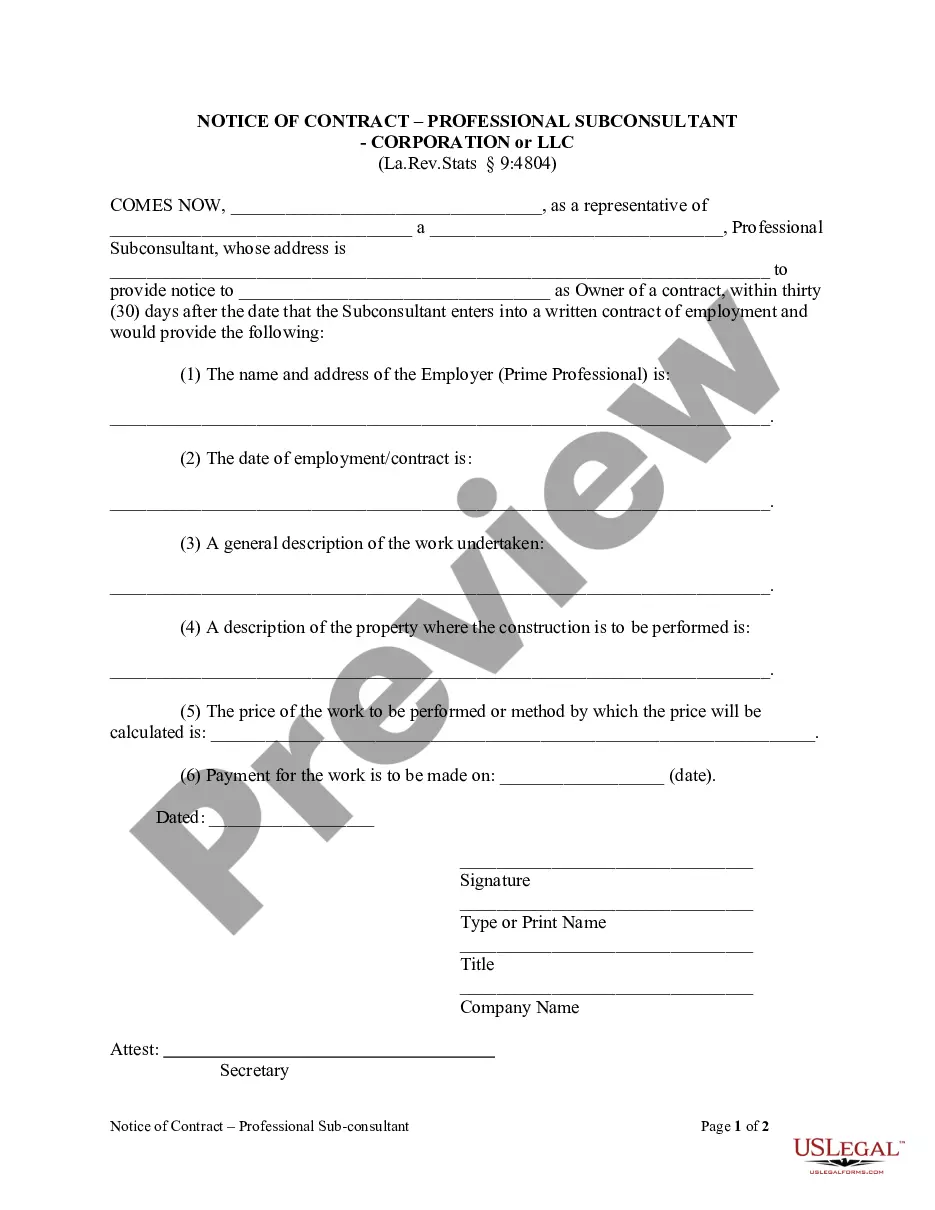
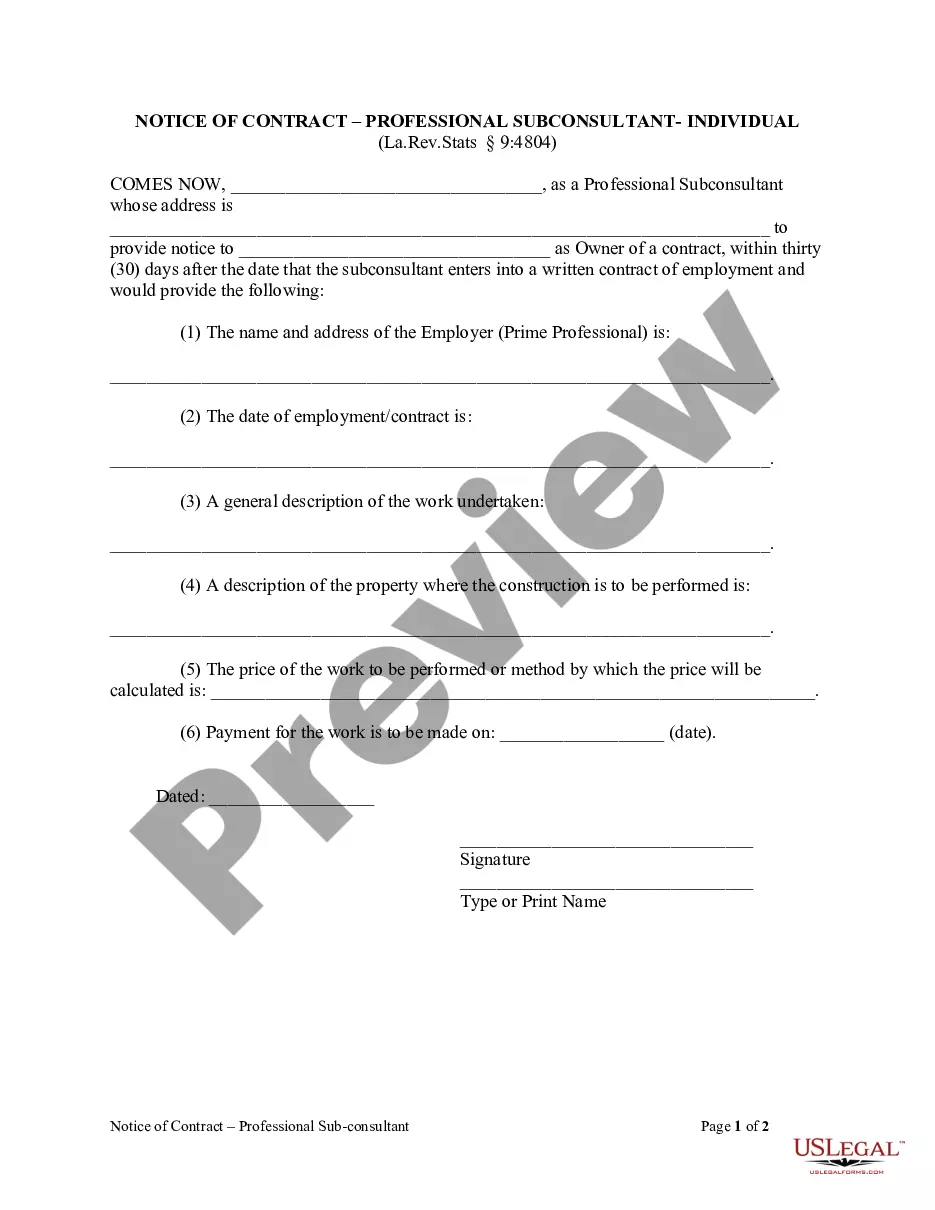
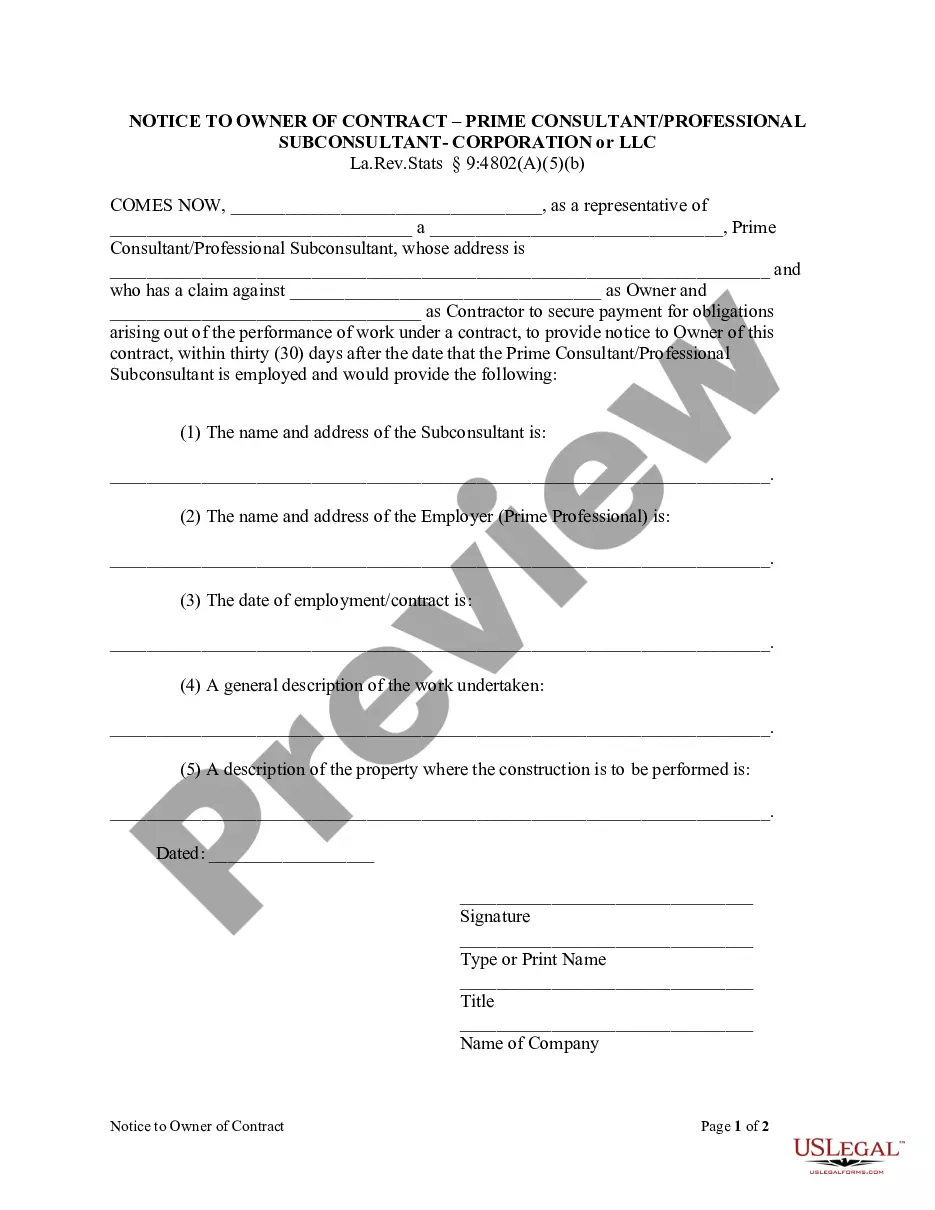
The Notice of Contract - Professional Sub-consultant is a legal document used by corporate or LLC professional sub-consultants to formally notify an owner about a contract. This notice must be provided within thirty days after entering into a written employment contract and includes key details relevant to the agreement. It differs from similar forms by focusing specifically on the sub-consultant's role in professional services related to construction projects.
Key parts of this document
- Name and address of the Employer (Prime Professional)
- Date of employment or contract
- General description of the work undertaken
- Description of the property where the work will be performed
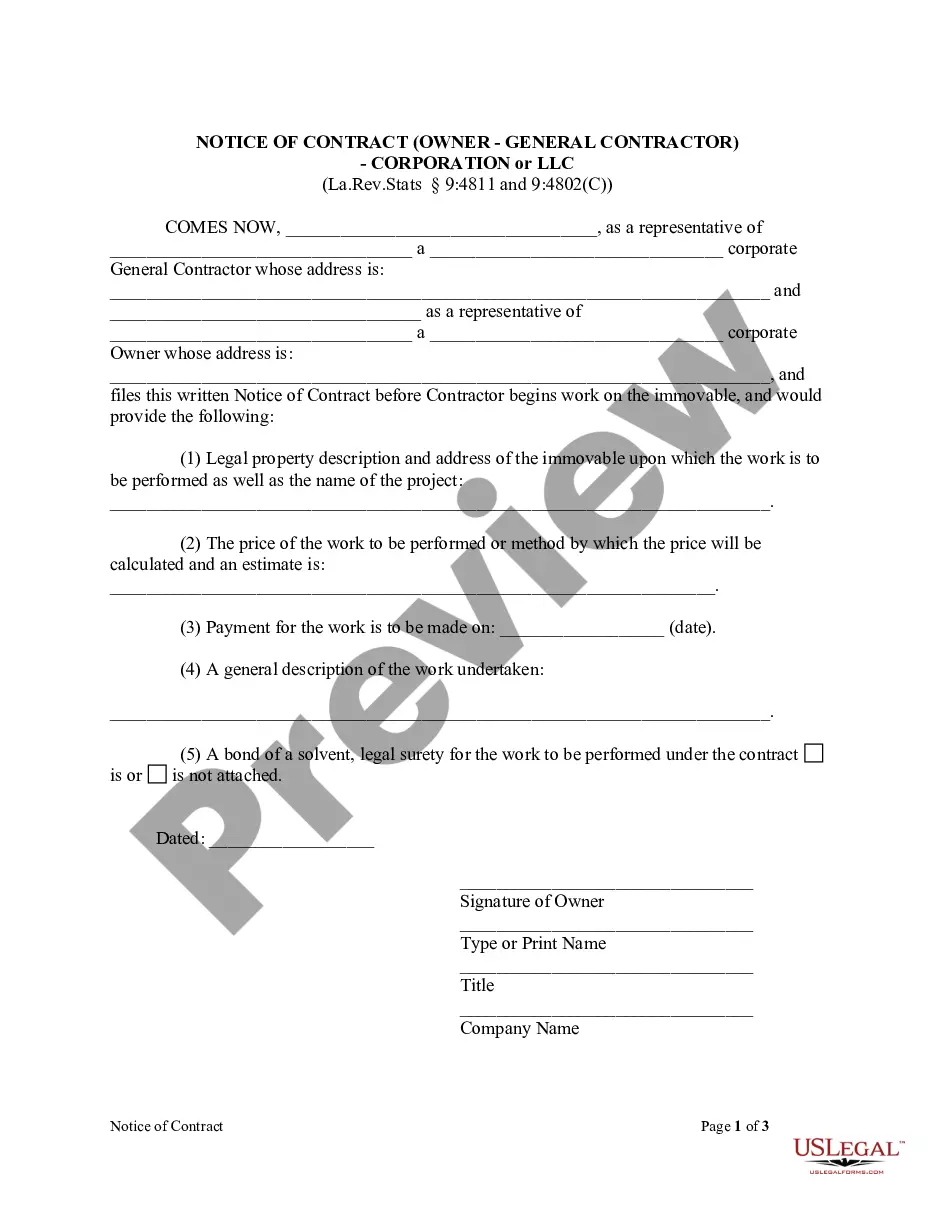
- Total price for the work, or method of calculating the price
- Date for payment of the work
Situations where this form applies
This form is typically used when a corporate or LLC professional sub-consultant begins work on a construction project and needs to inform the owner about their contractual agreement. It ensures that the owner is aware of the sub-consultant's involvement and provides necessary details for administrative and legal purposes.
Intended users of this form
- Corporate entities or LLCs acting as sub-consultants in construction
- Professionals involved in the building and construction industry
- Those required to notify property owners of contractual agreements
Completing this form step by step
- Identify the parties involved by filling in the name of the sub-consultant and the owner.
- Indicate the date the contract was signed.
- Provide a brief description of the work that will be performed.
- Detail the property where the construction services will be carried out.
- Specify the price for the work or the method for calculating it.
- Enter the date when the payment for the work is due.
Does this form need to be notarized?
This form does not typically require notarization unless specified by local law. However, it is advisable to consult local regulations to ensure compliance with any notarization requirements.
Get your form ready online
Our built-in tools help you complete, sign, share, and store your documents in one place.
Make edits, fill in missing information, and update formatting in US Legal Forms—just like you would in MS Word.
Download a copy, print it, send it by email, or mail it via USPS—whatever works best for your next step.
Sign and collect signatures with our SignNow integration. Send to multiple recipients, set reminders, and more. Go Premium to unlock E-Sign.
If this form requires notarization, complete it online through a secure video call—no need to meet a notary in person or wait for an appointment.
We protect your documents and personal data by following strict security and privacy standards.

Make edits, fill in missing information, and update formatting in US Legal Forms—just like you would in MS Word.

Download a copy, print it, send it by email, or mail it via USPS—whatever works best for your next step.

Sign and collect signatures with our SignNow integration. Send to multiple recipients, set reminders, and more. Go Premium to unlock E-Sign.

If this form requires notarization, complete it online through a secure video call—no need to meet a notary in person or wait for an appointment.

We protect your documents and personal data by following strict security and privacy standards.
Common mistakes to avoid
- Failing to submit the notice within the thirty-day timeframe
- Not providing all required details, such as payment terms
- Incorrectly identifying the parties involved in the contract
Benefits of completing this form online
- Convenient access to the form from anywhere with an internet connection
- Editable templates that allow for customization of details
- Reliable formats drafted by licensed attorneys ensuring legal validity
Legal use & context
- This notice serves as a formal acknowledgment of the contract between the sub-consultant and the owner, which may be required for legal enforceability.
- Proper documentation ensures that all parties have agreed upon the terms of the project, including payment details.
Summary of main points
- The Notice of Contract for Professional Sub-consultants is crucial for clear communication in construction projects.
- It ensures compliance with legal requirements and delineates responsibilities between parties.
- Completing this form promptly can prevent disputes related to contracts and payments.
Looking for another form?
Form popularity
FAQ
If your family member or friend fails to leave by the requested date, you can then file an eviction petition. Once you file your petition, you must request an unlawful detainer hearing. This is a short court hearing in which you explain the reason for the eviction and present evidence of the prior notices to vacate.
Serve written notice. All eviction processes must begin with the serving of written notice. File papers with a judge. If the notice period has come to a close and the issues have not been fixed, you must file a petition with the justice of the peace in the county where the unit is located. Go to court.
Evictions in Louisiana typically follow a 5 to 10 day timeline mandated by its Code of Civil Procedure. Most evictions are handled in Justice of the Peace Courts. Otherwise, a landlord must file suit in the county or parish where the property is located.
As the next step in the eviction process, Louisiana landlords must file a complaint in the appropriate court, and the court will issue a rule for possession ordering the defendant to appear for a hearing. In Jefferson Parish, this costs $150 in filing fees and an additional $225 if a writ of possession is requested.
Addresses. Date. Tenant names. Status and date of the lease. Why the eviction notice is served (clear and concise explanation) Date tenant must vacate the property. Proof of service or delivery of notice.
Eviction Process for No Lease / End of Lease In the state of Louisiana, if tenants hold over, or stay in the rental unit after the rental term has expired, then the landlord must give tenants notice before evicting them. This can include tenants without a written lease and week-to-week and month-to-month tenants.
Serve written notice. All eviction processes must begin with the serving of written notice. File papers with a judge. If the notice period has come to a close and the issues have not been fixed, you must file a petition with the justice of the peace in the county where the unit is located. Go to court.
The moratorium has since been extended multiple times as the pandemic continues to affect people's ability to pay rent, most recently extended until June 30th, 2021.According to the order, landlords cannot evict tenants because of their inability to pay rent.