Louisiana Answer to Petition for Custody
About this form
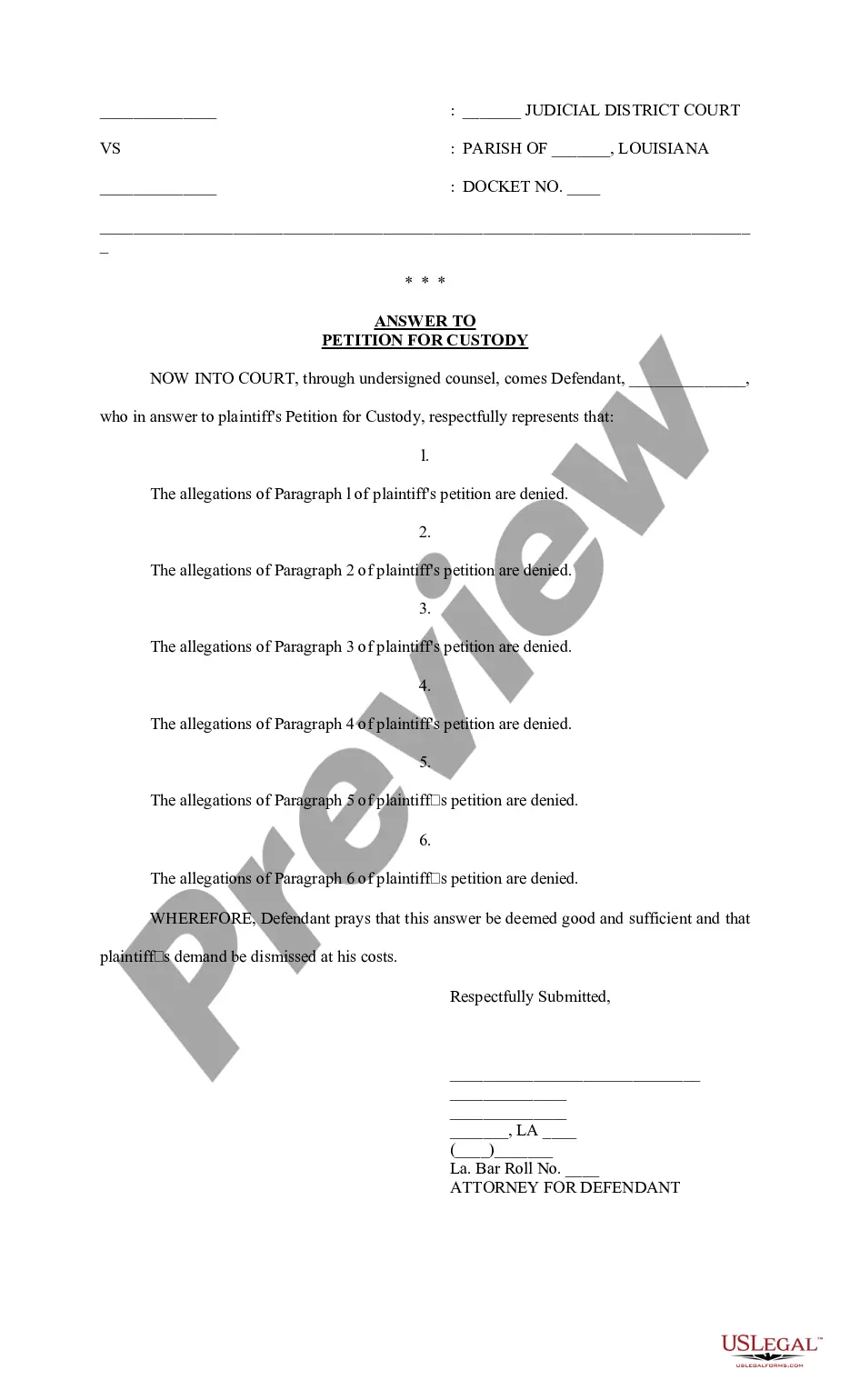
The Answer to Petition for Custody is a legal document used by a defendant in response to a plaintiff's custody petition. This form allows the defendant to deny the plaintiff's allegations and request that the court dismiss the petition. Unlike other forms related to custody, this specific document focuses on providing a defense against the claims made by the plaintiff regarding custody arrangements.
Key parts of this document
- Header: Includes the parish, state, and docket number.
- Introduction: Identifies the defendant and acknowledges the petition.
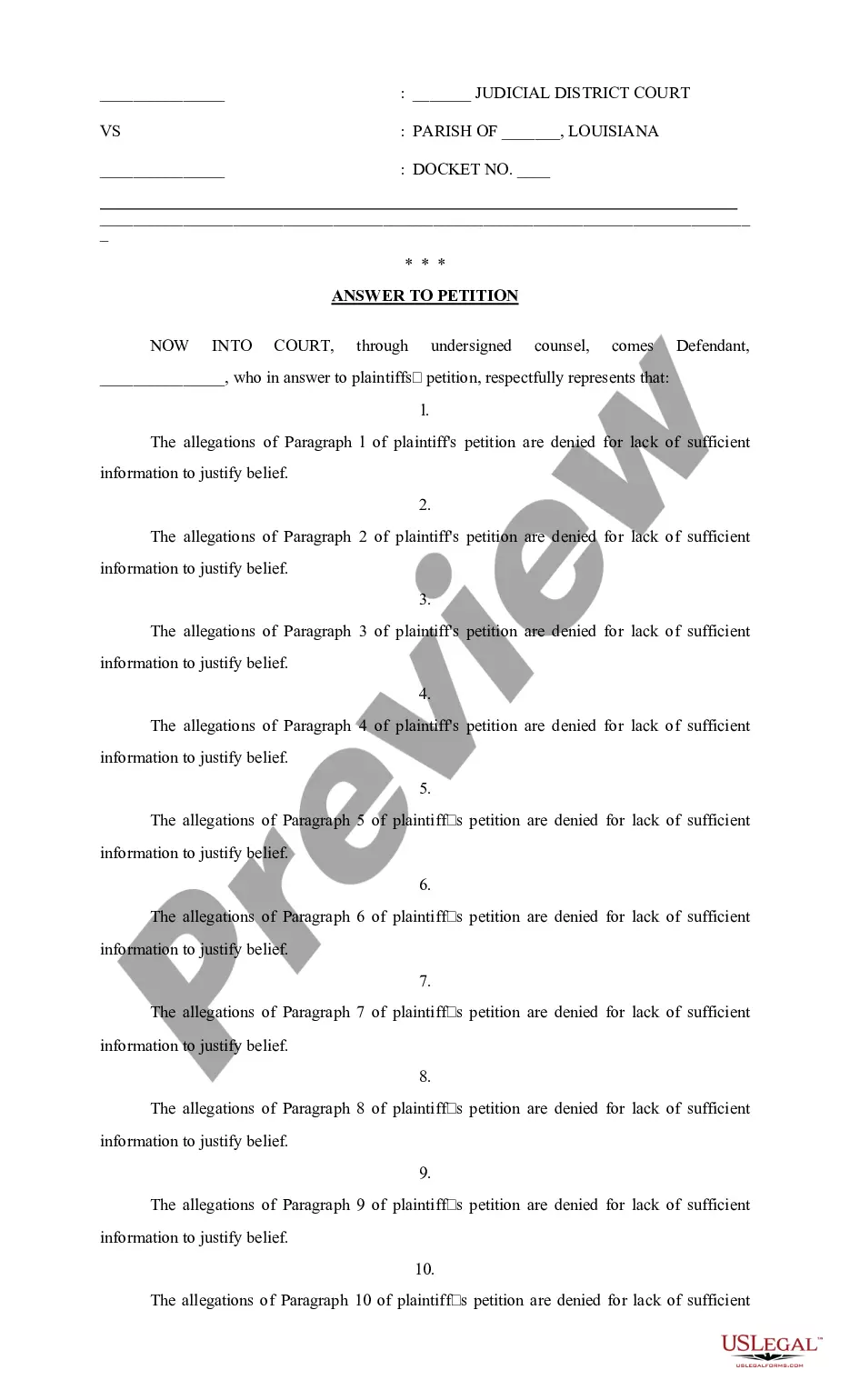
- Status of allegations: Denies each allegation presented in the plaintiff's petition.
- Request for relief: Asks the court for the dismissal of the petition and outlines costs.
- Certification of service: Confirms that a copy of the form has been delivered to the plaintiff's attorney.


Common use cases
This form is used when a defendant receives a Petition for Custody from a plaintiff and wishes to formally respond to the allegations. It is necessary to file this answer if the defendant disagrees with the plaintiffâs claims and wants to seek dismissal of the custody petition in court.
Intended users of this form
This form is intended for:
- Parents or guardians who are responding to a custody petition filed by another party.
- Individuals who wish to contest custody arrangements proposed by the plaintiff.
- Defendants in custody disputes seeking to formally present their defenses in court.
Instructions for completing this form
Follow these steps to fill out the Answer to Petition for Custody:
- Enter the parish name and docket number at the top of the form.
- Identify yourself as the defendant and input your name in the introduction section.
- Carefully review each of the plaintiffâs allegations, and indicate your denial of each one.
- Include your request for dismissal of the petition and outline any associated costs.
- Sign the document and include your attorney's details if represented.
- Certify that you have served a copy of the answer to the plaintiff's attorney.
Notarization requirements for this form
This form does not typically require notarization unless specified by local law.
Get your form ready online
Our built-in tools help you complete, sign, share, and store your documents in one place.
Make edits, fill in missing information, and update formatting in US Legal Forms—just like you would in MS Word.
Download a copy, print it, send it by email, or mail it via USPS—whatever works best for your next step.
Sign and collect signatures with our SignNow integration. Send to multiple recipients, set reminders, and more. Go Premium to unlock E-Sign.
If this form requires notarization, complete it online through a secure video call—no need to meet a notary in person or wait for an appointment.
We protect your documents and personal data by following strict security and privacy standards.

Make edits, fill in missing information, and update formatting in US Legal Forms—just like you would in MS Word.

Download a copy, print it, send it by email, or mail it via USPS—whatever works best for your next step.

Sign and collect signatures with our SignNow integration. Send to multiple recipients, set reminders, and more. Go Premium to unlock E-Sign.

If this form requires notarization, complete it online through a secure video call—no need to meet a notary in person or wait for an appointment.

We protect your documents and personal data by following strict security and privacy standards.
Common mistakes
- Failing to deny each specific allegation clearly.
- Not signing the document or missing the certification of service.
- Using incorrect or outdated jurisdiction-specific language.
Benefits of completing this form online
- Immediate access to the form for quick response to legal challenges.
- Easily editable to suit individual circumstances without legal jargon.
- Drafted by licensed attorneys to ensure reliability and compliance with state laws.
Main things to remember
- Answer to Petition for Custody is essential for defending against custody claims.
- It must be properly completed and submitted within legal deadlines.
- Clear denials of allegations help establish the defendant's position in court.
Looking for another form?
Form popularity
FAQ
One significant mistake in custody battles is failing to communicate effectively with your legal representation. Clear, open dialogue ensures your lawyer understands your position and can craft an appropriate Louisiana Answer to Petition for Custody. Additionally, not prioritizing the child's best interests can hinder your chances for a favorable outcome.
Fill out your court forms. Have your forms reviewed. Make at least 2 copies of all your forms. File your forms with the court clerk. Serve your papers on the other parent. File your Proof of Service. Go to your court hearing.
Tell the Truth. A declaration is a written statement made under penalty of perjury. Know Your Audience. Organize for Effect. Be Specific. Stay Relevant. Don't Argue With the Opposing Side. Write Naturally; Make It Easy to Read. Put Emotion Aside.
You can write a letter to the Judge but the Judge will not read it. You have to provide testimony through witnesses including yourself. You do not have to agree with what the GAL proposes. You need an attorney to represent you.
Contact the clerk's office of the court where the lawsuit was filed. You'll find a phone number and address for the clerk's office on your summons. The clerk will be able to tell you exactly what documents you should file with your answer and whether any filing fee is required.
To respond to the issues raised in the Request for Order (form FL-300) and accompanying papers, the responding party must complete, file, and have a Responsive Declaration to Request for Order (form FL-320) served on all parties in the case.
Begin your letter by introducing yourself and explaining your relationship to the parent and how long you've known her. Then, spend two or three paragraphs explaining why you think she should be awarded custody. Use your final paragraph to summarize the points you've made in the body of your letter.
The best way to convince a judge that the parent most fit for custody is to provide real world evidence through behavior and actions. When there are certain situations that may be best for the child, it is important to seek these out and to offer better circumstances if possible.
Legal declarations by definition need to be truthful and accurate to the best of your knowledge. This means it is a good idea to back up any statements you make with documented evidence. Be specific, as declarations are usually about facts. Sign the letter to make it legally binding.
Write clearly, and use your own words. Use bulleted lists for your major points. Don't insult or bash your ex. Attach evidence such as pay stubs or bank statements, but redact SSN and account numbers. Affirm that you are making your statement under oath, and under penalty of perjury.