Louisiana Consent Judgment of Visitation
Overview of this form
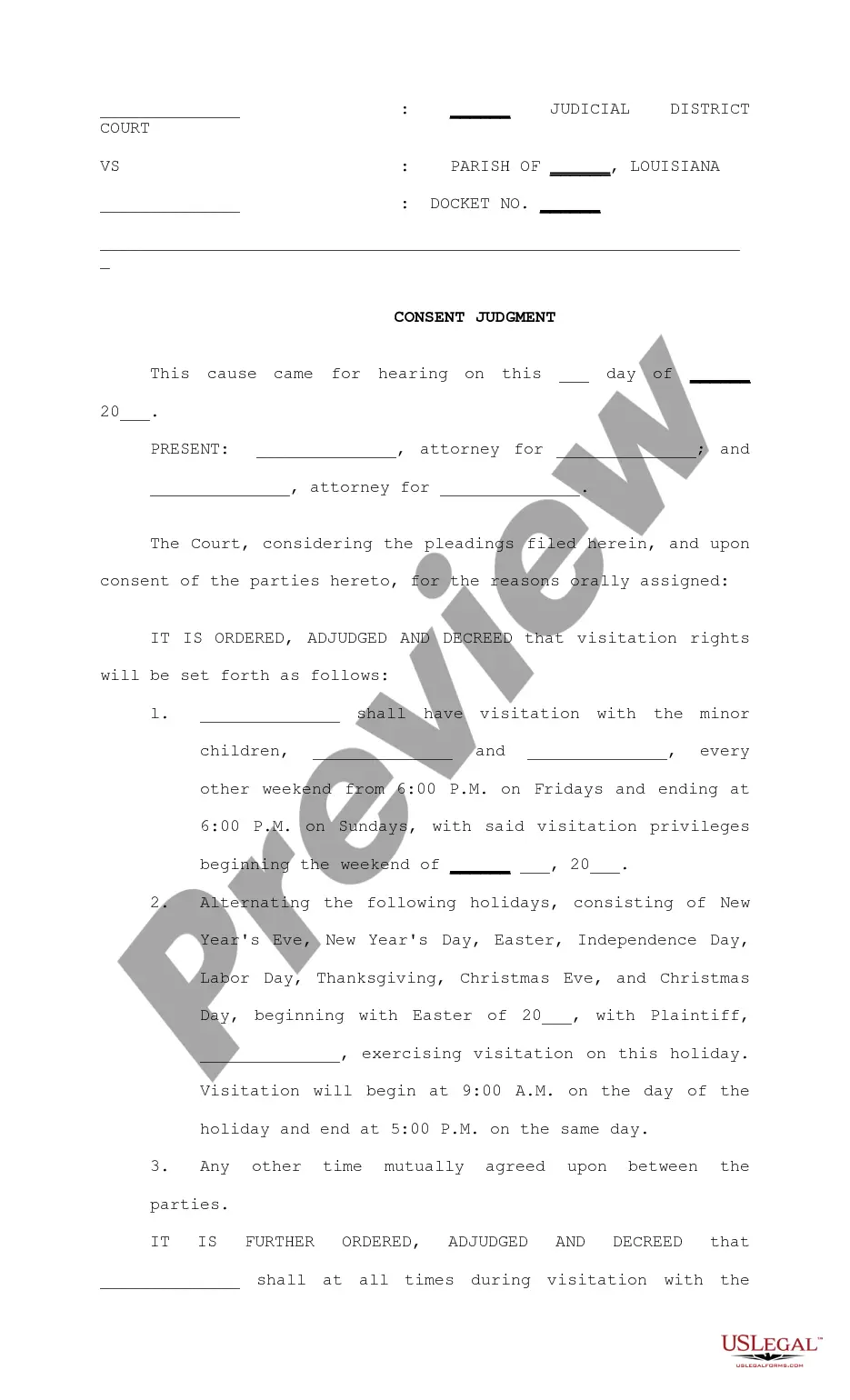
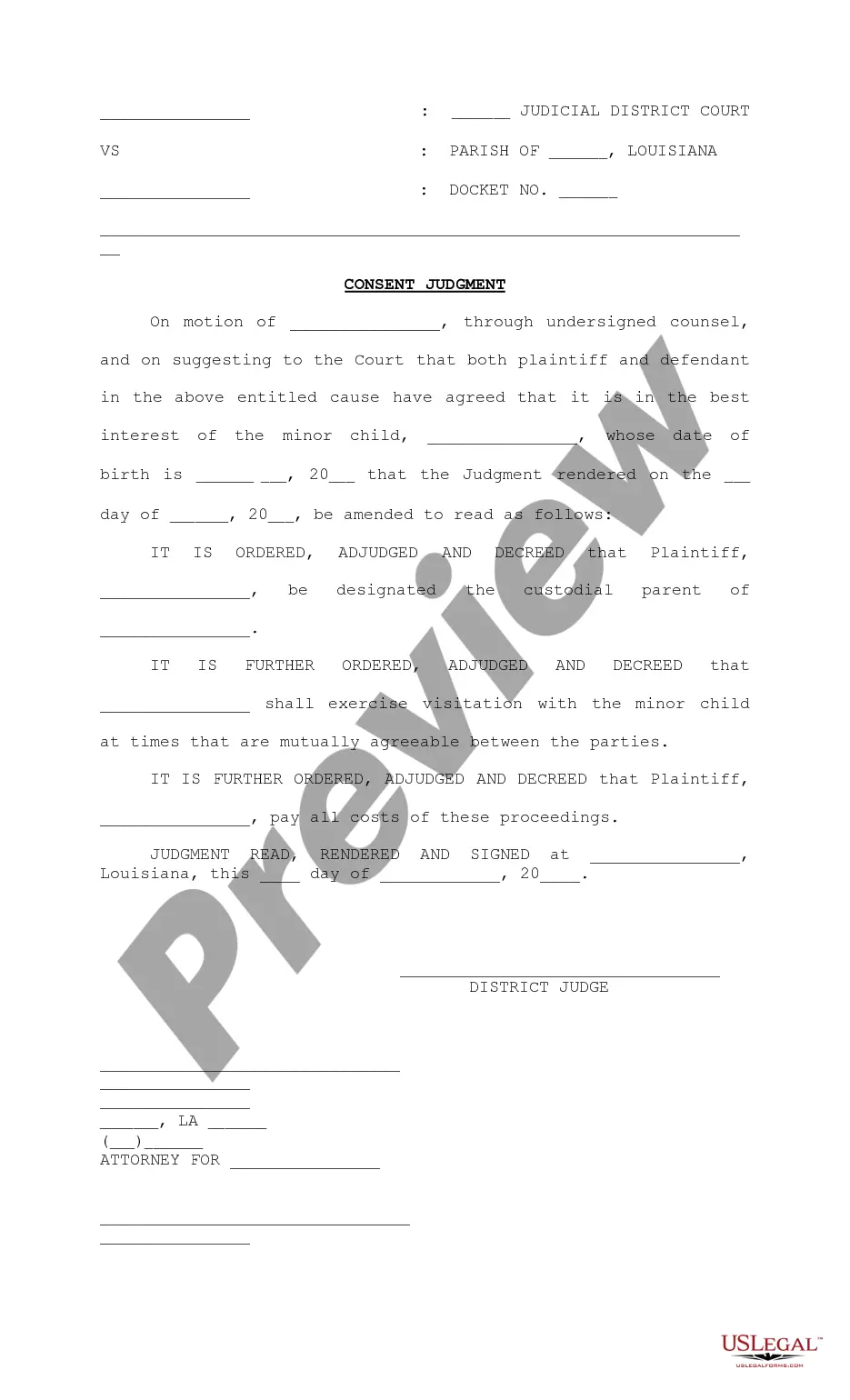
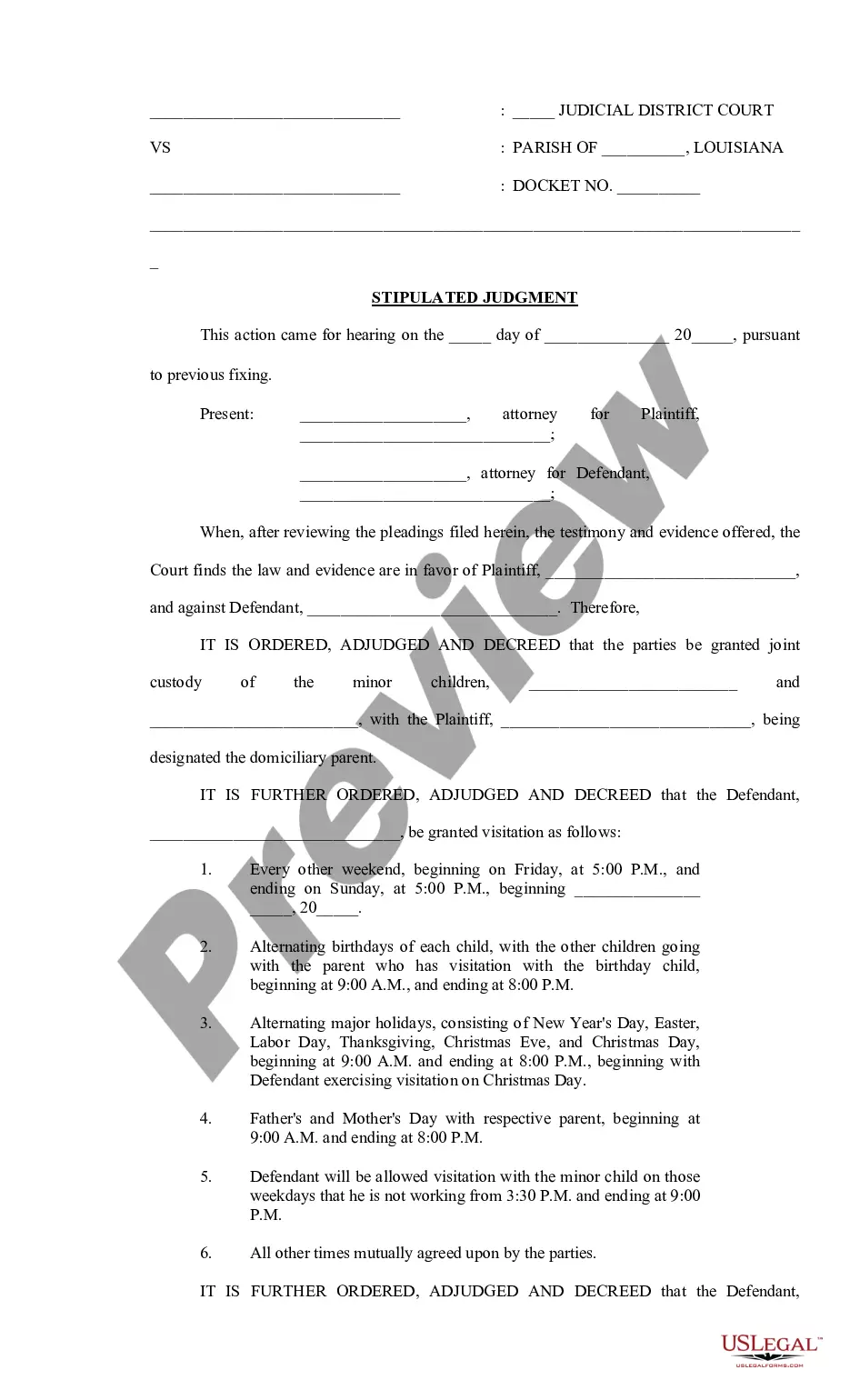
The Consent Judgment of Visitation is a legal document used by divorced or separated parents to agree on a visitation schedule for their minor children. This form serves as a binding agreement that outlines the rights and responsibilities of both parents regarding when and how they can spend time with their children. Unlike other types of custody agreements, a consent judgment is filed with the court and has the same authority as any other legal judgment.
Key parts of this document
- Details of the parties involved in the visitation agreement
- Specific visitation schedule, including weekends and holidays
- Conditions regarding the conduct of the visiting parent during visitation
- Assignment of court costs related to the proceedings
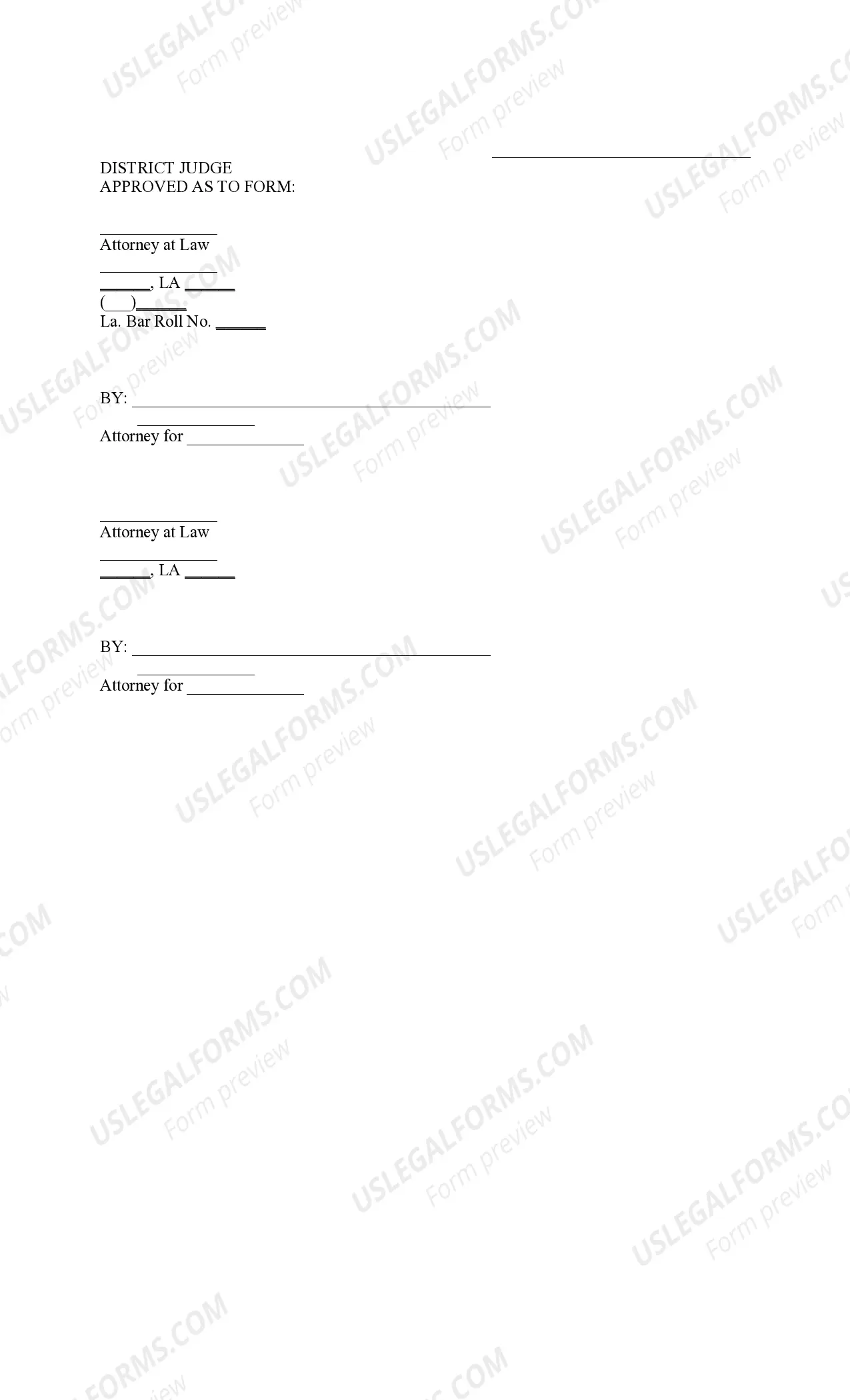
- Signatures of both parties and their attorneys
When this form is needed
This form is typically used when parents have reached an agreement on a visitation schedule after a divorce or separation. It is appropriate in situations where parents wish to formalize their arrangement with the court to ensure enforceability. If there are disputes about visitation rights, this form can help resolve those issues amicably.
Who this form is for
- Divorced or separated parents needing a formalized visitation schedule
- Parents looking to modify an existing visitation order
- Attorneys representing parents in family law matters
How to prepare this document
- Identify the full names and contact information of both parents.
- Specify the details of the visitation schedule, including dates and times.
- Include any conditions, such as prohibitions on substance use during visitation.
- Determine who will be responsible for court costs and document this in the agreement.
- Both parties should review and sign the document, along with their attorneys, in front of the court.
Does this form need to be notarized?
This form does not typically require notarization unless specified by local law. However, having the form notarized can provide an additional layer of validation for the agreement between parties.
Get your form ready online
Our built-in tools help you complete, sign, share, and store your documents in one place.
Make edits, fill in missing information, and update formatting in US Legal Forms—just like you would in MS Word.
Download a copy, print it, send it by email, or mail it via USPS—whatever works best for your next step.
Sign and collect signatures with our SignNow integration. Send to multiple recipients, set reminders, and more. Go Premium to unlock E-Sign.
If this form requires notarization, complete it online through a secure video call—no need to meet a notary in person or wait for an appointment.
We protect your documents and personal data by following strict security and privacy standards.

Make edits, fill in missing information, and update formatting in US Legal Forms—just like you would in MS Word.

Download a copy, print it, send it by email, or mail it via USPS—whatever works best for your next step.

Sign and collect signatures with our SignNow integration. Send to multiple recipients, set reminders, and more. Go Premium to unlock E-Sign.

If this form requires notarization, complete it online through a secure video call—no need to meet a notary in person or wait for an appointment.

We protect your documents and personal data by following strict security and privacy standards.
Common mistakes to avoid
- Failing to clearly define the visitation schedule
- Not including important conditions that affect visitation
- Omitting signatures from both parties and their legal representatives
Benefits of completing this form online
- Convenient access to legal templates drafted by licensed attorneys
- Editable format allows for adjustments to meet specific family needs
- Time-saving process with instant download availability
Looking for another form?
Form popularity
FAQ
A consent judgment in Louisiana is a legal agreement reached by two or more parties, which becomes enforceable by the court. Specifically regarding the Louisiana Consent Judgment of Visitation, this agreement outlines visitation rights and responsibilities for parents or guardians. This approach reduces the need for prolonged court battles and emphasizes cooperation and agreement. Using platforms like US Legal Forms can simplify creating such documents to meet your specific needs.
When a judgment is filed against you in Louisiana, it typically involves a court decision that may require you to fulfill certain obligations. If this pertains to a Louisiana Consent Judgment of Visitation, it means you must adhere to visitation agreements as determined by the court. Failing to comply with a judgment can lead to legal consequences, including enforcement actions. Understanding your rights and responsibilities is vital in these situations.
One of the biggest mistakes in a custody battle is failing to focus on the child's best interests. Many parents become emotionally driven and forget that the court prioritizes the child's well-being. Clear communication, cooperation, and presenting yourself positively can influence the outcome. Seeking guidance around a Louisiana Consent Judgment of Visitation can also help you understand how to advocate effectively for your rights.
You can write a letter to the Judge but the Judge will not read it. You have to provide testimony through witnesses including yourself. You do not have to agree with what the GAL proposes. You need an attorney to represent you.
You cannot write a letter to the family court judge. This would be considered an ex parte communication.
Be willing to work with the child's other parent. See your children whenever possible. Don't involve your children in the court case. Don't put the children in the middle. Perception is everything. Hire an experienced child custody lawyer.
Judges must decide custody based on the best interests of the child." The best interests of the child law requires courts to focus on the child's needs and not the parent's needs. The law requires courts to give custody to the parent who can meet the child's needs best .
However, when a person is awaiting trial, writing a letter to the judge will not help. At best, the letter will go unread by the judge, and will be of no help. In a worst-case scenario, the letter will end up being used by the prosecution as evidence against that person.
Begin your letter by introducing yourself and explaining your relationship to the parent and how long you've known her. Then, spend two or three paragraphs explaining why you think she should be awarded custody. Use your final paragraph to summarize the points you've made in the body of your letter.
Visitation rights may be determined by the agreement of the parents or by a court order if the parents cannot agree. Courts will generally consider the wishes of the child, if age appropriate, when reviewing custody and visitation issues.The parents can draft a specific agreement which may include: Specific weekends.