Louisiana Motion for Preliminary Default
About this form
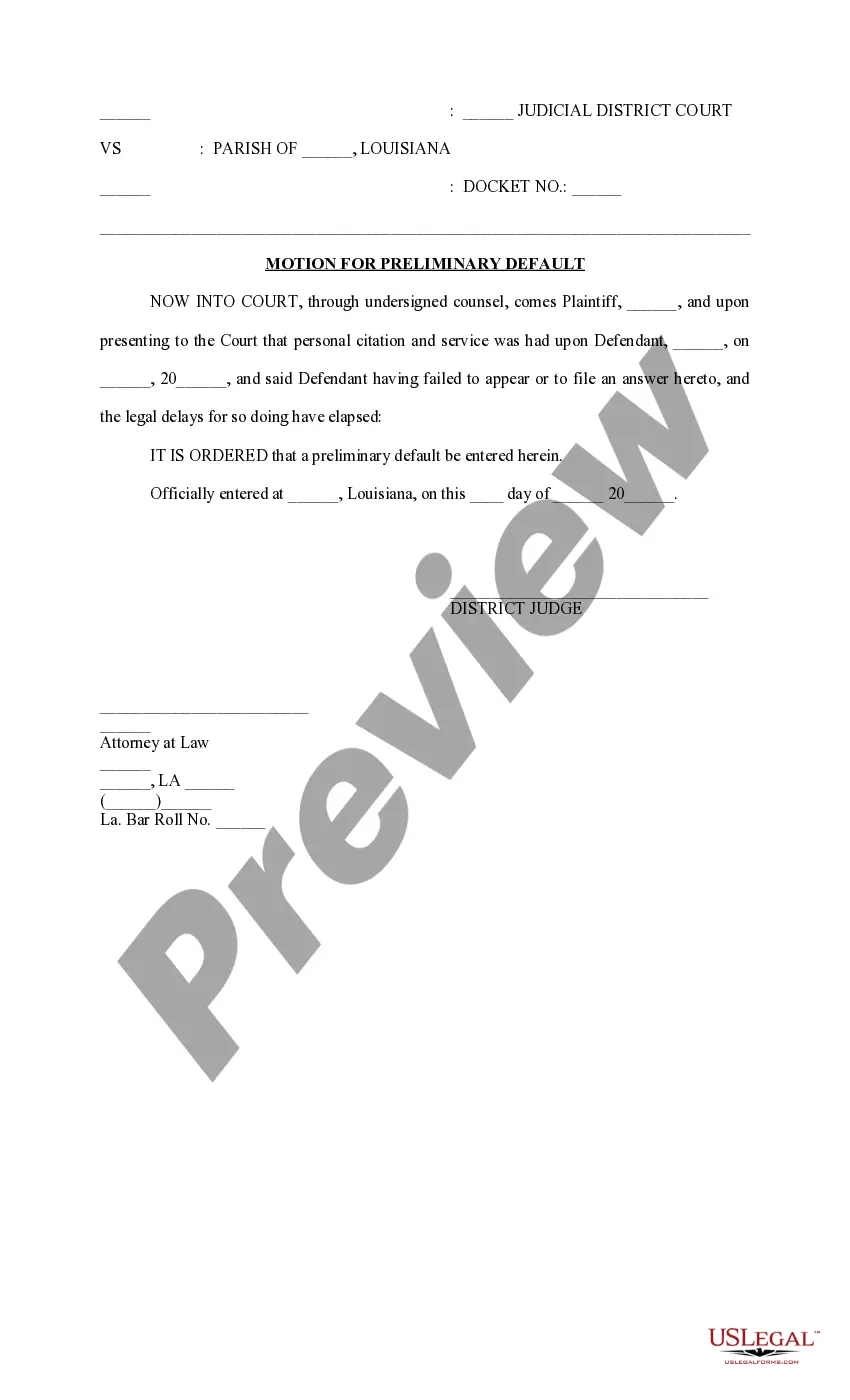
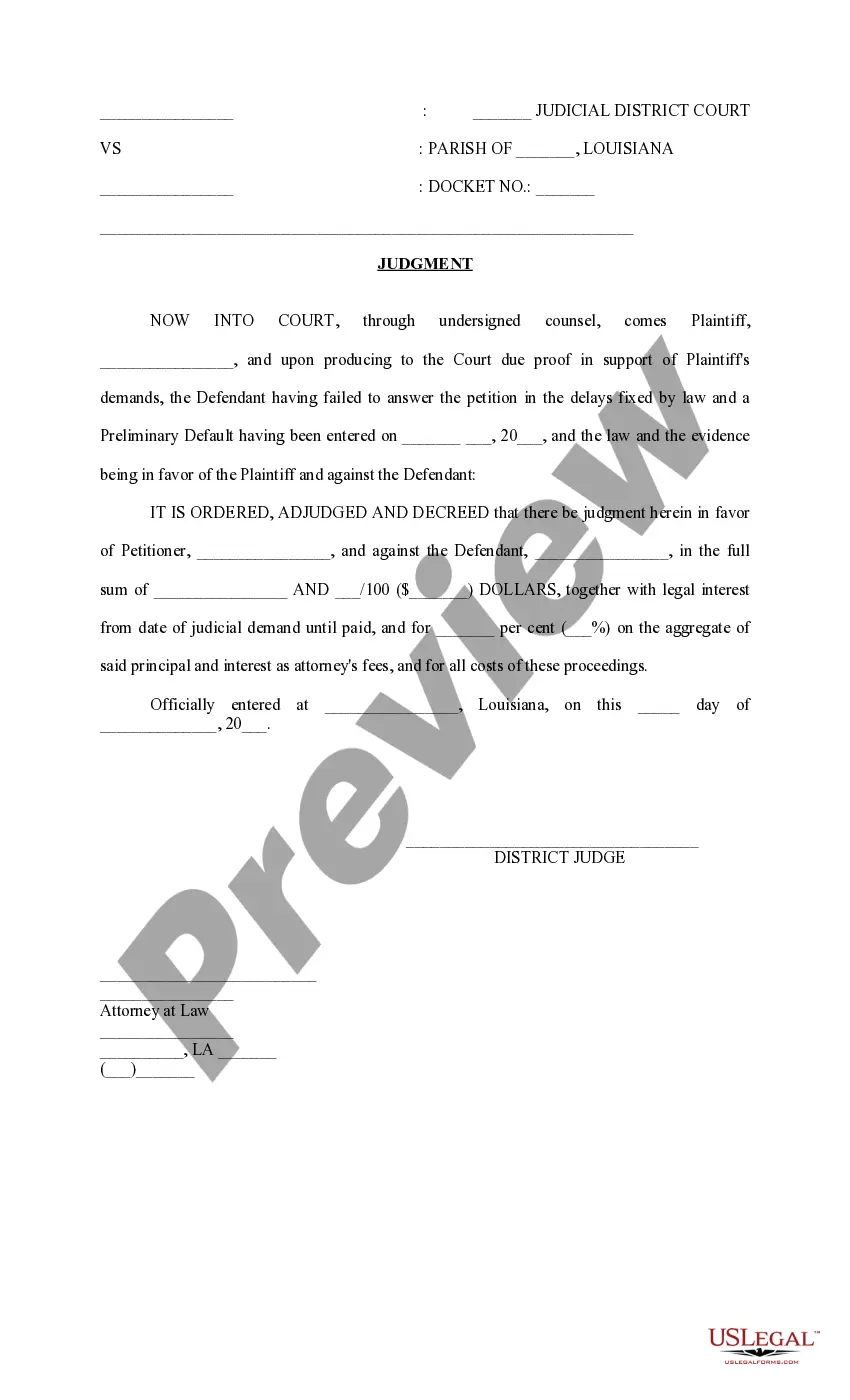
The Motion for Preliminary Default is a legal form used in civil cases when a defendant fails to respond to a plaintiff's citation within the required timeframe. This motion requests a preliminary default judgment, meaning that the court can grant the plaintiff's request without a full trial since the defendant did not engage in the legal process. This form is important for plaintiffs looking to expedite their case when the other party is unresponsive.
Key parts of this document
- Parties involved: Names of the plaintiff and defendant.
- Docket number: The case identification number used by the court.
- Date of citation: When the defendant was served with the legal papers.
- Request for order: A statement asking the court to enter a preliminary default.
- Judgeâs signature: A space for the district judge to approve the motion.
Situations where this form applies
This form is typically used when a defendant does not appear in court or fails to submit an answer to the filing. If you, as a plaintiff, have served your complaint but have not received any response from the defendant within the legal deadlines, you can file this motion to move your case forward by requesting a default judgment. This ensures that the court recognizes your claim and allows you to seek resolution without the defendantâs participation.
Who needs this form
This form is suitable for:
- Plaintiffs in civil lawsuits who have not received any response from the defendant.
- Individuals or businesses seeking a default judgment against a non-responsive party.
- Legal representatives filing on behalf of individuals or entities involved in litigation.
Completing this form step by step
- Identify the parties: Enter the names of the plaintiff and defendant clearly.
- Fill in the docket number: Include the court's case number to which this motion pertains.
- Specify the date of citation: Enter the date when the defendant was served.
- Request default: Clearly state your request for the court to enter a preliminary default.
- Complete attorney information: If applicable, fill in your attorneyâs name and contact details.
Does this document require notarization?
This form does not typically require notarization unless specified by local law. It is always advisable to check your local rules to confirm any specific requirements.
Get your form ready online
Our built-in tools help you complete, sign, share, and store your documents in one place.
Make edits, fill in missing information, and update formatting in US Legal Forms—just like you would in MS Word.
Download a copy, print it, send it by email, or mail it via USPS—whatever works best for your next step.
Sign and collect signatures with our SignNow integration. Send to multiple recipients, set reminders, and more. Go Premium to unlock E-Sign.
If this form requires notarization, complete it online through a secure video call—no need to meet a notary in person or wait for an appointment.
We protect your documents and personal data by following strict security and privacy standards.

Make edits, fill in missing information, and update formatting in US Legal Forms—just like you would in MS Word.

Download a copy, print it, send it by email, or mail it via USPS—whatever works best for your next step.

Sign and collect signatures with our SignNow integration. Send to multiple recipients, set reminders, and more. Go Premium to unlock E-Sign.

If this form requires notarization, complete it online through a secure video call—no need to meet a notary in person or wait for an appointment.

We protect your documents and personal data by following strict security and privacy standards.
Avoid these common issues
- Failing to include the correct docket number.
- Not accurately stating the date of citation.
- Omitting the names of all parties involved.
- Submitting the form after the deadline for default has passed.
Benefits of using this form online
- Convenience: Easily access and download the form from anywhere.
- Editability: Customize the form as necessary for your specific case.
- Reliability: Ensure you have the latest legal language approved by licensed attorneys.
Looking for another form?


Form popularity
FAQ
When a default is entered, the party who requested the entry of default must obtain a default judgment against the defaulting party within 45 days after the default was entered, unless the court has granted an extension of time.
In California, entry of default completely cuts off a party's right to appear in the action (e.g., take discovery, file motions other than a motion for relief from default or contest the material allegations of the complaint for purposes of the action).
The rule to show cause provided in Civil Code Article 102 shall allege proper service of the initial petition for divorce, that the requisite period of time, in accordance with Article 103.1, or more has elapsed since that service, and that the spouses have lived separate and apart continuously for the requisite period
In law, a default is the failure to do something required by law.
Default judgments happen when you don't respond to a lawsuit often from a debt collector and a judge resolves the case without hearing your side.Next up could be wage garnishment or a bank account levy, which allows a creditor to remove money from your bank accounts to repay the debt.
A motion for default is made when a defendant fails to file a timely answer to a complaint/petition.If you were not served with the original petition/complaint, you can always file a petition to reopen the case.
What happens next? When you file your Motion and Affidavit to Set Aside Default, you will get a hearing date and time from the court clerk. At the hearing, the judge will grant or deny the motion. If the judge grants your motion, the default or default judgment will be set aside, and the case will move forward.